AI Wrapper Stack Guide for Solo Developers
Complete guide to the AI wrapper stack - when to use it, setup, pros/cons, and alternatives.
The Stack
| Layer | Tool | Why |
|---|---|---|
| Frontend + Backend | Next.js or Python (FastAPI/Django) | Full-stack with API routes for AI calls |
| AI Provider | OpenAI, Anthropic, or open-source models | The intelligence layer |
| AI SDK | Vercel AI SDK (JS) or LangChain/LiteLLM (Python) | Streaming, model switching, structured output |
| Database | Supabase or PostgreSQL | Store conversations, users, usage tracking |
| Auth | Clerk or Supabase Auth | User management with usage limits per plan |
| Payments | Stripe | Credit-based or subscription billing |
| Hosting | Vercel (JS) or Railway (Python) | Edge-optimized streaming (Vercel) or flexible compute (Railway) |
| Vector Database | Pinecone, Qdrant, or pgvector | RAG (Retrieval Augmented Generation) if needed |
"AI wrapper" gets used as an insult, but some of the fastest-growing SaaS products right now are wrappers around OpenAI or Anthropic APIs with a focused UX for a specific use case. The key is that the AI is the engine, but the product is the interface, the workflow, and the domain-specific context you add on top.
When to Use This Stack
Perfect for: AI-powered writing tools, code assistants, data analysis tools, customer support bots, content generation platforms, any product where AI is the core value proposition.
Not ideal for: Products that need AI as a minor feature (just call the API directly, you don't need a whole stack for it), or applications where latency is critical and you can't tolerate API round-trips.
If your product's main interaction is "user gives input, AI generates output," this is your stack.
Why Solo Developers Love It
Vercel AI SDK handles the hard parts. Streaming AI responses to the browser in real-time is tricky to build from scratch. The Vercel AI SDK gives you useChat and useCompletion hooks that handle streaming, loading states, error handling, and message history out of the box. What would take days to build correctly takes minutes with the SDK.
Model switching is a lifesaver. The AI SDK abstracts provider differences. Switch from OpenAI to Anthropic to an open-source model by changing one line. This matters because AI providers change pricing, models, and capabilities frequently. Being locked to one provider is risky.
The margin structure works for solo developers. You pay per API call (a few cents per request typically) and charge users monthly ($10-49/month) or per credit. The margins are high once you have enough volume because AI API costs are relatively low compared to what users will pay for a well-designed product.
Speed to market is unbeatable. You can build a functional AI product in a weekend. The AI does the hard work. You're building the interface, the workflow, and the billing layer. Strip away the AI provider and what remains is a fairly standard web application.
The Parts Nobody Warns You About
API costs can spiral. Flagship models cost many times more per token than the mini and nano tiers (GPT-5.4 is $2.50 input versus GPT-5.4-mini at $0.75 and GPT-5.4-nano at $0.20 per million tokens on OpenAI's current published rates), and users will consume more than you expect. I've seen AI wrapper developers shocked by their first real API bill. Monitor usage carefully, set hard limits per user, and design your pricing to cover worst-case API costs with comfortable margin.
Build a cost tracking system from day one. Log every API call with its token count and cost. Know exactly what each user costs you. Some users will send massive prompts that cost 10x what a normal request costs. Your pricing needs to account for these outliers.
"Just a wrapper" is a real competitive risk. If your product is a text box that sends input to OpenAI and displays the response, you have zero defensibility. OpenAI can replicate your product tomorrow. The moat comes from domain-specific context, curated prompts, integrations with other tools, and workflows that go beyond a single AI call.
Streaming UX requires thought. Streaming AI responses character by character looks cool but creates UX challenges. How do you handle errors mid-stream? What if the user navigates away? What about mobile where long streams push content off screen? The Vercel AI SDK handles the technical streaming, but the UX design around streaming is on you.
Prompt engineering is ongoing maintenance. Your prompts are your product's brain. They need regular tuning as models change, user feedback comes in, and edge cases emerge. Budget ongoing time for prompt refinement. Treat prompts as code. Version them, test them, and review changes carefully.
Rate limits and timeouts. AI API calls take 2-30 seconds depending on the model and response length. Your app needs to handle loading states, timeouts, and rate limit errors gracefully. Users are surprisingly impatient, even when they know AI generation takes time.
Setting Up the Stack
JavaScript path (fastest to ship). Start with Next.js (16.2.6 is current on npm). Install the Vercel AI SDK with npm install ai (6.0.193 latest, and the package pulls roughly 12.8 million downloads a week). Add a provider package alongside it, for example npm install @ai-sdk/openai. Set up your provider API key. The useChat hook gives you a complete chat interface in about 20 lines of code. Add Supabase for auth and database, Stripe for billing, deploy to Vercel.
Python path (more AI ecosystem access). Start with FastAPI (0.136.3 current) or Django (6.0.5 current). Use LiteLLM (pip install litellm, 1.86.2 current) for unified AI API access across more than 100 providers behind one interface. Build your own streaming endpoint (FastAPI's StreamingResponse works well). Add a React or Next.js frontend that consumes your API. Deploy the backend to Railway and the frontend to Vercel. If you prefer the heavier orchestration layer, LangChain hit its 1.x line (langchain 1.3.2 on PyPI).
For both paths, implement usage tracking immediately. Every API call should record the user, model used, tokens consumed, and cost. This data drives your pricing decisions and helps you identify users who are costing more than they're paying.
Architecture
Frontend (Next.js)
  ├── Chat / Input interface
  ├── Streaming response display
  ├── History / saved outputs
  └── Usage dashboard

Backend (Next.js API routes or FastAPI)
  ├── AI provider calls (OpenAI, Anthropic)
  ├── Prompt management
  ├── Usage tracking & rate limiting
  ├── User authentication
  └── Billing (Stripe)

Data Layer
  ├── PostgreSQL (users, conversations, usage logs)
  ├── Redis (rate limiting, caching)
  └── Vector DB (RAG documents, if needed)

AI Provider
  ├── OpenAI (current GPT-5 line, plus a mini and nano tier)
  ├── Anthropic (Claude Opus, Sonnet, Haiku)
  └── Open source (Llama, Mistral via Groq/Together)
By the Numbers (2026)
Real, current figures for the tools in this stack, verified on 2026-05-30. Always re-check the vendor pages before you price your own product, because these move.
Tooling versions and reach. Vercel AI SDK ai 6.0.193 on npm, around 12.8 million weekly downloads. The vercel/ai repo sits at roughly 24,500 GitHub stars. Next.js 16.2.6. LiteLLM 1.86.2 (about 48,700 stars), LangChain 1.3.2 (about 138,000 stars). FastAPI 0.136.3, Django 6.0.5. For the vector layer, Qdrant 1.18.1 (about 31,700 stars) or pgvector (about 21,500 stars) if you keep everything in Postgres.
AI provider pricing per million tokens. OpenAI's current published rates run GPT-5.4 at $2.50 input and $15 output, with a mini tier (GPT-5.4-mini) at $0.75 input and $4.50 output and a nano tier at $0.20 input and $1.25 output. Anthropic publishes Claude Opus 4.5 at $5 input and $25 output, Sonnet 4.5 at $3 input and $15 output, and Haiku 4.5 at $1 input and $5 output. The old GPT-4o tier this guide originally cited has been retired from OpenAI's published list, so pick a current model and check the live page.
Infra and billing. Vercel Hobby is free, Pro is $20 per user per month plus usage. Supabase Free is $0, Pro $25 per month, Team $599 per month. Clerk Free covers up to 50,000 monthly active users, Pro is $25 per month ($20 if billed annually). Railway Hobby is $5 per month (includes $5 of usage), Pro is $20 per month (includes $20 of usage). Stripe is 2.9% plus 30 cents per successful domestic card charge. Pinecone Starter is free (up to 2 GB storage), Standard starts at a $50 per month usage minimum.
Cost Breakdown
| Service | Cost (checked 2026-05-30) |
|---|---|
| Vercel (hosting) | Free (Hobby) to $20/user/month (Pro) |
| Supabase (database) | Free to $25/month (Pro), $599/month (Team) |
| Railway (Python backend) | $5/month (Hobby) to $20/month (Pro), usage included |
| Clerk (auth) | Free to 50,000 MAU, then $25/month (Pro) |
| AI provider API | usage-based, see By the Numbers above |
| Stripe | 2.9% + 30c per successful domestic card charge |
| Pinecone (vector, optional) | Free Starter to $50/month minimum (Standard) |
The wild card is AI API costs. Take a product with 100 active users making 10 requests per day. At GPT-5.4-mini rates ($0.75 input, $4.50 output per million tokens), a few thousand modest requests a day land in the low tens of dollars per month. Lean on a flagship model like GPT-5.4 or Claude Opus 4.5 for every call and that same traffic can run into the hundreds. Reach for the mini and nano tiers wherever quality allows, and check current pricing before you commit your margins.
Pricing Models That Work
Credit-based. Users buy credits, each AI generation costs credits. This directly ties your revenue to your costs. Easiest to manage profitably.
Subscription + limits. Monthly plan with a set number of generations per month. $9/month for 100 generations, $29/month for 500, $79/month for unlimited (with fair use limits).
Freemium. 10-20 free generations to hook users, then require a subscription. The free tier is your marketing funnel.
I'd recommend credits or subscription with limits for v1. "Unlimited" plans are dangerous with AI APIs because heavy users can cost you more than they pay.
Alternatives to Consider
If you want to avoid API costs: Run open-source models (Llama, Mistral) on your own GPU via RunPod or Modal. Higher upfront cost but predictable pricing and no dependency on OpenAI.
If you want simpler: Skip the framework entirely. Build a Chrome extension or Raycast plugin that calls the AI API directly. Smaller scope, faster to build, different distribution model.
If you're building with Python: Django + Celery for async AI processing + HTMX for the frontend. All Python, no JavaScript framework needed.
My Take
AI wrappers get dismissed as low-effort products, and honestly, many of them are. A text box connected to OpenAI's API is not a product. But a focused tool that solves a specific problem using AI as the engine? That's a real business.
The winning AI wrapper products have three things in common. First, they solve a narrow, specific problem (not "AI for everything" but "AI that writes real estate listings" or "AI that summarizes legal documents"). Second, they add context and domain knowledge through carefully crafted prompts, RAG, or curated workflows. Third, they make the output usable, not just generated text, but formatted, actionable results that integrate into the user's existing workflow.
If you can build that, the wrapper label doesn't matter. The value is in the product, not the underlying technology.
Common Errors and Fixes
These are the failures that trip up most first AI wrapper builds, with the cause and the fix grounded in the official docs.
Stream never reaches the browser with the Vercel AI SDK. The most common cause is mixing major versions. The ai package and your provider package (for example @ai-sdk/openai) must be on the same major line, and the App Router route must return the SDK's streaming response. Pin a single major across ai, the provider package, and @ai-sdk/react, then return the result from streamText directly. The AI SDK docs describe streamText and the useChat transport contract.
401 or invalid API key. The key is missing from the server environment, or it is exposed client-side. Provider keys must live in server-side env (a Next.js route handler or server action), never in a client component. Set the key in your hosting provider's environment settings and restart the deployment so it is picked up.
429 rate limit or quota errors. You are above your provider tier's request or token ceiling, or your account has no billing set up. New accounts often sit at a low tier with small free credits. Add billing, then implement retry with backoff and a per-user hard cap so one user cannot exhaust your quota. Anthropic documents usage tiers (Tier 1 through Enterprise) that raise limits as spend grows.
Costs higher than the price table suggests. Two usual causes. First, you are sending the whole conversation history on every turn, so input tokens compound. Trim or summarize history. Second, you are calling a flagship model for work a mini or nano tier could handle. Anthropic's own guidance is Haiku for simple tasks, Sonnet for most production work, Opus for the hardest reasoning, and to use prompt caching for repeated context (a cache hit costs 10% of the standard input price).
pip install litellm resolves an old version. Pin it. pip install "litellm==1.86.2" (current) avoids a stale cached wheel and keeps provider routing behavior stable across deploys.
pgvector queries are slow or error on dimension. The column dimension must match your embedding model's output size, and you need an index for speed. Create the column with the right dimension and add an HNSW or IVFFlat index, per the pgvector README, before you query at scale.
Sources
- Vercel AI SDK version (ai 6.0.193): https://registry.npmjs.org/ai/latest (checked 2026-05-30)
- Vercel AI SDK weekly downloads (~12.8M): https://api.npmjs.org/downloads/point/last-week/ai (checked 2026-05-30)
- vercel/ai GitHub stars (~24,500): https://github.com/vercel/ai (checked 2026-05-30, via GitHub API)
- Next.js version (16.2.6): https://registry.npmjs.org/next/latest (checked 2026-05-30)
- LiteLLM version (1.86.2) and stars (~48,700): https://pypi.org/pypi/litellm/json and https://github.com/BerriAI/litellm (checked 2026-05-30)
- LangChain version (1.3.2) and stars (~138,000): https://pypi.org/pypi/langchain/json and https://github.com/langchain-ai/langchain (checked 2026-05-30)
- FastAPI version (0.136.3): https://pypi.org/pypi/fastapi/json (checked 2026-05-30)
- Django version (6.0.5): https://pypi.org/pypi/Django/json (checked 2026-05-30)
- Qdrant version (1.18.1) and stars (~31,700): https://github.com/qdrant/qdrant (checked 2026-05-30, via GitHub API)
- pgvector stars (~21,500): https://github.com/pgvector/pgvector (checked 2026-05-30, via GitHub API)
- OpenAI API pricing (GPT-5.4, mini, nano): https://developers.openai.com/api/docs/pricing (checked 2026-05-30)
- Anthropic Claude API pricing (Opus 4.5, Sonnet 4.5, Haiku 4.5, prompt caching, usage tiers): https://platform.claude.com/docs/en/about-claude/pricing (checked 2026-05-30)
- Vercel pricing (Hobby free, Pro $20/user/mo): https://vercel.com/pricing (checked 2026-05-30)
- Supabase pricing (Free, Pro $25/mo, Team $599/mo): https://supabase.com/pricing (checked 2026-05-30)
- Clerk pricing (Free to 50,000 MAU, Pro $25/mo): https://clerk.com/pricing (checked 2026-05-30)
- Railway pricing (Hobby $5/mo, Pro $20/mo): https://railway.com/pricing (checked 2026-05-30)
- Stripe pricing (2.9% + 30c domestic card): https://stripe.com/pricing (checked 2026-05-30)
- Pinecone pricing (Starter free, Standard $50/mo min): https://www.pinecone.io/pricing/ (checked 2026-05-30)
Like this? You'll like what I'm building too.
Two ways to support and get more of this work.
HEARTH
A privacy-first Life OS for your desktop. Journal, tasks, and notes that stay on your machine. Coming soon, direct download from this site.
Read moreMY TOOLKITS
Receipts-first toolkits for shipping after hours, building Claude agents, publishing on Amazon, and more. The exact methods I used, not theory.
Browse on WhopRelated Articles
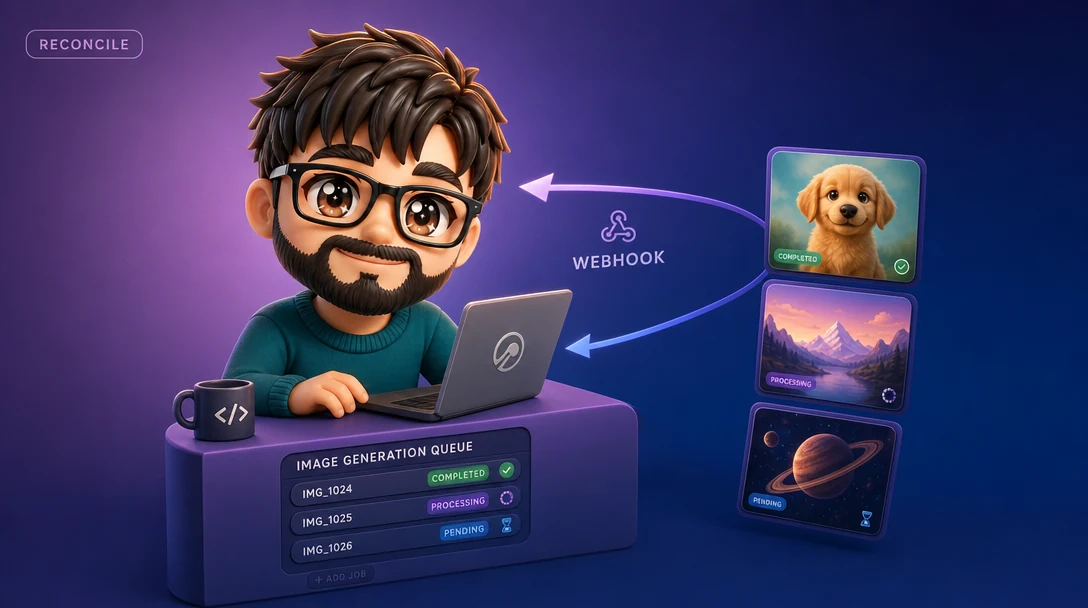
The Backend Behind An AI Image Product
AI image generation is slow and async. Webhooks fail, so I run a reconciliation system that makes the backend converge to the right state on its own.
Best Tech Stack for Building an AI Wrapper as a Solo Developer
The ideal tech stack for solo developers building an AI wrapper in 2026.
Best Tech Stack for an Analytics Dashboard as a Solo Developer
The best tech stack for building an analytics dashboard as a solo developer - frameworks, databases, hosting, and tools.