Best Tech Stack for Building an AI Wrapper as a Solo Developer
The ideal tech stack for solo developers building an AI wrapper in 2026.
Let me address the elephant in the room first. Yes, people joke about "AI wrappers" being low-effort products. But the reality is that some of the fastest-growing startups of the past two years are, at their core, wrappers around AI APIs with great UX and smart business logic. Jasper, Copy.ai, Cursor. These are all essentially AI wrappers that provide massive value.
The trick isn't just calling the OpenAI API. It's building the right interface, prompt engineering, context management, and user experience around it. I've built a few AI-powered tools, and the one that actually makes money isn't the one with the fanciest model. It's the one that solves a specific problem for a specific audience better than ChatGPT can.
Here's the stack that lets you build an AI wrapper fast and keep it running affordably.
The Recommended Stack
| Layer | Tool | Current version | Why |
|---|---|---|---|
| Frontend | Next.js (App Router) | 16.2.6 | Streaming support, server components, React ecosystem |
| Backend | Next.js API Routes + Vercel AI SDK | ai 6.0.193 |
Built-in streaming, model-agnostic |
| AI Provider | OpenAI + Anthropic (fallback) | GPT-4o, Claude Sonnet 4.6 | Best models, good pricing, reliable APIs |
| Database | Supabase (PostgreSQL) | Free or Pro $25/mo | User data, chat history, usage tracking |
| Auth | Clerk or Supabase Auth | @clerk/nextjs 7.4.2 |
Quick setup, handles social logins |
| Payments | Stripe | 2.9% + 30 cents per charge | Usage-based billing, subscriptions |
| Hosting | Vercel | Hobby free, Pro $20/user/mo | Streaming works out of the box, edge functions |
| Rate Limiting | Upstash Redis | @upstash/ratelimit 2.0.8 |
Protect your API budget |
All package versions above were the latest published releases on npm as of 2026-05-30. Full source links are in the Sources section at the bottom.
Why This Stack Works for Solo Developers
AI wrappers have a unique cost structure. Unlike most web apps where your hosting costs are relatively fixed, AI API calls cost real money per request. A viral moment can burn through hundreds of dollars in API fees before you even wake up. This stack is designed to keep costs under control while delivering a fast, responsive experience.
The Vercel AI SDK is the secret weapon here. It provides a unified interface for calling different AI providers (OpenAI, Anthropic, Google, Mistral) with streaming support built in. Switching from GPT-4 to Claude is literally changing one import and one model string. This flexibility matters because AI pricing changes frequently, and you want to be able to swap models without rewriting your backend.
The SDK is not a niche bet. The ai package pulls roughly 12.9 million npm downloads a week, and the vercel/ai repository sits at about 24,500 GitHub stars. Next.js itself is at around 139,600 stars and roughly 40 million weekly npm downloads, so you are building on tooling that is unlikely to disappear out from under you. The current major line is ai 6.0.193, paired with provider packages like @ai-sdk/openai 3.0.67 (itself around 6.3 million weekly downloads).
Streaming is non-negotiable for AI wrappers. Users expect to see text appearing in real time, like ChatGPT does. Without streaming, your app shows a loading spinner for 5-15 seconds and then dumps the full response. That feels broken. With the Vercel AI SDK and Next.js, streaming works with about 10 lines of code on both the server and client.
Frontend: Next.js with Vercel AI SDK
The Vercel AI SDK provides React hooks (useChat, useCompletion) that handle the entire streaming UI. You don't have to manage WebSocket connections, parse Server-Sent Events, or buffer partial responses. The useChat hook gives you a messages array that updates in real time as tokens stream in, an input state, and a submit handler. Your chat UI is maybe 30 lines of code.
For the UI itself, use shadcn/ui components. The chat interface components (message bubbles, input fields, send buttons) are straightforward to build with shadcn's primitives. Don't use a pre-built chat widget library. They're rarely flexible enough for AI-specific needs like regenerate buttons, model switching, or streaming indicators.
One thing I learned building AI tools is that markdown rendering in responses matters more than you would think. AI models return markdown-formatted text with code blocks, lists, and headers. Use react-markdown (currently 10.1.0, around 15,700 GitHub stars) with the remark-gfm plugin (currently 4.0.1) and a syntax highlighting library like shiki (currently 4.1.0, around 13,400 stars) for code blocks. Your responses will look polished and professional. For the chat UI primitives mentioned above, the shadcn/ui project is at roughly 115,300 stars and ships its CLI as the shadcn package, currently 4.8.3.
AI Provider: Be Model-Agnostic
Don't lock yourself into one AI provider. The landscape changes rapidly. Today's best model might be tomorrow's second-best. The Vercel AI SDK makes this easy by providing a consistent interface across providers.
My recommendation: use OpenAI's GPT-4o as your primary model (fast, cheap, good quality) and Anthropic's Claude as a fallback. Having two providers protects you against outages and gives you options when one provider's pricing changes.
For cost optimization, use different models for different tasks. GPT-4o-mini or Claude Haiku for simple tasks (summarization, classification, short responses). GPT-4o or Claude Sonnet for complex tasks (code generation, long-form writing, analysis). This can reduce your API costs sharply without users noticing a quality difference on simpler interactions, and the gap between the tiers is large enough to make tiered routing worth the effort.
Here is what those tokens actually cost as of 2026-05-30, priced per million tokens (input then output).
| Model | Input | Output | Best for |
|---|---|---|---|
| GPT-4o-mini | $0.15 | $0.60 | High-volume cheap tasks |
| GPT-4o | $2.50 | $10.00 | General quality work |
| Claude Haiku 4.5 | $1.00 | $5.00 | Fast cheap fallback |
| Claude Sonnet 4.6 | $3.00 | $15.00 | Complex reasoning, 1M context |
GPT-4o-mini comes in at one sixteenth the input cost of GPT-4o, which is why routing simple work to the mini model is the single biggest lever on your bill. Both vendors also offer a batch API at 50 percent off for asynchronous jobs, and prompt caching cuts repeated context cost (OpenAI cached input is $1.25 per million, and Anthropic caching cuts cached input by up to 90 percent). Note that newer GPT-4.1 and GPT-5 families shipped in 2026 with their own pricing, so check the current pricing page before you commit a default model.
Prompt engineering is your competitive advantage. The model is the same for everyone. What makes your wrapper better is the system prompt, the context you provide, and the post-processing you apply. Spend more time on your prompts than on your UI. A mediocre UI with excellent prompts beats a beautiful UI with generic prompts every time.
Rate Limiting: Protect Your Budget
This is the part most developers forget until they get a $500 API bill. Use Upstash Redis for rate limiting. It is serverless, has a genuinely usable free tier, and integrates cleanly with Next.js middleware. The free Upstash Redis plan includes 500,000 commands a month and 256 MB of storage as of 2026-05-30, and the pay-as-you-go tier is $0.20 per 100,000 commands beyond that. For a rate limiter that does a couple of Redis ops per request, the free tier covers a lot of early traffic. The official @upstash/ratelimit package is at 2.0.8.
Implement rate limiting at three levels: per user per minute (prevent abuse), per user per day (enforce plan limits), and globally per minute (protect your total budget). If a user on the free plan tries to send 100 messages in a minute, your rate limiter stops them before those API calls cost you money.
Also set up budget alerts with your AI provider. OpenAI lets you set hard spending limits per month. Enable these. I cannot stress this enough. A misconfigured integration, a scraping bot, or a user automating requests against your API can drain your account fast if you don't have limits in place.
Database: Usage Tracking
Beyond storing user data and chat history, your database needs to track token usage per user. Every API call returns token counts (prompt tokens and completion tokens). Store these for every request, and use them for billing and analytics.
Supabase with Row Level Security means each user can only access their own data. Chat histories are personal, and you don't want to accidentally expose one user's conversations to another. RLS enforces this at the database level, which is more reliable than checking permissions in your application code. On cost, the Supabase free plan gives you 500 MB of database, 50,000 monthly active users, and 1 GB of file storage, though free projects pause after a week of inactivity. The Pro plan is $25 a month and lifts that to 100,000 monthly active users and 8 GB of disk per project with daily backups (figures as of 2026-05-30). The supabase/supabase repo sits at roughly 103,200 GitHub stars, so the ecosystem and docs are deep.
If you reach for Clerk instead of Supabase Auth, its Hobby tier is free for up to 50,000 monthly retained users, and Pro is $25 a month (or $20 billed annually). The @clerk/nextjs package is currently 7.4.2.
Store conversations as JSON in a messages column or as individual rows in a messages table linked to a conversations table. I'd go with individual rows because it makes searching, analytics, and pagination much easier. The JSON-in-a-column approach seems simpler at first but becomes a pain when you want to find all messages that contain a certain keyword across all users.
What I'd Skip
Fine-tuning models for v1. Start with prompting and in-context learning. Fine-tuning is expensive, takes time, and locks you to a specific model version. Most AI wrapper use cases can be handled with well-crafted system prompts and a few examples in the context.
Self-hosting models. Unless you need complete data privacy (medical, legal, finance), using hosted APIs is the right call. Running your own GPU inference is expensive and complex. The managed APIs are faster, more reliable, and cheaper at low-to-medium volumes.
Vector databases at launch. If you're building a RAG (Retrieval-Augmented Generation) feature, you'll eventually need a vector database. But for v1, start with simple context passing. Include relevant information directly in the prompt. Add Pinecone or pgvector when your context exceeds the model's token limit.
Complex agent frameworks. LangChain, LlamaIndex, and similar frameworks are powerful but add significant complexity. For a straightforward AI wrapper, the Vercel AI SDK's built-in tool calling is enough. Add agent frameworks when you need multi-step reasoning chains that are genuinely complex.
Getting Started
Here's what I'd do this week.
Define your niche. "ChatGPT but for X" needs a very specific X. The narrower your focus, the better your prompts can be. "AI writing assistant" is too broad. "AI that writes Shopify product descriptions from photos" is a product.
Build the core flow. Run
npx create-next-app@latest, install the Vercel AI SDK and OpenAI provider, create a chat route handler with streaming, and build a basic chat UI withuseChat. You can have a working prototype in an afternoon.Nail the prompts. Write your system prompt. Test it with 50 different inputs. Refine it. This is where you spend most of your time. A great prompt is worth more than any feature.
Add auth and rate limiting. Install Clerk, add Upstash rate limiting middleware. Protect your API budget from day one.
Deploy and validate. Put it on Vercel, share it with 10 people in your target audience. Watch how they use it. Their behavior will tell you which features to build next and which prompts to improve.
The fixed-cost side of this stack stays small while you validate. Vercel Hobby is free forever for personal projects, and Pro is $20 per user per month with $20 of included usage credit (as of 2026-05-30). Stripe charges no monthly fee on the standard plan and takes 2.9 percent plus 30 cents per successful domestic card charge, so you only pay it once money is actually moving. Combined with the Supabase and Upstash free tiers, you can run a real AI wrapper for close to zero infrastructure cost until the variable API spend (your tokens) becomes the dominant line item, which is exactly the cost you protect with rate limiting.
The best AI wrapper stack is one that handles streaming, controls costs, and lets you iterate on prompts quickly. This combination does all three. The AI model is commoditized. Your value is in the UX, the prompting, and the specific problem you solve.
Sources
All figures above were checked on 2026-05-30 against the following sources.
- Next.js latest version: registry.npmjs.org/next/latest
- Next.js weekly downloads: api.npmjs.org/downloads/point/last-week/next
- Next.js GitHub stars: github.com/vercel/next.js
- Vercel AI SDK version and downloads: registry.npmjs.org/ai/latest, api.npmjs.org/downloads/point/last-week/ai
- Vercel AI SDK GitHub stars: github.com/vercel/ai
- @ai-sdk/openai version and downloads: registry.npmjs.org/@ai-sdk/openai/latest
- react-markdown version: registry.npmjs.org/react-markdown/latest
- remark-gfm version: registry.npmjs.org/remark-gfm/latest
- shiki version: registry.npmjs.org/shiki/latest
- shadcn CLI version and shadcn/ui stars: registry.npmjs.org/shadcn/latest, ui.shadcn.com
- @upstash/ratelimit version and Upstash pricing: registry.npmjs.org/@upstash/ratelimit/latest, upstash.com/pricing
- @clerk/nextjs version and Clerk pricing: registry.npmjs.org/@clerk/nextjs/latest, clerk.com/pricing
- OpenAI API token pricing: developers.openai.com/api/docs/pricing
- Anthropic Claude API token pricing: platform.claude.com/docs/en/about-claude/pricing
- Supabase pricing: supabase.com/pricing
- Stripe pricing: stripe.com/pricing
- Vercel pricing: vercel.com/pricing
Like this? You'll like what I'm building too.
Two ways to support and get more of this work.
HEARTH
A privacy-first Life OS for your desktop. Journal, tasks, and notes that stay on your machine. Coming soon, direct download from this site.
Read moreMY TOOLKITS
Receipts-first toolkits for shipping after hours, building Claude agents, publishing on Amazon, and more. The exact methods I used, not theory.
Browse on WhopRelated Articles
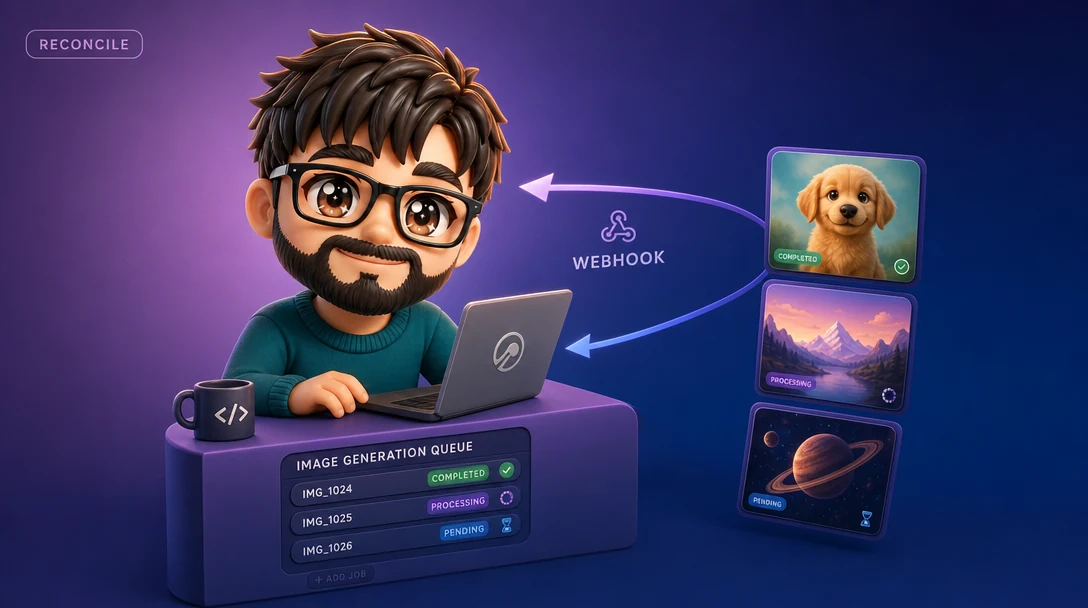
The Backend Behind An AI Image Product
AI image generation is slow and async. Webhooks fail, so I run a reconciliation system that makes the backend converge to the right state on its own.
AI Wrapper Stack Guide for Solo Developers
Complete guide to the AI wrapper stack - when to use it, setup, pros/cons, and alternatives.
Best Tech Stack for an Analytics Dashboard as a Solo Developer
The best tech stack for building an analytics dashboard as a solo developer - frameworks, databases, hosting, and tools.