Best Tech Stack for a Slack App as a Solo Developer
The best tech stack for building a Slack app as a solo developer - frameworks, databases, hosting, and tools.
Best Tech Stack for a Slack App as a Solo Developer
Building a Slack app is one of the smartest moves a solo developer can make. You get instant distribution through Slack's marketplace, a captive audience of millions of teams, and a well-documented API to work with. The tricky part? Choosing a tech stack that lets you ship fast, handle webhooks reliably, and keep your infrastructure costs near zero while you validate your idea.
This guide breaks down the exact tech stack I'd recommend for building a Slack app as a solo developer in 2025.
Recommended Stack at a Glance
| Layer | Pick |
|---|---|
| Runtime | Node.js (TypeScript) |
| Framework | Bolt.js (Slack SDK) |
| Database | PostgreSQL (via Supabase or Neon) |
| Hosting | Railway or Render |
| Background Jobs | BullMQ + Redis |
| Monitoring | Sentry (free tier) |
Backend: Node.js + Bolt.js
Skip the generic web frameworks. Slack's official Bolt.js SDK is purpose-built for Slack apps and handles all the ceremony for you: verifying request signatures, managing OAuth installation flows, routing slash commands, handling interactive components, and processing events.
With Bolt.js, what would take you 200 lines of Express middleware takes about 15 lines. It supports Socket Mode for development (no public URL needed) and HTTP mode for production. TypeScript support is first-class, so you get autocomplete for every Slack API method and event payload.
The package is actively maintained and free (MIT licensed). The latest release on npm is @slack/bolt v4.7.3, the slackapi/bolt-js repository carries 2,912 GitHub stars, and the package pulls roughly 3.3 million weekly downloads on npm, so you are building on something Slack ships and the wider ecosystem leans on heavily (figures checked 2026-05-30, see Sources).
Why Node.js over Python? Bolt for Python exists, but the Node.js ecosystem is stronger for Slack development. More examples, more community packages, faster time to working prototype. The async/await model also maps cleanly to Slack's event-driven architecture.
Frontend: You Probably Don't Need One
Here's the thing most guides won't tell you: most Slack apps don't need a traditional frontend. Slack IS your frontend. You build interactions using Block Kit (Slack's UI framework), modals, and message components. Slack even has a visual Block Kit Builder where you can prototype your UI.
If you do need a web dashboard (for settings, billing, or analytics), keep it dead simple with Next.js. It gives you API routes co-located with your dashboard pages, so you can run your Bolt.js backend and admin dashboard from one deployment. Next.js is free and open source, and it is one of the most battle-tested choices you can make. The latest release on npm is next v16.2.6, the vercel/next.js repository sits at 139,595 GitHub stars, and the package pulls roughly 40 million weekly downloads on npm (figures checked 2026-05-30, see Sources).
Database: PostgreSQL
PostgreSQL is the right call for a Slack app. You'll be storing workspace installations (OAuth tokens), user preferences, and whatever domain-specific data your app manages. Postgres handles all of this elegantly.
For hosting the database, Neon gives you a free tier with branching (great for development), or Supabase if you want a dashboard to inspect your data without writing SQL every time. Both offer serverless-style scaling that keeps costs low until you have real traction.
Neon's free plan covers 0.5 GB of storage per project and 100 compute-hours (CU-hours) per project each month, which is plenty for an early Slack app storing tokens and preferences. When you outgrow it, the Launch plan moves to usage-based pricing (roughly $0.106 per CU-hour for compute at the time of writing). Supabase's free plan gives you 500 MB of database storage and lets you keep up to two active projects, but note that free Supabase projects are paused after one week of inactivity, so for an always-on Slack backend you may prefer Neon's free tier or budget for Supabase Pro (from $25 per month). Both figures were checked 2026-05-30 (see Sources); confirm current limits before you rely on them.
Keep your schema simple. At minimum you need an installations table (workspace tokens from OAuth), a users table, and whatever tables your app's core feature requires.
Hosting: Railway
For Slack apps specifically, Railway is the best hosting choice for solo developers. Here's why:
- Always-on processes. Slack apps need to respond to events and webhooks in real-time. Railway keeps your server running (unlike serverless cold starts that violate Slack's 3-second response requirement).
- Built-in Redis. One click to add a Redis instance for background job processing.
- Simple deploys. Push to GitHub, it deploys. No Dockerfiles needed.
- Cheap to start. The Hobby plan is $5 per month and includes $5 of usage credit, which covers a small Slack app easily. There is also a one-time $5 trial credit (no credit card) if you just want to kick the tires first. When you need teams and longer log retention, the Pro plan is $20 per month per seat (prices checked 2026-05-30, see Sources).
Render is a solid alternative with a similar developer experience. Render's Hobby workspace is free and includes 750 instance-hours per month, but free web services spin down after 15 minutes of inactivity and cold-start on the next request, which is exactly what you want to avoid with Slack's 3-second timeout. To keep a Render service always on you pay from $7 per month per service, and its free Postgres databases are capped at 1 GB and expire after 30 days (checked 2026-05-30, see Sources). For that reason, Railway's always-on Hobby instance is usually the easier default for a Slack event handler. Avoid AWS Lambda or Vercel serverless for your main Slack event handler. Cold starts will cause you pain with Slack's strict timeout requirements.
Background Jobs: BullMQ + Redis
Slack expects you to acknowledge events within 3 seconds. If your app does anything non-trivial (API calls, data processing, sending messages to multiple channels), you need background jobs.
BullMQ with Redis is the simplest setup. When a Slack event comes in, acknowledge it immediately, push the work to a BullMQ queue, and process it asynchronously. This pattern is essential for reliability and keeps Slack from retrying events because your handler was too slow.
BullMQ is free and open source. The latest release on npm is bullmq v5.77.6, the taskforcesh/bullmq repository carries 8,943 GitHub stars, and the package pulls roughly 5.6 million weekly downloads on npm, so it is a well-supported foundation for your queue (figures checked 2026-05-30, see Sources).
Railway or Render let you run your worker process alongside your web process without extra configuration.
Nice-to-Haves
- ngrok or Cloudflare Tunnel. For local development with HTTP mode (Socket Mode is easier though)
- Sentry. Error tracking. Its free Developer plan covers 5,000 errors plus 10,000 performance units per month with 30-day retention and a single dashboard user, which is enough to catch the many edge cases Slack apps hit across different workspace configurations. The current SDK is
@sentry/nodev10.55.0 (checked 2026-05-30, see Sources) - PostHog. Track which features teams actually use. The free plan includes 1 million events, 5,000 session recordings, 1 million feature-flag requests, and 100,000 error-tracking exceptions per month on a single project, so analytics stays free well past launch (checked 2026-05-30, see Sources)
- Slack's Block Kit Builder. Visual prototyping at app.slack.com/block-kit-builder
Monthly Cost Breakdown
| Service | Cost |
|---|---|
| Railway (Hobby, $5 usage credit included) | $5/month |
| Neon Postgres (Free, 0.5 GB / 100 CU-hours) | $0 |
| Redis on Railway | Included in usage |
| Sentry (Developer, 5,000 errors/month) | $0 |
| PostHog (Free, 1M events/month) | $0 |
| Domain (optional) | ~$1/month |
| Total | ~$5-6/month |
All prices were checked 2026-05-30 (see Sources). Once you're listed on the Slack App Directory and have paying customers, you can scale Railway resources as needed. Railway's Hobby plan is $5 per month with $5 of included usage, and the Pro plan runs $20 per month per seat when you need team features and longer log retention. Most Slack apps serving hundreds of workspaces run fine on $15-20/month of infrastructure.
Stack Cost Comparison
A quick side-by-side of the free and entry-paid tiers for the hosting and database picks, so you can see where the limits bite. All figures checked 2026-05-30 (see Sources).
| Service | Free tier | Entry paid | Watch out for |
|---|---|---|---|
| Railway | One-time $5 trial credit, no card | Hobby $5/mo ($5 usage included); Pro $20/mo per seat | Usage beyond the $5 credit bills on top |
| Render | Hobby free, 750 instance-hrs/mo | From $7/mo per always-on service | Free services sleep after 15 min idle |
| Neon | 0.5 GB storage, 100 CU-hours/project | Launch, usage-based (~$0.106/CU-hour) | Storage and compute metered separately |
| Supabase | 500 MB DB, up to 2 projects | Pro from $25/mo | Free projects paused after 1 week idle |
| Sentry | Developer, 5,000 errors + 10,000 perf units/mo | Team from $26/mo | 1 dashboard user; events dropped past cap |
| PostHog | 1M events/mo, 1 project | Usage-based after free volume | Free volume stays even after upgrade |
Conclusion
The winning formula for a solo developer building a Slack app: Bolt.js on Node.js, PostgreSQL on Neon, hosted on Railway, with BullMQ for background jobs. This stack respects Slack's timeout requirements, costs almost nothing to start, and scales smoothly as you grow.
Skip the over-engineering. Don't build a complex frontend when Block Kit handles your UI. Don't reach for Kubernetes when Railway handles your deploys. Ship your Slack app, get it in the directory, and iterate based on what teams actually need.
Sources
All figures verified on 2026-05-30. Pricing and limits change often, so confirm current terms on each vendor's page before you commit.
- Bolt.js version and downloads: registry.npmjs.org/@slack/bolt/latest, api.npmjs.org/downloads/point/last-week/@slack/bolt
- Bolt.js GitHub stars: github.com/slackapi/bolt-js via api.github.com/repos/slackapi/bolt-js
- BullMQ version and downloads: registry.npmjs.org/bullmq/latest, api.npmjs.org/downloads/point/last-week/bullmq
- BullMQ GitHub stars: github.com/taskforcesh/bullmq via api.github.com/repos/taskforcesh/bullmq
- Next.js version and downloads: registry.npmjs.org/next/latest, api.npmjs.org/downloads/point/last-week/next
- Next.js GitHub stars: github.com/vercel/next.js via api.github.com/repos/vercel/next.js
- Sentry SDK version: registry.npmjs.org/@sentry/node/latest; plan limits: sentry.io/pricing
- Railway pricing: railway.com/pricing
- Render pricing: render.com/pricing
- Neon pricing: neon.com/pricing
- Supabase pricing: supabase.com/pricing
- PostHog pricing: posthog.com/pricing
Like this? You'll like what I'm building too.
Two ways to support and get more of this work.
HEARTH
A privacy-first Life OS for your desktop. Journal, tasks, and notes that stay on your machine. Coming soon, direct download from this site.
Read moreMY TOOLKITS
Receipts-first toolkits for shipping after hours, building Claude agents, publishing on Amazon, and more. The exact methods I used, not theory.
Browse on WhopRelated Articles
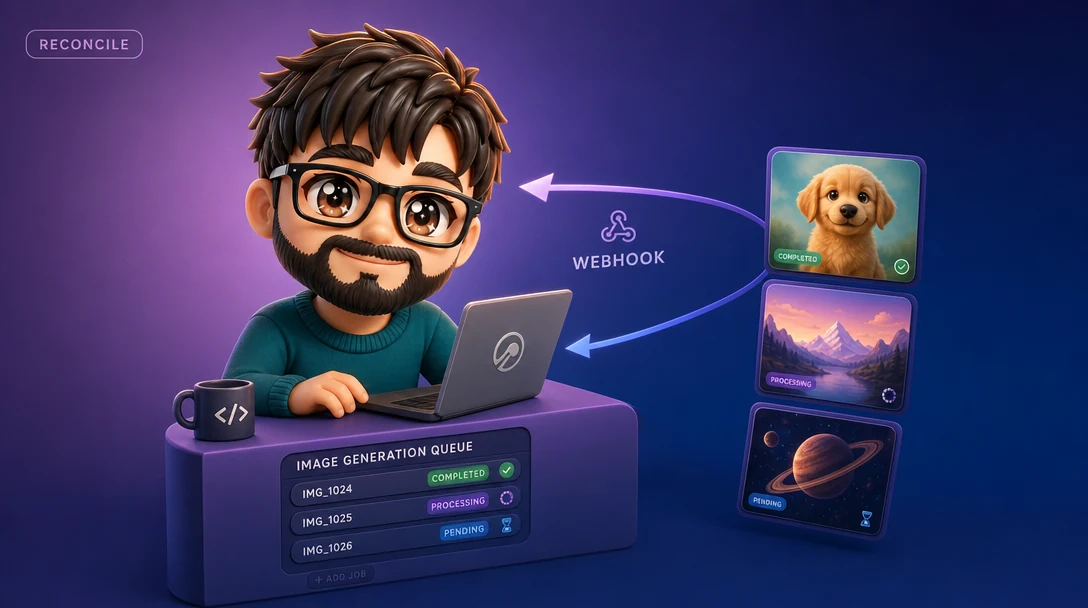
The Backend Behind An AI Image Product
AI image generation is slow and async. Webhooks fail, so I run a reconciliation system that makes the backend converge to the right state on its own.
AI Wrapper Stack Guide for Solo Developers
Complete guide to the AI wrapper stack - when to use it, setup, pros/cons, and alternatives.
Best Tech Stack for Building an AI Wrapper as a Solo Developer
The ideal tech stack for solo developers building an AI wrapper in 2026.