Build Versus Buy For A Custom AI Feature
How to decide between an off-the-shelf AI tool and a custom AI feature, weighing control, cost, differentiation, and data with a clear framework.
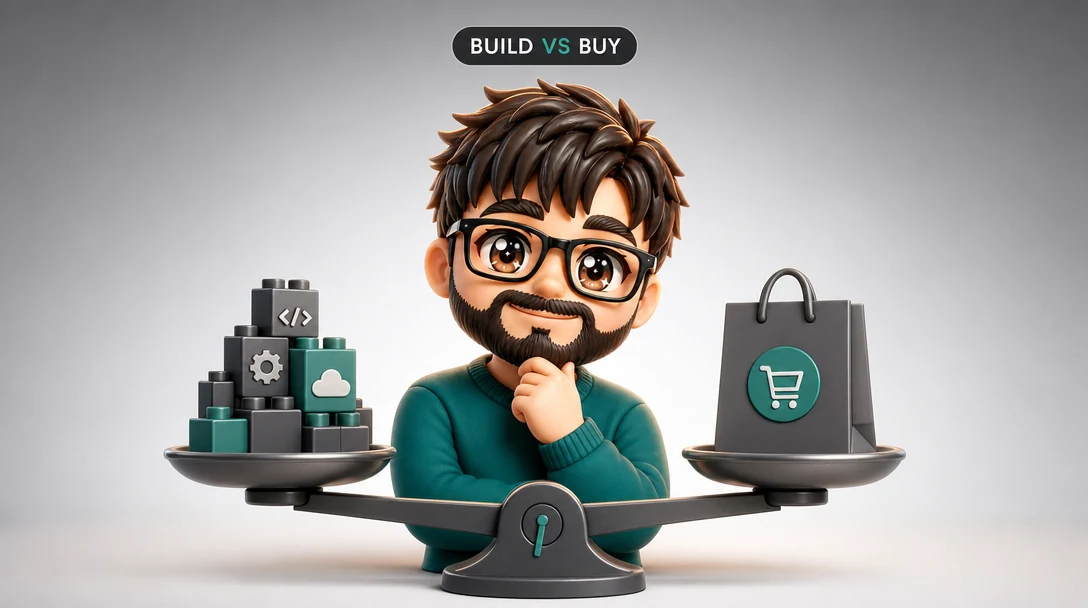
The real question almost every founder asks me is some version of this. Should I drop a ready-made AI tool into my product, or should I pay someone to build a custom AI feature that does exactly what I want? It feels like a yes or no decision, but it is really four smaller questions wearing one coat. Once you separate them, the answer usually picks itself.
I have built both kinds for clients. I have wired up an existing tool in an afternoon, and I have spent weeks building a feature that no off-the-shelf product could ever match. Neither is the smart choice on its own. The smart choice depends on what you are actually trying to win.
Let me give you the four questions, then a framework you can run in about ten minutes, then a few honest examples of when each path is right.
What Buying Actually Means
When I say buy, I mean using something that already exists. That could be a chat widget you paste into your site, a transcription API, a content generation tool, a support assistant from a vendor, or a feature inside a platform you already pay for. You configure it, you connect it, and you ship.
Buying is fast and cheap to start. You get a working result the same week, and someone else maintains the model, the uptime, and the safety guardrails. That is real value, and most founders underrate it. If a vendor solves your problem for a monthly fee that is less than one day of engineering, and the problem is not the thing your customers pay you for, buying is almost always correct.
The catch is that you are renting capability, not owning it. You move at the vendor's pace. Their pricing, their limits, and their roadmap are now part of your product. And every one of your competitors can buy the exact same thing.
What Building Actually Means
Building does not always mean training your own model from scratch. That is rare and expensive, and most companies should not do it. Building usually means assembling a custom feature on top of existing models. You choose the model, you control the prompts and the logic, you connect it to your own data, and you shape the experience so it fits your product instead of the other way around.
This is more work up front. It costs engineering time, and it costs ongoing care. Models change, prompts drift, and someone has to own it. But you get control, you get something competitors cannot copy by signing up for the same vendor, and you keep your data inside your own walls.
The honest tradeoff is speed and maintenance against control and ownership. Buying trades ownership for speed. Building trades speed for ownership. Everything else is detail.
The Four Questions That Decide It
Run your idea through these four. Each one pulls you toward build or toward buy, and the weight of them together usually makes the answer obvious.
Control. How much does the exact behavior matter? If the AI just needs to be roughly helpful, like a generic chatbot or a draft generator, a tool is fine. If the output has to follow your rules, your tone, your compliance constraints, or a specific workflow, you will fight an off-the-shelf product forever. Custom wins when control matters.
Cost. Look at the full picture, not the sticker price. A tool has a predictable subscription. A custom feature has build cost up front and a smaller running cost after. The question is where the lines cross. If usage is low or uncertain, buying keeps you cheap and flexible. If you expect heavy, growing usage, per-seat or per-call vendor pricing can quietly become your largest bill, and a custom build pays for itself over time.
Differentiation. Is this feature part of why customers choose you, or is it plumbing? If it is plumbing, like sending an email or transcribing a call, buy it and move on. If it is the thing that makes your product yours, the part you would put in your pitch, then handing it to a vendor that everyone else can use is a strategic mistake. Differentiators get built.
Data. What does the feature touch? If it works with public or low-sensitivity information, a vendor is usually fine. If it touches private customer data, regulated records, or the proprietary information that gives you an edge, you need to know where that data goes and who can train on it. The more sensitive the data, the more building inside your own boundary stops being a preference and starts being a requirement.
A Framework You Can Run In Ten Minutes
Here is the version I walk clients through. Score each of the four questions as buy, build, or either.
Start with differentiation, because it is the loudest signal. If this feature is a core reason people pay you, lean build no matter what the other three say, then use the others to decide how much to build. If it is clearly plumbing, lean buy and let cost or data override only if one of them is extreme.
Then check data. If the feature touches sensitive or proprietary data and the vendor cannot give you a clear, contractual answer about storage and training, treat that as a build signal that overrides convenience. Data risk is the one factor I let veto a cheap, easy buy.
Then weigh control and cost together. High control needs plus high expected usage point firmly at build. Low control needs plus low or uncertain usage point firmly at buy. A mixed result is common and useful, and it points to the third path.
That third path is the one most founders miss. Buy now, build later. Ship with an off-the-shelf tool to validate that anyone wants the feature at all, learn how people actually use it, and only invest in a custom build once the demand and the requirements are real. You will build a far better feature with three months of real usage data than with a guess, and you will not have spent the money if the feature flops.
The reverse, building first and never quite shipping, is the failure mode I see most. Do not build a custom AI feature to find out if people want it. Buy the cheap version, find out, then build the version that wins.
A Few Honest Examples
A support assistant that answers common questions from your help docs. This is usually a buy. The behavior is forgiving, the data is your own documentation rather than secrets, and good vendor products exist. Build it only if support quality is genuinely your differentiator.
A pricing or recommendation engine tuned on your own transaction history. This is usually a build. It touches proprietary data, the logic is specific to your business, and it is often part of why you win. No generic tool will understand your catalog the way a custom feature can.
A feature that summarizes or drafts content for users. This one truly depends. If summaries are a nice extra, buy. If the quality and format of those summaries are the product, build. Run the four questions and let differentiation break the tie.
The pattern across all of these is the same. Plumbing gets bought. The thing that makes you special gets built. Sensitive data pulls you toward your own walls. And uncertain demand says buy the cheap version first.
If you want a second opinion on which side your specific feature falls, that is exactly the kind of decision I help with under AI integration, and I would rather talk you out of building something you should rent than sell you a project you do not need.
What To Do Next
Write down the one AI feature you are weighing. Score it on control, cost, differentiation, and data, in that order, and let differentiation and data do most of the talking. If it comes out as buy, find the best tool and ship this week. If it comes out as build, get clear on the requirements before anyone writes code. If it comes out mixed, buy the cheap version, learn, and build the real one once you know what real looks like.
The goal is not to build as much as possible or to avoid building. The goal is to spend your time and money only where ownership actually pays you back. If you want help running that call on your own feature, you can book a call and we will work through it together.
I am Kevin Gabeci, a software engineer who builds this kind of thing for clients, solo and fast. If you want it built, book a call.
Like this? You'll like what I'm building too.
Two ways to support and get more of this work.
HEARTH
A privacy-first Life OS for your desktop. Journal, tasks, and notes that stay on your machine. Coming soon, direct download from this site.
Read moreMY TOOLKITS
Receipts-first toolkits for shipping after hours, building Claude agents, publishing on Amazon, and more. The exact methods I used, not theory.
Browse on WhopRelated Articles

Treating Video As Code With Remotion And fal
How I turned a script into a finished video with code instead of a timeline app, and why determinism is the real win for a solo dev.
Can One Developer Build Your Whole MVP
An honest look at whether a single full-stack developer can ship your whole MVP, when it works beautifully, and when you should bring in more people.

I Built a Discord Bot to Watch My Cluster
A tiny self-hosted Discord bot is a cheap always-on ops surface for a solo dev. Scope its cluster access read-only and render status as cards, not log walls.