Django Monolith Stack Guide for Solo Developers
Complete guide to the Django monolith stack - when to use it, setup, pros/cons, and alternatives.
The Stack
| Layer | Tool | Why |
|---|---|---|
| Backend + Frontend | Django | Full-stack framework with ORM, admin, auth, forms, all included |
| Database | PostgreSQL | The gold standard for relational data |
| Cache + Broker | Redis | Caching, session storage, and Celery message broker |
| Background Jobs | Celery | Async task processing for emails, reports, data pipelines |
| Hosting | Railway, Render, or VPS (Hetzner/OVH) | Flexible deployment options |
| Frontend (optional) | HTMX or React | Interactivity without a separate frontend app |
Django is the "batteries included" framework that refuses to die, and I mean that as the highest compliment. While JavaScript frameworks cycle through reinventions every two years, Django has been quietly powering products from Instagram to Disqus to the Washington Post. For solo developers, the monolith approach means one codebase, one deployment, one thing to debug.
The numbers back up the staying power. Django sits at about 87,500 stars on GitHub, and the project still ships major releases on a steady cadence. The current stable line is Django 6.0 (6.0.5 on PyPI as of late May 2026), which now requires Python 3.12 or newer. PostgreSQL 18 is the current major version (18.4 released May 2026), and the Redis server project carries roughly 74,600 GitHub stars. None of these are abandoned weekend projects. They are the boring, dependable core you want under a product you plan to keep running for years.
When to Use This Stack
Perfect for: Data-heavy applications, admin-heavy tools, marketplaces, CRMs, internal business tools, anything where the admin panel alone saves you weeks of work.
Not ideal for: Static content sites (overkill, use Astro), real-time heavy apps (Django channels works but it's not WebSocket-native), or teams where nobody knows Python.
This stack shines when your application has complex business logic, needs a powerful admin interface, or when you expect the backend to be the primary source of complexity. If your app is more backend than frontend, Django is probably the right choice.
Why Solo Developers Love It
The admin panel is a superpower. I cannot overstate this. Django's built-in admin gives you a fully functional back-office interface for free. CRUD operations on every model, search, filters, inline editing, bulk actions. For a solo developer, this means you don't need to build an internal dashboard. The admin IS your dashboard for the first six months.
I've shipped products where the only "frontend" for the first version was the Django admin. Customers used it directly with some customization. It's not pretty, but it works and it's free.
The ORM is genuinely good. Django's ORM handles 95% of database operations without writing SQL. Migrations are automatic. Relationships (foreign keys, many-to-many) work intuitively. And when you need raw SQL for that complex query, you can drop down to it seamlessly.
Everything is included. Auth, permissions, CSRF protection, form validation, email sending, file uploads, caching, sessions, middleware. Other frameworks make you choose and configure each of these. Django just has them, they work, and they're well-documented.
Python's ecosystem. Need to process CSV files? Import csv. Need machine learning? Import sklearn. Need PDF generation? Install weasyprint. Python has a library for literally everything, and they all work natively in Django without weird interop layers.
The Parts Nobody Warns You About
Django is slow compared to Go or Node. For most applications this doesn't matter. Django handles thousands of requests per second with proper caching, which is more than enough for a solo developer's product. But if you're building something that needs to handle 50,000 concurrent WebSocket connections, Django isn't the right tool.
Celery is powerful but painful. Celery does everything, retries, scheduling, rate limiting, result backends, priority queues. But configuring it is an exercise in reading cryptic documentation and debugging obscure errors. Budget extra time for Celery setup and use Redis as your broker (not RabbitMQ) for simplicity.
The template system feels outdated. Django templates work fine, but they're not reactive. For modern UIs, you'll want HTMX (for progressive enhancement) or a React/Vue frontend consuming Django REST Framework APIs. Deciding between these approaches early saves you from a messy hybrid later.
Deployment is your responsibility. Unlike Vercel where you push and it deploys, Django requires you to configure Gunicorn, Nginx, PostgreSQL, Redis, and Celery workers. Docker Compose simplifies this enormously, and platforms like Railway handle most of it, but it's still more work than serverless platforms.
Setting Up the Stack
Start with Django's project template and immediately add these packages. Here are the current versions on PyPI as of late May 2026, so you can pin them in requirements.txt from day one and avoid surprise breakage later:
| Package | Latest version | Role |
|---|---|---|
Django |
6.0.5 | The framework (needs Python 3.12+) |
psycopg |
3.3.4 | PostgreSQL driver (the version 3 line, replaces psycopg2) |
celery |
5.6.3 | Background task queue |
redis |
8.0.0 | Python client for cache and Celery broker |
gunicorn |
26.0.0 | WSGI application server for production |
whitenoise |
6.12.0 | Static file serving without a separate CDN |
djangorestframework |
3.17.1 | REST APIs if you split off a frontend |
django-environ |
0.13.0 | Environment variable parsing |
django-extensions |
4.1 | shell_plus and other dev tools |
django-cors-headers |
4.9.0 | CORS handling for a separate frontend |
django-environ handles environment variables, django-extensions gives you shell_plus and better development tools, whitenoise serves static files without a separate CDN, and django-cors-headers is for when you'll have a separate frontend. Note that the current PostgreSQL driver is psycopg version 3, not the old psycopg2. New projects should reach for psycopg[binary] 3.x.
Set up PostgreSQL from the start. Don't develop with SQLite and switch later. The migration from SQLite to PostgreSQL always causes headaches with type differences, JSON field behavior, and full-text search.
Add Redis early too. Use it for Django's cache backend and as your Celery broker. One Redis instance, two purposes. This keeps your infrastructure simple.
For the frontend decision, I'd go with Django templates + HTMX for most applications. It keeps everything in one codebase and HTMX gives you enough interactivity for dashboards, forms, and data tables. HTMX is mature and widely adopted now, sitting at roughly 48,100 GitHub stars. The current stable release is v2.0.9. There is a v4.0.0 line in beta, so for a production solo project stick with the 2.x stable line until v4 ships final. Only reach for a separate React frontend if your UI is genuinely complex (drag-and-drop, real-time collaboration, heavy client-side state).
Deployment Options
Current pricing as of late May 2026 (all figures from each vendor's pricing page, see Sources):
| Option | Cost | Effort | Best For |
|---|---|---|---|
| Railway | $5/month Hobby (usage included), $20/month/seat Pro | Low | Quick deployment, managed services |
| Render | Free tier (sleeps after 15 min idle), $7/month/service Starter | Low | Similar to Railway, real free tier for testing |
| VPS (Hetzner CAX11) | 4.49 EUR/month (about $5) | Medium | Full control, best cost efficiency |
| VPS + Docker Compose | 4.49 EUR/month (about $5) | Medium | Reproducible deployments, easy scaling |
A note on Hetzner. The CAX11 was the legendary 3.29 EUR/month Arm box for years. Hetzner raised cloud prices on April 1, 2026, so it now lists at 4.49 EUR/month (excluding VAT) for 2 vCPU, 4 GB RAM, 40 GB SSD, and 20 TB of traffic. Still absurdly cheap for what you get, just not the 3-something it used to be.
I run my Django apps on a VPS with Docker Compose. It's a bit more setup initially, but under 5 EUR per month for a Hetzner CAX11 running Django + PostgreSQL + Redis + Celery is hard to beat. Railway (Hobby at $5/month with usage included) or Render (Starter at $7/month per service) is worth the premium if you want to avoid server management entirely. Render's free tier is genuinely useful for testing, but free web services spin down after 15 minutes of inactivity and cold-start in 30 to 60 seconds, so do not point a real product at it.
Cost Breakdown
| Service | Cost |
|---|---|
| VPS (Hetzner CAX11) | 4.49 EUR/month (about $5) |
| Domain | $10-15/year |
| Transactional email (Resend) | Free tier (3,000 emails/month, 100/day) |
| Total | ~$5/month |
This is the cheapest production stack you can run. A single VPS running Docker Compose with Django, PostgreSQL, Redis, and Celery. No vendor lock-in, no surprise bills, no usage-based pricing. Resend's free tier covers 3,000 emails per month with a 100-per-day cap, which is plenty for signups, password resets, and receipts on an early product. When you outgrow it, Resend Pro starts at $20/month for 50,000 emails (check current pricing before you commit, the limits move).
Alternatives to Consider
If you want the JavaScript ecosystem: Replace Django with Next.js + Supabase. You lose the admin panel and ORM power but gain the TypeScript ecosystem and easier frontend development.
If you want faster performance: Go with a Go backend or FastAPI. Both are significantly faster than Django for raw throughput, but you lose Django's batteries-included approach.
If you want Ruby: Rails is Django's closest cousin. Same philosophy (convention over configuration), different language. Pick based on language preference.
Common Errors and Fixes
These are the gotchas that bite almost everyone wiring this exact stack together. The fixes below are grounded in the official Django, Celery, and package docs.
ImproperlyConfigured: Error loading psycopg2 or psycopg module. Django 6 supports both the legacy psycopg2 and the newer psycopg version 3. If neither is installed, or you installed the source-only psycopg without the binary, the database backend cannot load. For new projects install psycopg[binary] (the 3.x line, currently 3.3.4) and set your engine to django.db.backends.postgresql. The single backend value works for both drivers.
Celery worker connects but tasks never run. Almost always a broker URL mismatch. Set CELERY_BROKER_URL to your Redis instance (for example redis://localhost:6379/0) and confirm the worker is started with the right app, celery -A yourproject worker -l info. If you are on Windows, the default prefork pool will not work, run with --pool=solo for local testing. Use Redis as the broker rather than RabbitMQ for the simplest setup.
Static files return 404 in production but work in development. Django does not serve static files when DEBUG=False. Run python manage.py collectstatic during your build, and let WhiteNoise (currently 6.12.0) serve them by adding whitenoise.middleware.WhiteNoiseMiddleware directly after SecurityMiddleware in MIDDLEWARE. No separate Nginx static block required.
DisallowedHost / Invalid HTTP_HOST header. When you flip DEBUG to False, Django enforces ALLOWED_HOSTS. Add your real domain (and the server IP if you hit it directly) to ALLOWED_HOSTS, and set CSRF_TRUSTED_ORIGINS to your full origin including the scheme (for example https://example.com) so form posts behind HTTPS are not rejected.
CORS errors from a separate React or Vue frontend. Install django-cors-headers (4.9.0), add corsheaders to INSTALLED_APPS, put corsheaders.middleware.CorsMiddleware near the top of MIDDLEWARE (above CommonMiddleware), and set CORS_ALLOWED_ORIGINS to your frontend origin. Do not use CORS_ALLOW_ALL_ORIGINS = True in production.
relation does not exist after switching from SQLite to PostgreSQL. This is the migration pain the guide warns about. Develop against PostgreSQL from the first commit. If you already have SQLite migrations, point your settings at a fresh PostgreSQL database and run python manage.py migrate to apply the full migration history cleanly rather than copying the SQLite file.
My Take
Django is the unsexy choice that keeps working. It doesn't have the hype of the JavaScript ecosystem or the performance numbers of Go. What it has is 20 years of battle-tested stability, the best admin panel in any framework, and an ORM that lets you move fast without thinking about SQL.
For a solo developer building a business tool, marketplace, or data-heavy application, I'd pick Django over almost anything else. The admin panel alone saves weeks of development time. The ORM saves hours every day. And Python's ecosystem means you'll never be stuck looking for a library to do what you need.
The monolith approach is underrated in 2025. One codebase, one deployment, one thing to debug when something goes wrong at 2 AM. Keep it simple, ship fast, iterate based on what users actually want. Django makes that easy.
Sources
Versions, prices, and star counts in this guide were checked on 2026-05-30.
- Django latest version (6.0.5, requires Python 3.12+): https://pypi.org/project/Django/
- Celery latest version (5.6.3): https://pypi.org/project/celery/
- redis Python client latest version (8.0.0): https://pypi.org/project/redis/
- psycopg latest version (3.3.4): https://pypi.org/project/psycopg/
- Gunicorn latest version (26.0.0): https://pypi.org/project/gunicorn/
- WhiteNoise latest version (6.12.0): https://pypi.org/project/whitenoise/
- Django REST Framework latest version (3.17.1): https://pypi.org/project/djangorestframework/
- django-environ latest version (0.13.0): https://pypi.org/project/django-environ/
- django-extensions latest version (4.1): https://pypi.org/project/django-extensions/
- django-cors-headers latest version (4.9.0): https://pypi.org/project/django-cors-headers/
- Django GitHub stars (about 87,500): https://github.com/django/django
- Redis GitHub stars (about 74,600): https://github.com/redis/redis
- HTMX stars (about 48,100) and stable release v2.0.9: https://github.com/bigskysoftware/htmx
- PostgreSQL current major version (18.4, released May 2026): https://www.postgresql.org/
- Hetzner Cloud pricing, including the April 1, 2026 increase: https://www.hetzner.com/cloud/ and https://docs.hetzner.com/general/infrastructure-and-availability/price-adjustment/
- Railway pricing (Hobby $5/month, Pro $20/month per seat): https://railway.com/pricing
- Render pricing (free tier, Starter $7/month per service): https://render.com/pricing
- Resend pricing (free tier 3,000 emails/month, 100/day; Pro from $20/month): https://resend.com/pricing
Like this? You'll like what I'm building too.
Two ways to support and get more of this work.
HEARTH
A privacy-first Life OS for your desktop. Journal, tasks, and notes that stay on your machine. Coming soon, direct download from this site.
Read moreMY TOOLKITS
Receipts-first toolkits for shipping after hours, building Claude agents, publishing on Amazon, and more. The exact methods I used, not theory.
Browse on WhopRelated Articles
The Backend Behind An AI Image Product
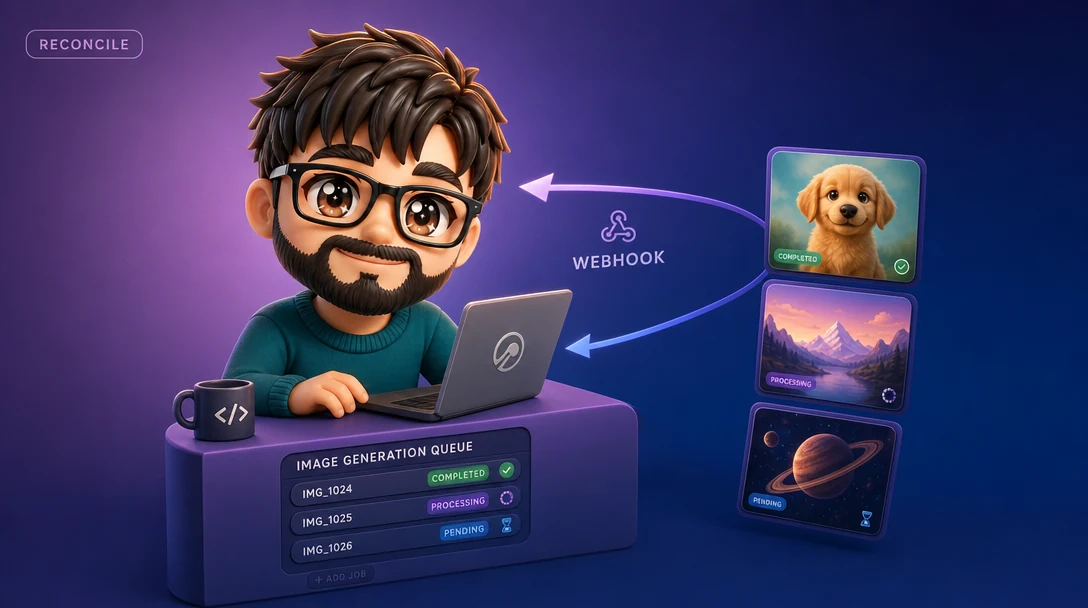
AI image generation is slow and async. Webhooks fail, so I run a reconciliation system that makes the backend converge to the right state on its own.
AI Wrapper Stack Guide for Solo Developers
Complete guide to the AI wrapper stack - when to use it, setup, pros/cons, and alternatives.
Best Tech Stack for Building an AI Wrapper as a Solo Developer
The ideal tech stack for solo developers building an AI wrapper in 2026.