Laravel Full-Stack Stack Guide for Solo Developers
Complete guide to the Laravel full-stack stack - when to use it, setup, pros/cons, and alternatives.
The Stack
| Layer | Tool | Why |
|---|---|---|
| Backend + Frontend | Laravel | Full-stack PHP framework with Blade templates |
| Database | MySQL or PostgreSQL | Eloquent ORM works beautifully with both |
| Frontend Interactivity | Livewire or Inertia.js | Reactive UIs without leaving PHP (Livewire) or with Vue/React (Inertia) |
| CSS | Tailwind CSS | Laravel's default CSS framework since Breeze and Jetstream |
| Hosting | Laravel Forge + DigitalOcean | One-click server provisioning and deployment |
| Queue | Laravel Queues + Redis | Background jobs with built-in retry, batching, rate limiting |
Laravel is the PHP framework that made PHP cool again. I know some JavaScript developers roll their eyes at PHP, but Laravel's ecosystem is unmatched for full-stack web development speed. Forge handles deployment. Cashier handles Stripe. Socialite handles OAuth. Nova handles admin panels. There's a first-party package for almost everything a SaaS needs.
By the Numbers (2026)
These are the current versions and adoption figures for the core pieces of this stack, checked on 2026-05-30. Pin against the official sources before you start a build, since the Laravel ecosystem ships fast.
| Piece | Latest version | Adoption | Source |
|---|---|---|---|
| Laravel (framework) | v13.12.0 (released 26 May 2026) | 34,700+ GitHub stars; 531M+ total Packagist installs, 10.5M+/month | github.com/laravel/framework, packagist.org |
| Laravel (application skeleton) | tracks v13 | 84,300+ GitHub stars | github.com/laravel/laravel |
| Livewire | v4.3.0 (released 1 May 2026) | 23,500+ GitHub stars; 84M+ total installs, 4.2M+/month | github.com/livewire/livewire |
| Inertia.js | v3.3.0 (released 27 May 2026) | 8,000+ GitHub stars | github.com/inertiajs/inertia |
| Tailwind CSS | v4.3.0 (released 8 May 2026) | bundled with all official starter kits | github.com/tailwindlabs/tailwindcss |
| Filament (admin panels) | active | 30,900+ GitHub stars | github.com/filamentphp/filament |
| Pest (testing) | active | 11,500+ GitHub stars | github.com/pestphp/pest |
The takeaway is that this is a busy, well-funded ecosystem. Laravel pulls north of ten million Composer installs a month, and the satellite packages a solo developer actually leans on (Livewire, Inertia, Filament, Pest) all have real maintenance momentum behind them.
When to Use This Stack
Perfect for: SaaS products, web applications, CRUD-heavy business tools, marketplaces, any product where rapid development matters more than bleeding-edge frontend interactivity.
Not ideal for: Projects where you need heavy client-side interactivity (complex drag-and-drop, real-time collaboration), teams that refuse to write PHP, or serverless-first architectures.
Laravel shines when you want to build fast without making architecture decisions every five minutes. The framework is opinionated in all the right ways.
Why Solo Developers Love It
Laravel Forge makes deployment trivial. The Hobby plan is $12/month (flat-rate, verified on the Forge pricing page) and it manages your DigitalOcean or AWS servers for you. Automatic SSL, deployments triggered by Git push, queue workers, scheduled tasks, database backups. No Docker, no Kubernetes, no CI/CD pipeline to configure. Push to main and your site updates. If you outgrow Hobby, Growth is $19/month and Business is $39/month, both with a discount on Forge's own Laravel VPS option.
Livewire lets you build reactive UIs in PHP. This is the game changer. Instead of building a React frontend, consuming a REST API, and managing client-side state, you write Blade components that update reactively. Dropdown that filters a table? 20 lines of PHP. Modal with form validation? Same. It feels like magic the first time you use it.
Eloquent ORM is a joy to use. Relationships, eager loading, query scopes, model events, mass assignment protection. Eloquent makes database operations read like English. User::with('posts')->where('active', true)->latest()->paginate(20). That's a full query with relationship loading, filtering, sorting, and pagination in one readable line.
The ecosystem is complete. Breeze or Jetstream for auth scaffolding (with team support). Cashier for Stripe subscriptions. Horizon for monitoring queues. Telescope for debugging. Sanctum for API tokens. Socialite for OAuth. You rarely need to search for third-party packages because Laravel has first-party solutions for most common needs.
The Parts Nobody Warns You About
PHP's reputation creates hiring challenges. If you ever need to bring on another developer, the pool of people willing to write PHP is smaller than JavaScript or Python. This is a real consideration even for solo developers thinking long-term.
Livewire has performance limits. For highly interactive UIs with lots of real-time state changes (think a design tool or spreadsheet), Livewire's server-roundtrip model adds latency. For dashboards, forms, and data tables, it's perfect. For complex interactive applications, consider Inertia.js with Vue or React instead.
Forge is great but adds cost. $12/month for the Forge Hobby plan plus your server costs. A DigitalOcean Basic shared-CPU droplet runs $6/month for 1GB RAM or $12/month for 2GB RAM, with a $4/month 512MB tier if you are truly bootstrapping (prices verified on DigitalOcean's droplet pricing page). It's still cheap, but it's not free-tier like Vercel or Railway. For development, use Laravel Sail (Docker-based local development) to keep things consistent. If you want zero infrastructure work at all, Laravel Cloud is the team's serverless option, billed separately from Forge.
Testing culture is strong. Laravel has excellent testing tools (PHPUnit, Pest, Dusk for browser tests). The community expects well-tested code. If you're not writing tests, you'll feel the pain as your application grows. Budget time for testing from the start.
Setting Up the Stack
The setup story changed in Laravel 12 and carries through to Laravel 13 (framework v13.12.0, released 26 May 2026, per the GitHub releases page). Breeze and Jetstream were pulled out of the installer in Laravel 12, so the old composer create-project plus breeze:install dance is gone. The current flow is one command.
Make sure PHP, Composer, and the Laravel installer are present (the official php.new script installs PHP 8.5 plus Composer plus the installer in one shot on macOS, Windows, or Linux), then run laravel new your-app. The installer prompts you to pick a testing framework, a database, and a starter kit. The four official starter kits are React, Vue, Svelte, and Livewire, all wired to Laravel Fortify for auth. The Livewire kit ships Livewire 4, Tailwind, and the Flux UI component library; the React kit ships React 19, Inertia 3, Tailwind 4, and shadcn/ui. There is also a WorkOS AuthKit variant of each kit if you want social login, passkeys, and SSO without handling passwords yourself.
After creation, run cd your-app, then npm install && npm run build, then composer run dev to start the app server, queue worker, and Vite all at once. Your app is live at http://localhost:8000.
A fresh Laravel 13 app defaults to SQLite, and the installer even runs the initial migrations for you. To switch to MySQL or PostgreSQL, edit the DB_* variables in your .env file and run php artisan migrate. Laravel's migration system is excellent. Schema changes are versioned, reversible, and shared across environments.
For deployment, sign up for Laravel Forge, connect your DigitalOcean account, and provision a server. Connect your GitHub repo and configure auto-deployment on push. The whole process takes about 15 minutes and then you never think about deployment again. Note that Forge now bundles zero-downtime deployments for a single server on every new subscription, so a separate Envoyer plan is no longer required.
Project Structure
app/
  ├── Models/              (Eloquent models)
  ├── Http/
  │   ├── Controllers/     (Request handlers)
  │   └── Middleware/       (Request middleware)
  ├── Livewire/            (Livewire components)
  ├── Jobs/                (Background queue jobs)
  ├── Mail/                (Email classes)
  └── Policies/            (Authorization policies)
resources/
  ├── views/
  │   ├── layouts/         (Blade layouts)
  │   ├── livewire/        (Livewire views)
  │   └── components/      (Blade components)
  └── css/                 (Tailwind entry point)
database/
  ├── migrations/          (Schema changes)
  ├── seeders/             (Test data)
  └── factories/           (Model factories for testing)
routes/
  ├── web.php              (Web routes)
  └── api.php              (API routes)
Cost Breakdown
| Service | Cost | Source checked 2026-05-30 |
|---|---|---|
| Laravel Forge (Hobby) | $12/month | laravel.com/forge/pricing |
| DigitalOcean Basic Droplet | $6/month (1GB) to $12/month (2GB) | digitalocean.com/pricing/droplets |
| Domain | $10-15/year | varies by registrar (check current pricing) |
| Transactional email (Resend/Mailgun) | Free tier | check current limits |
| Total | $18-24/month |
Not the cheapest option (Django on a VPS is cheaper), but you're paying for deployment automation that saves hours every month. The total is still very affordable for a business generating revenue.
Alternatives to Consider
If you want free hosting: Next.js + Vercel or SvelteKit + Cloudflare Pages. Zero hosting costs on free tiers.
If you want Python: Django is the closest equivalent. Same monolith philosophy, different language. Django's admin is better, Laravel's Eloquent is more elegant.
If you want TypeScript everywhere: Next.js or SvelteKit gives you full-stack TypeScript. You lose Laravel's ecosystem but gain type safety across the stack.
If you want to self-host cheaper: Skip Forge and deploy with Docker Compose on a $4/month Hetzner VPS. More setup work but half the cost.
My Take
Laravel is the productivity king for solo developers who don't mind PHP. The combination of Eloquent, Livewire, and the first-party ecosystem means you spend almost all of your time building features instead of gluing libraries together.
I've watched indie developers ship complete SaaS products in Laravel faster than most React developers can set up their build pipeline. That's not a dig at React. It's a testament to how much Laravel has optimized for developer velocity.
The Forge + Livewire combination is particularly powerful. You get reactive UIs without JavaScript framework complexity and deployments without DevOps knowledge. For a solo developer building a business tool, marketplace, or subscription product, this stack gets out of your way and lets you focus on what matters: shipping something users will pay for.
Common Errors and Fixes
These are the snags most people hit in the first hour, grounded in the current official Laravel 13 docs.
php artisan breeze:install fails with "command not found." This is the big one if you are following an older tutorial. Breeze and Jetstream were removed from the installer in Laravel 12, so there is no breeze:install command in a fresh Laravel 13 app. Use the official starter kits instead: run laravel new your-app and pick React, Vue, Svelte, or Livewire when prompted. Auth scaffolding now comes from Laravel Fortify inside whichever kit you choose.
laravel: command not found after install. The Laravel installer is a global Composer package. If laravel new is not found, install it with composer global require laravel/installer and make sure your global Composer vendor/bin directory is on your PATH. On a fresh machine, the php.new script installs PHP, Composer, and the installer together.
App boots but every page 500s with a key error. A fresh app needs an application key. Running through the installer handles this, but if you cloned a repo, copy .env.example to .env and run php artisan key:generate, then php artisan migrate.
Frontend assets do not load or Vite throws a connection error. Laravel 13 compiles assets with Vite, not Mix. Run npm install && npm run build for production assets, or use composer run dev in development, which starts the app server, queue worker, and Vite dev server together. Forgetting the Vite dev server is the usual cause of unstyled pages locally.
Database connection refused on first migrate. A fresh Laravel 13 app defaults to SQLite and pre-runs its migrations, so you usually do not touch the database at all to start. If you switched to MySQL or PostgreSQL, confirm the DB_CONNECTION, DB_HOST, DB_PORT, DB_DATABASE, DB_USERNAME, and DB_PASSWORD values in .env match a database that actually exists, then run php artisan migrate. The official docs note you must create the database yourself before migrating when you move off SQLite.
Inertia starter kit fails to build after disabling an auth feature. The React, Vue, and Svelte kits use Wayfinder for type-safe routing, which generates route definitions at build time. If you disable a Fortify feature (say, email verification) in config/fortify.php but leave references to its routes in your frontend components, the build breaks. Remove the stale route imports from the frontend when you turn a feature off.
Sources
- Laravel framework GitHub releases and star count (v13.12.0, released 2026-05-26): https://github.com/laravel/framework/releases (checked 2026-05-30)
- Laravel application skeleton stars: https://github.com/laravel/laravel (checked 2026-05-30)
- Laravel framework Packagist install stats (531M+ total, 10.5M+/month): https://packagist.org/packages/laravel/framework/stats.json (checked 2026-05-30)
- Livewire GitHub releases, stars, and Packagist stats (v4.3.0, 84M+ installs): https://github.com/livewire/livewire and https://packagist.org/packages/livewire/livewire (checked 2026-05-30)
- Inertia.js GitHub releases and stars (v3.3.0): https://github.com/inertiajs/inertia (checked 2026-05-30)
- Tailwind CSS GitHub releases (v4.3.0): https://github.com/tailwindlabs/tailwindcss/releases (checked 2026-05-30)
- Filament and Pest star counts: https://github.com/filamentphp/filament and https://github.com/pestphp/pest (checked 2026-05-30)
- Laravel 13 installation and setup commands (laravel new, php.new, composer run dev, SQLite default): https://laravel.com/docs/13.x/installation (checked 2026-05-30)
- Laravel 13 starter kits (React/Vue/Svelte/Livewire, Fortify auth, WorkOS variant, Wayfinder build note): https://laravel.com/docs/13.x/starter-kits (checked 2026-05-30)
- Laravel Forge pricing (Hobby $12/mo, Growth $19/mo, Business $39/mo, flat-rate, bundled zero-downtime deploys): https://laravel.com/forge/pricing (checked 2026-05-30)
- DigitalOcean Basic Droplet pricing ($4/$6/$12 per month): https://www.digitalocean.com/pricing/droplets (checked 2026-05-30)
Like this? You'll like what I'm building too.
Two ways to support and get more of this work.
HEARTH
A privacy-first Life OS for your desktop. Journal, tasks, and notes that stay on your machine. Coming soon, direct download from this site.
Read moreMY TOOLKITS
Receipts-first toolkits for shipping after hours, building Claude agents, publishing on Amazon, and more. The exact methods I used, not theory.
Browse on WhopRelated Articles
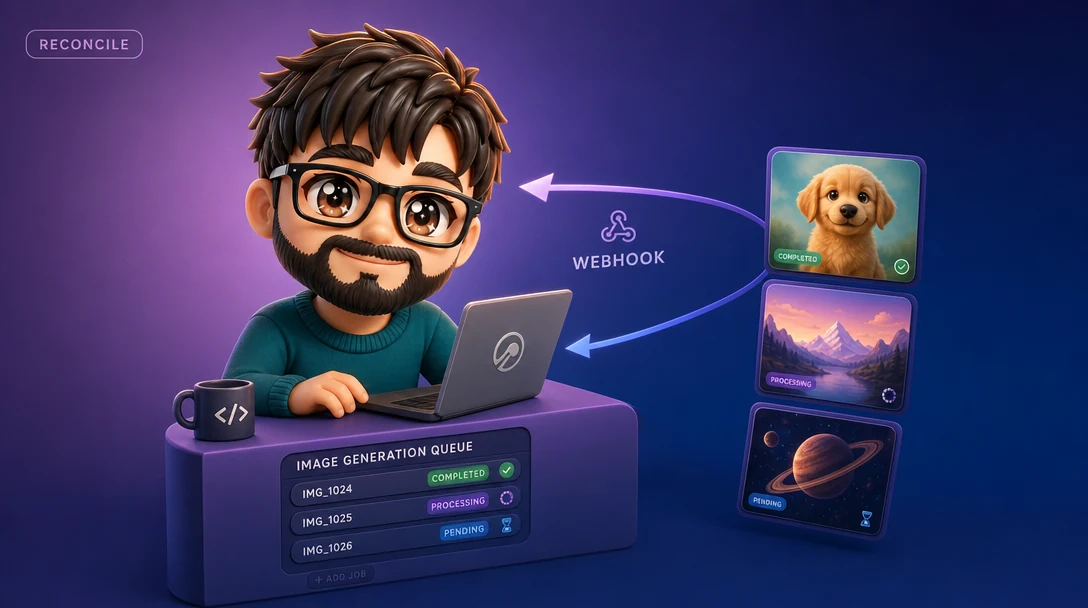
The Backend Behind An AI Image Product
AI image generation is slow and async. Webhooks fail, so I run a reconciliation system that makes the backend converge to the right state on its own.
AI Wrapper Stack Guide for Solo Developers
Complete guide to the AI wrapper stack - when to use it, setup, pros/cons, and alternatives.
Best Tech Stack for Building an AI Wrapper as a Solo Developer
The ideal tech stack for solo developers building an AI wrapper in 2026.