Curating 58 Real Squads From 1966 To 2022
World 11 runs on roughly 1,281 real players across every confederation. Here is the grind of sourcing them and calibrating ratings so eras sit on a fair scale.
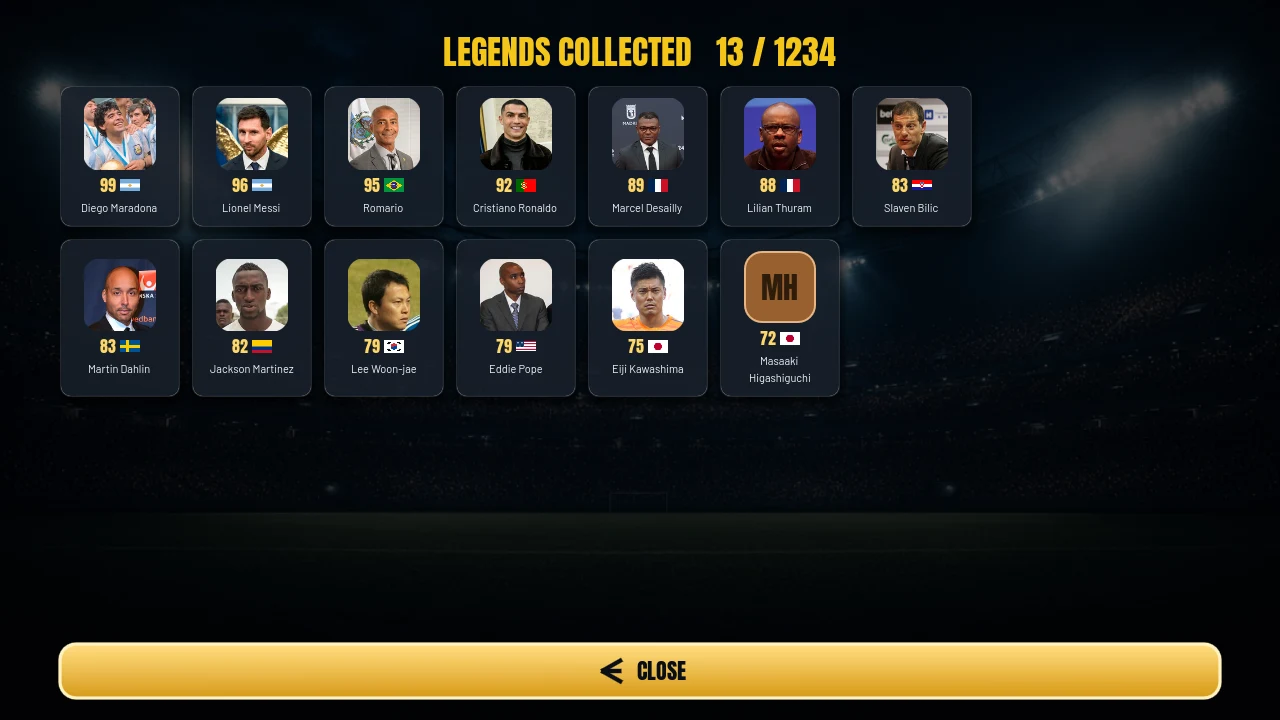
The systems in World 11 get all the attention, but the game would be nothing without the thing underneath them, which is the data. Fifty eight real World Cup squads. Roughly 1,281 players. Every confederation. A span from 1966 to 2022. Every one of those players sourced, entered, and given a rating that has to sit fairly next to a player from a different decade and a different continent. The draft, the chemistry, the penalties, none of it means anything if the roster is thin or the ratings are nonsense. This part of the project was not clever. It was a grind, and it was the most important grind in the whole build.
I want to talk honestly about that grind, because it is the part nobody warns you about and the part that decides whether a game about real players feels real. Sourcing the players was the easy half. Making their ratings fair across sixty years and six confederations was the hard half.
Play World 11 in your browser, or read the overview of how the whole game was built for the wider tour.
The Scope Of The Grind
The number that matters is roughly 1,281 players, and it is worth sitting with what that means in practice. Each of the fifty eight squads is a real tournament roster, and each player on it needs a name, a nation, a position, an era, and a rating. That is a lot of small, careful entries, and there is no shortcut that makes them appear correctly. Somebody has to go squad by squad, year by year, and put the eleven and the bench in.
The breadth is what makes it heavy. This is not one golden generation of one country. It is every confederation across the whole history of the modern World Cup, which means squads from regions and eras I knew well and squads I had to learn from scratch. A 1970 side and a 2018 side are both in there, and so are teams from confederations a casual fan rarely thinks about, because a draft that only spun the famous nations would be a much smaller, much more boring game. The whole appeal of the spin is that you might land anywhere, and that only works if everywhere is actually in the data.
Sourcing From Public References
The sourcing itself leaned on public references, the kind of openly available records of who played in which tournament. Tournament rosters are a matter of public record, so the raw question of who was on a given squad has a real answer you can look up and check against more than one source. That part is tedious but honest. You find the roster, you confirm it, you enter it.
The discipline I held myself to was to treat every squad as something I had to verify rather than remember. My memory of football is patchy and biased toward the teams I grew up watching, and a game that leaned on my recall would have great squads where I happen to know the history and thin, wrong squads everywhere else. So even for sides I thought I knew, I went back to the references. The goal was a roster that holds up regardless of which nation the spin lands on, and that meant doing the unglamorous work of confirming names I could have sworn I already knew.
The Hard Part Is The Ratings
Sourcing tells you who played. It does not tell you how good they were on a scale that works across the whole game, and that calibration was the real challenge. A rating in World 11 has to do something genuinely difficult, which is let a 1970 legend and a 2018 star stand next to each other in the same draft and feel fairly priced. Those two never shared a pitch, the game around them changed enormously over fifty years, and yet the draft has to put them on one common scale where the choice between them is meaningful rather than arbitrary.
If I rated everyone by raw modern impression, the recent stars would tower over the old legends, because they are the ones living memory and current footage favor, and every draft would just chase the newest names. If I overcorrected and inflated the old guard out of reverence, the opposite distortion would set in. The honest target is a scale where a great player is rated as great relative to his own era and his own region, and then those era-relative greatnesses are reconciled so a legend of one decade and a star of another are genuinely comparable in the draft. That reconciliation is the craft, and it is mostly judgment, done carefully and checked repeatedly.
Calibrating By Region
The reason the ratings are curated by region is that football is not one uniform talent pool, and pretending it is would make the draft lie. The depth and the ceiling of a squad differ across confederations and across eras, and a rating that ignored that would either flatten everyone into sameness or quietly punish certain regions. So the calibration is done with region in view, asking how a player stands within his own context first, and then placing that context fairly against the others.
The point of doing it this way is fairness in the moment that matters, which is the draft. When you spin a nation, the players you can take should feel correctly valued relative to the players you could have taken from a different spin. A standout from a less-heralded confederation should read as a standout, not as a discount option, and a depth player from a powerhouse should not be overrated just because of the shirt. Calibrating by region is how the spin stays exciting no matter where it lands, because wherever it lands, the players there are rated like they belong.
What The Curation Buys, And What It Cost
The payoff of all this is that the rest of the game gets to be honest. Chemistry, the out of position penalty, the match model, every one of them is a modifier on top of a base rating, and they are only as fair as that base. A beautifully designed chemistry system sitting on lazy ratings would still feel arbitrary, because the player would sense the underlying numbers were wrong. The curation is the foundation that lets the clever systems be trusted. It is invisible when it is right, and it is the first thing you feel when it is wrong.
The cost was time and patience, and I will not pretend otherwise. This was weeks of careful, repetitive work with no flashy result to show at the end of any single session, just a roster slowly becoming complete and a rating scale slowly becoming fair. It is the least glamorous part of the project and the one I would tell any solo developer not to skimp on, because a game about real players lives or dies on whether the players feel real. Mine do, and the reason is the grind, not the systems on top of it.
World 11 is the game that grind made possible, and every spin pulls from those fifty eight squads and that calibrated scale. Spin a nation you have never thought about and see whether its players hold up against the legends, because that fairness is the whole point of the weeks I spent on it. Play it at games.kevingabeci.com/world-11.
Like this? You'll like what I'm building too.
Two ways to support and get more of this work.
HEARTH
A privacy-first Life OS for your desktop. Journal, tasks, and notes that stay on your machine. Coming soon, direct download from this site.
Read moreMY TOOLKITS
Receipts-first toolkits for shipping after hours, building Claude agents, publishing on Amazon, and more. The exact methods I used, not theory.
Browse on WhopRelated Articles
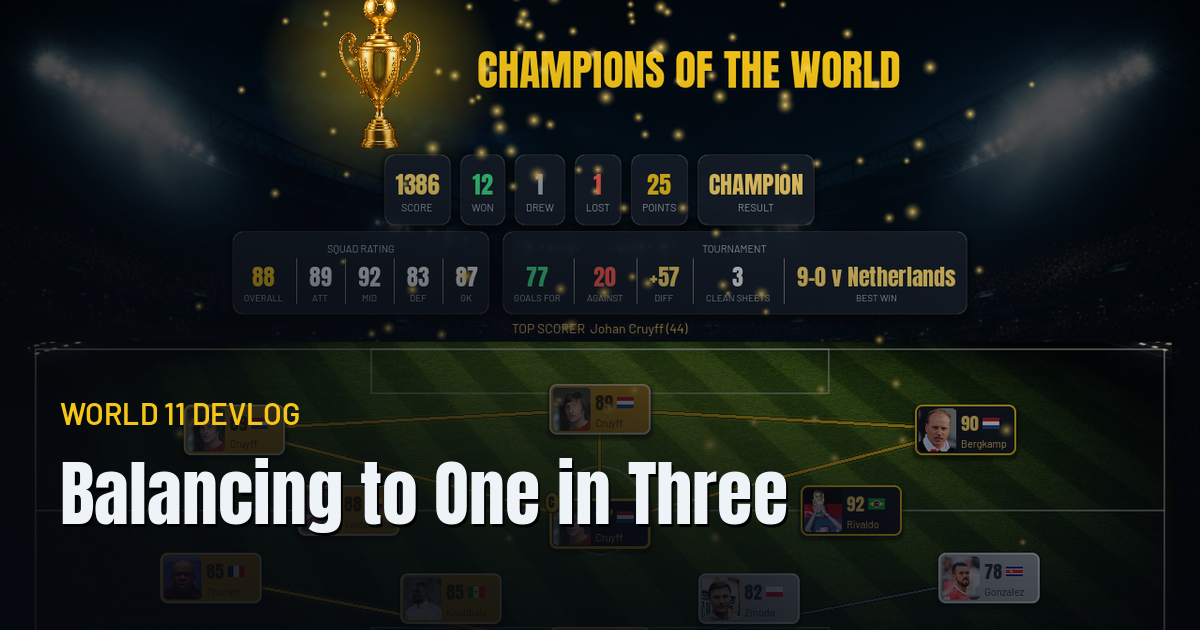
Balancing a Roguelike to a One-in-Three Win Rate With a Headless Harness
My draft roguelike was too easy. A strong team won the cup two-thirds of the time, so winning meant nothing. Here is how I stopped guessing and tuned it to a real one-in-three with a few hundred simulated runs.
What Building Small Games on Nights and Weekends Taught Me
I keep my games small on purpose. Here is what shipping little, finished, free browser games in Godot, instead of chasing one big dream project, has taught me about scope, momentum, and actually finishing.
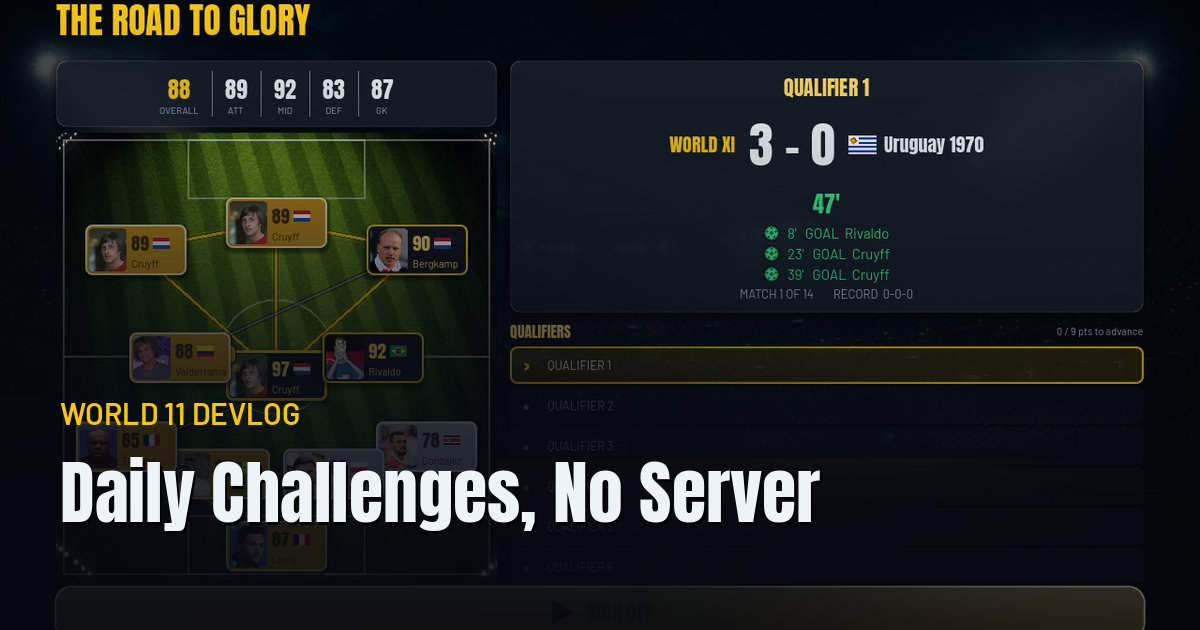
Daily Challenges and Shareable Seeds, No Server Required
A deterministic, seeded simulation gave my draft game a daily challenge and shareable challenge links for free, with no backend at all. Here is how a single integer unlocks both.