Why I Made a Football Game Where You Never Touch the Ball
World 11 is a football game with no passing, shooting, or defending. You draft a team and watch the result. Here is why a game about betting instead of playing is so addictive, and how the draft loop works.
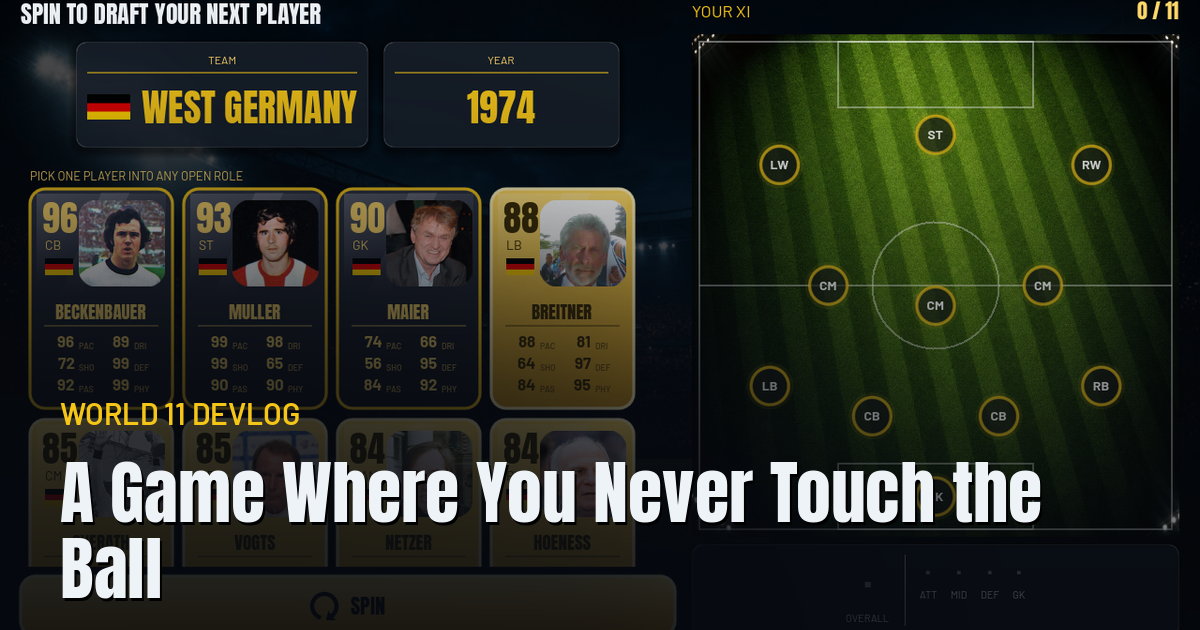
I build small games on nights and weekends, and the latest one is a football game where you never pass, shoot, or defend. There is no pitch you control, no thumbstick, no last-ditch tackle. You spin a random nation and a random year, you draft one real player per position from that era's squad, and then the match plays out as a simulation while you watch. That is the whole thing. It sounds like I forgot to build the actual game. I promise the omission is the point, and the more I played my own prototype the more sure I got that the kicking was the least interesting part all along. The game is called World 11, it is free in the browser, and here is why a football game about betting instead of playing turned out to be the most addictive thing I have made.
The Game Is Not Football, It Is the Conversation About Football
Think about how people actually enjoy football when they are not on the field. They argue about lineups. They build fantasy teams. They debate whether the 2010 Spain midfield would beat the 1970 Brazil attack. Almost none of that joy involves touching a ball. It is curation, prediction, and the long wait to see if you were right. World 11 leans entirely into that second mode. I stripped out the reflex layer that every other football game treats as the main course, and what was left was the part I already loved as a fan. You are not the striker. You are the person who picked the striker and now has to live with it.
You Spin a Nation and a Year, and That Is Your Hand
Every run starts with a spin. You get a nation and a specific year, and that pairing decides which real squad you are drafting from. Pull France 1998 and you are working with a golden generation. Pull a smaller footballing nation in an off year and you are scraping for a midfield that can hold together. The spin is the deal in a card game. It sets the constraints before you make a single choice, and it means no two runs start from the same place. You do not get to pick the dream squad on demand. You get what the wheel gives you, and the game becomes about what you do with it.
You Draft One Real Player Per Position
Once you have your nation and year, you fill out the eleven positions by drafting real players from that squad. Each slot is a small decision. Do you take the obvious star at striker, or grab a defender first because your back line looks thin and the good ones will be gone soon. Drafting one at a time, against a clock of dwindling options, is what turns a roster screen into a game. A list of names is data. A draft is a sequence of bets where every pick changes the value of the next one.
Every Spin Is a Quiet Little Bet
Here is the tension I did not expect to find until I was deep in playtesting. When you spin, you can draft from what you got, or you can spin again and gamble that the next nation and year will hand you something better. But a reroll is never free of cost in attention and momentum, and the squad in front of you right now might be the best you see for a while. So every spin becomes a small wager against yourself. Draft the decent team you have, or risk it for a great one you might not get. That push and pull is the engine. It is the same feeling as deciding whether to keep your dice or roll again, scaled up to an entire national team.
Rerolls Are the Pressure Valve
If the spin were the only randomness, a bad pull would just feel like punishment, and punishment without an out is how you get people to quit. So rerolls exist as the pressure valve. When a spin gives you something you cannot work with, you have a lever to pull. That single mechanic changes the emotional shape of a bad outcome. Instead of being stuck, you are choosing. A reroll is not a get out of jail card you can spam forever, it is a limited resource you spend, which means using one is itself a decision worth thinking about. Good roguelikes are not about removing bad luck. They are about giving you tools to respond to it, and the reroll is mine.
Chemistry Turns a Roster Into a Puzzle
If you just drafted the highest rated player at every slot, the game would be a spreadsheet and I would be bored. So picks talk to each other. Players from the same nation and the same decade have chemistry, and chemistry lifts the whole team above the sum of its individual ratings. Suddenly the optimal move is not always the biggest name. A slightly lower rated player who shares an era with three of your other picks can be worth more than a superstar who plugs in cold and connects with nobody. That one rule is what converts the draft from a ranking exercise into an actual puzzle. You are not collecting the best parts, you are assembling a team that fits together, and the fit is where the thinking lives.
The Simulated Match Is the Payoff
You do not play the match, you watch it resolve. After the last pick, the simulation runs and tells you what your choices were worth. This is the moment the whole loop has been building toward, and it works for the same reason opening a pack works, or watching your fantasy lineup score on a Sunday works. You committed to a set of decisions, you sat with the uncertainty, and now the result lands. A win validates the read you made on a thin squad. A loss makes you replay your own draft in your head and spot the slot where you got greedy. The match is short because it is a verdict, not a sport. The drama already happened during the draft. The simulation just reads it back to you.
It Is a Deck-Builder Wearing a Football Shirt
If you have played the modern wave of deck-builders or run-based games, the skeleton here will feel familiar. A spin deals you a constrained set of options. You make a sequence of decisions under scarcity, with a reroll as your relief valve. Synergy between your choices, the chemistry, rewards planning over raw stat chasing. Then a single resolution pays the whole thing off and sends you into the next run. I did not set out to clone that structure, I set out to build a football game, but I kept following what felt fun and ended up at a draft roguelike that happens to be about real players from real World Cups. Football was the theme. The genre was hiding underneath the genre the whole time.
Why I Cut the Part Everyone Expects
I am one person building this on the side, so cutting the playable match was partly honesty about scope. I was never going to out-simulate a studio with a hundred people and a physics team, and I did not want to ship a worse version of a game that already exists. But the bigger reason is that the playable match was solving a problem the rest of the design did not have. The fun was in the choosing. Adding a thumbstick on top would have buried the part that actually worked under a part I could only ever do worse. Constraints made me find the real game faster, and the real game did not need a ball you could kick.
Play It Free in Your Browser
World 11 is free and runs in the browser, built in Godot 4, no download. Spin a nation, draft your eleven, and watch the match decide whether you read it right. Then do it again, because the next spin might be the one that hands you a golden generation. Play it at games.kevingabeci.com and tell me which lineup finally broke your gauntlet.
Like this? You'll like what I'm building too.
Two ways to support and get more of this work.
HEARTH
A privacy-first Life OS for your desktop. Journal, tasks, and notes that stay on your machine. Coming soon, direct download from this site.
Read moreMY TOOLKITS
Receipts-first toolkits for shipping after hours, building Claude agents, publishing on Amazon, and more. The exact methods I used, not theory.
Browse on WhopRelated Articles
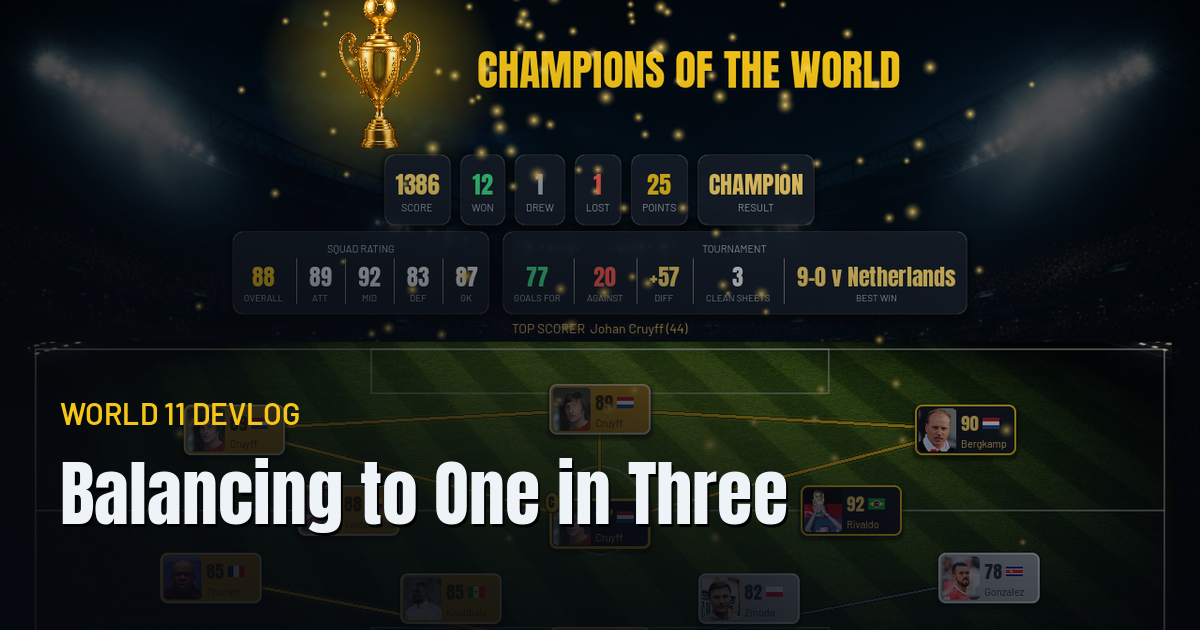
Balancing a Roguelike to a One-in-Three Win Rate With a Headless Harness
My draft roguelike was too easy. A strong team won the cup two-thirds of the time, so winning meant nothing. Here is how I stopped guessing and tuned it to a real one-in-three with a few hundred simulated runs.
What Building Small Games on Nights and Weekends Taught Me
I keep my games small on purpose. Here is what shipping little, finished, free browser games in Godot, instead of chasing one big dream project, has taught me about scope, momentum, and actually finishing.
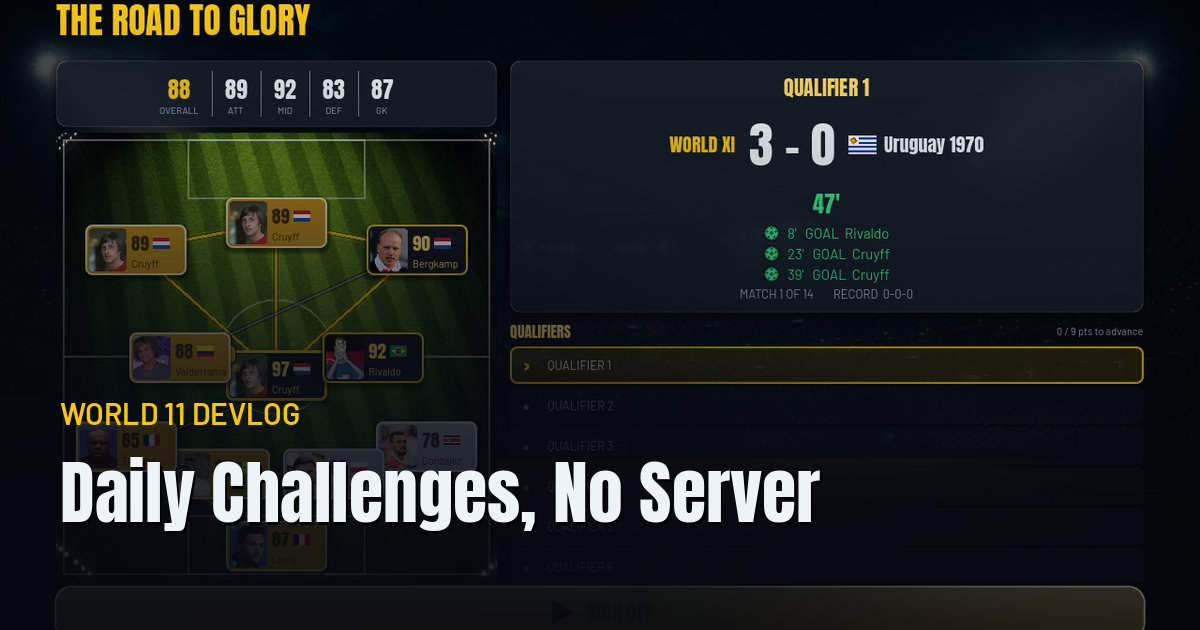
Daily Challenges and Shareable Seeds, No Server Required
A deterministic, seeded simulation gave my draft game a daily challenge and shareable challenge links for free, with no backend at all. Here is how a single integer unlocks both.