What Building Small Games on Nights and Weekends Taught Me
I keep my games small on purpose. Here is what shipping little, finished, free browser games in Godot, instead of chasing one big dream project, has taught me about scope, momentum, and actually finishing.
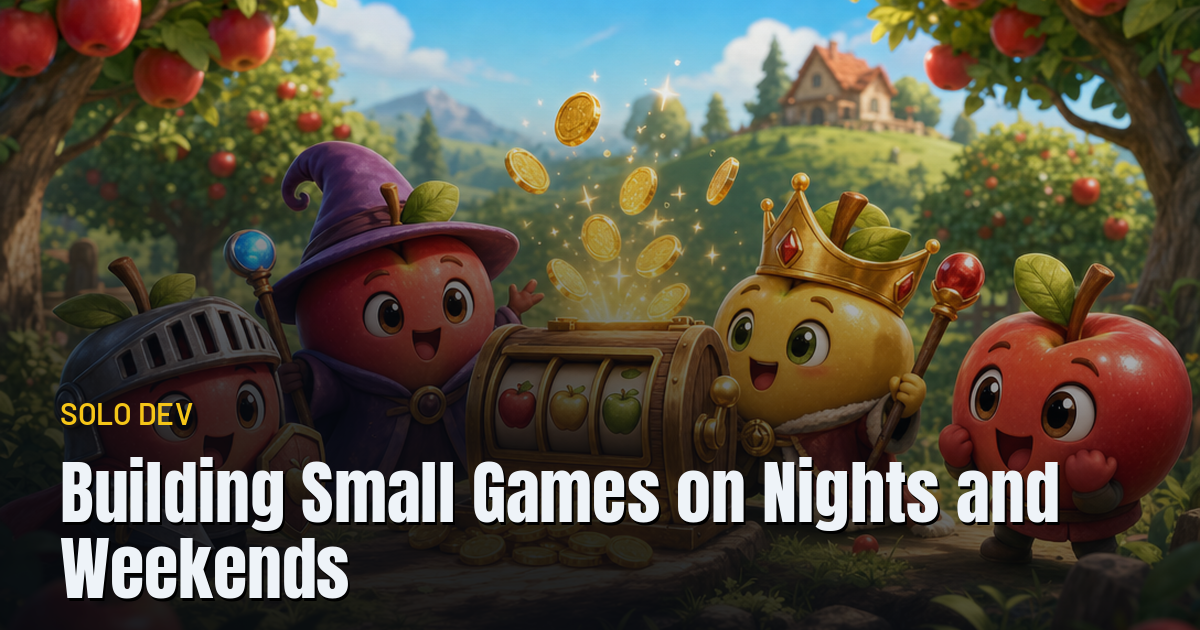
For years I carried around the idea of one big game. The dream project. The thing I would build once I had time, once I had skill, once I had a clear weekend stretch that never actually arrived. I have a day job. My game development happens at night and on weekends, in the gaps. And what I slowly learned, after a long stretch of starting things I never finished, is that the dream project was the problem. Not my schedule. Not my skill. The size of the idea itself.
So I made a rule. Build small on purpose. Pick one mechanic I cannot stop fiddling with, wrap the smallest possible game around it, and ship it free in the browser. Two of those have made it out the door so far. World 11, a World Cup draft roguelike where you spin a nation and a year, draft eleven real players, and run a gauntlet of matches. And Orchard Deck, a cozy collectathon about building up a little card-driven orchard. Both made in Godot 4. Both free in the browser. Both built around a single loop I kept poking at long after I should have stopped. Here is what that approach actually taught me.
A Game That Fits in One Sentence Is a Game You Can Finish
When someone asks what I am working on and I can answer in one clean sentence, I know the scope is right. World 11 is "draft a national team and play a roguelike gauntlet." Orchard Deck is "stack cards to grow an orchard." That is the whole pitch. No appendix. No "and also."
The moment the answer needs an "and also," I have started to drift. The big dream project could never fit in a sentence. It needed paragraphs, because it was really five games wearing one title and pretending to be a plan. A one-sentence game has a finish line you can actually see from the start. You know what done looks like, which means you can walk toward it instead of wandering.
One Strong Core Mechanic Beats Five Half-Built Systems
Every game I abandoned had the same shape. A crafting system that was forty percent done. A dialogue system that was thirty percent done. A combat system I had blocked out but never tuned. Five systems, none of them finished, none of them fun, all of them competing for the same scarce hours.
The small games flipped that. World 11 lives or dies on the draft. So I spent my time making the draft feel good, the tension of passing on a player you want because you need a defender, the small thrill of a late steal. Orchard Deck lives on the stacking loop, so that is where the polish went. One mechanic, sharpened until it carried the whole thing. A single system that genuinely works will hold a player longer than five that almost do. I would rather ship one good idea than five rough ones.
Finishing Teaches You What a Dream Project Never Will
The perpetual dream project is a wonderful place to hide. As long as it stays unfinished, it stays perfect in your head. Nobody plays it, so nobody can tell you the second mechanic is boring or the pacing sags in the middle.
Shipping strips that away, and that is the gift. The day World 11 went live, I learned things no amount of planning had taught me, what people actually did first, where they got confused, which part they replayed and which they skipped. You only get that feedback from a finished thing in someone else's hands. A dream project protects you from being wrong, and being wrong, quickly and cheaply, is the entire job. Every game I shipped made me a better developer than every game I imagined.
Free in the Browser Removes the Friction for Everyone
I made both games free, playable in a browser, no download, no account, no store page. Part of that is generosity, but most of it is plain self-interest, because friction is the enemy of a small game.
For a player, free in the browser means the distance between hearing about it and playing it is one click. No checkout, no install, no wondering if it is worth the money. For me, it means no store submission, no review cycles, no platform paperwork, no refund handling. The game goes up, the link works, and that is the launch. When the thing you built is small, the overhead around shipping it should be small too, otherwise the overhead becomes a bigger project than the game.
Scope Discipline Is Mostly Cutting Things You Want to Build
This is the hard part, and I will be honest about it. For both games I had a long list of features I genuinely wanted, deeper progression for World 11, more card types and seasons for Orchard Deck, systems I could picture clearly and was excited to make.
I cut almost all of it before launch. Not because the ideas were bad, but because each one pushed the finish line further out, and a finish line that keeps moving is one you eventually stop walking toward. Scope discipline is not picking good features. It is looking at a feature you love and saying "not in version one," knowing full well it might never make it in at all. That is uncomfortable every single time. It is also the only reason these games exist instead of sitting in a folder with the others.
Depth Comes After Launch, Not Before
Cutting features at launch is not the same as killing them. It is sequencing them. The rule I follow now is simple. Ship the small thing first, get it live, get people playing, and only then look at what depth is worth adding.
This works because once a game is live, you are layering depth onto something real. You add the feature people are actually asking for, into a loop you have watched people enjoy, instead of guessing in the dark before launch. The deep features I wanted are not gone. They are just waiting behind the one thing that mattered most, which was getting a finished, playable game in front of someone. Depth added to a live game compounds. Depth added to a game nobody can play is just more reasons not to ship.
Momentum Compounds, So the Next One Is Faster
Here is the quiet payoff nobody tells you about. The first small game I shipped was slow and clumsy. I was learning Godot, learning my own pipeline, learning what "done" even meant for me. The second one moved noticeably faster.
Some of that is reusable code and habits. Most of it is belief. Once you have actually finished and shipped one thing, you stop secretly suspecting you are someone who never finishes. That suspicion is heavier than any technical problem, and shipping is the only thing that lifts it. Each finished game makes the next feel less like a gamble and more like a thing you simply do. Momentum is not a mood. It is evidence, and you build it one small launch at a time.
Making Peace With Not Building the Magnum Opus
I will not pretend this approach is free. Small means small. World 11 is not the sprawling football management epic I could imagine. Orchard Deck is not a hundred-hour cozy world. Neither is the magnum opus, and on some nights that stings.
But I have made peace with the trade. A modest game that exists, that people can play tonight, is worth more than a masterpiece that lives only in my head. The dream project taught me nothing for years. The small ones taught me something every time I shipped. If the price of finishing is that no single game is the great one, I will pay it, because a stack of finished small things is its own kind of body of work. Maybe the magnum opus comes later, built on everything these little games taught me. It will not come from a folder of abandoned beginnings.
The Quiet Reward of Done
The best part of building small is the feeling on the night you push a finished game live. Not relief that it is over, but the simple, solid sense that a thing exists now that did not before, and anyone can go play it.
That feeling is the whole reason I keep doing this in the gaps around a full life. Small, finished, free, and out in the world beats big, perfect, and forever unstarted. If you want to see what that looks like in practice, both games are free to play in your browser at games.kevingabeci.com. Go draft a squad, or grow an orchard. They are small on purpose, and that is exactly why they are there for you to play at all.
Like this? You'll like what I'm building too.
Two ways to support and get more of this work.
HEARTH
A privacy-first Life OS for your desktop. Journal, tasks, and notes that stay on your machine. Coming soon, direct download from this site.
Read moreMY TOOLKITS
Receipts-first toolkits for shipping after hours, building Claude agents, publishing on Amazon, and more. The exact methods I used, not theory.
Browse on WhopRelated Articles
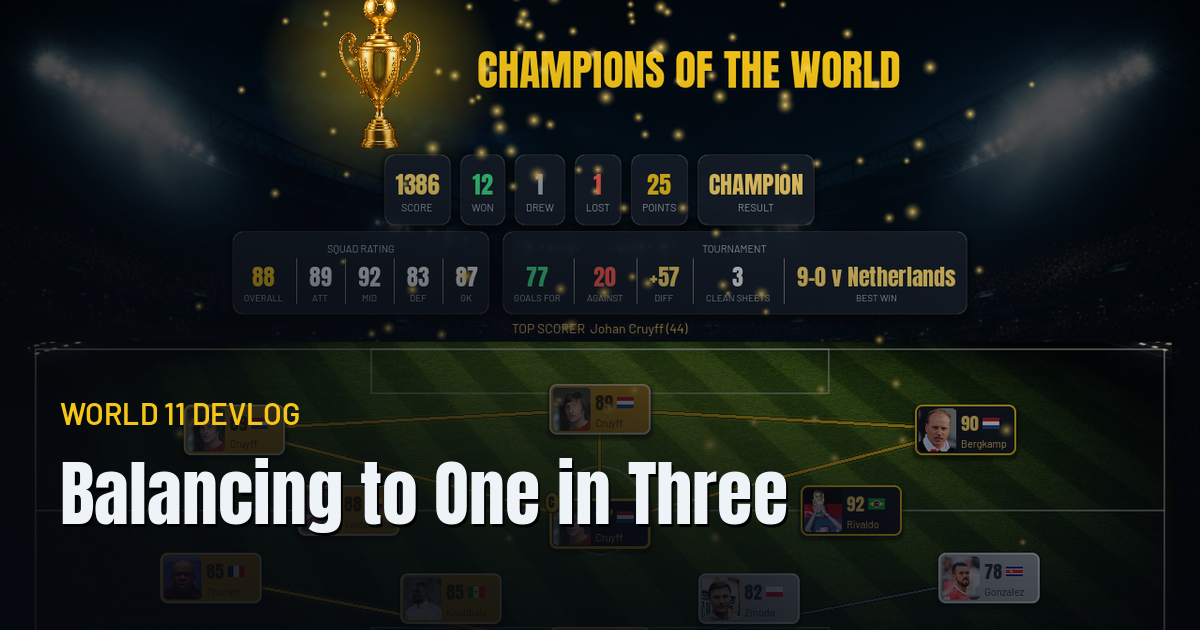
Balancing a Roguelike to a One-in-Three Win Rate With a Headless Harness
My draft roguelike was too easy. A strong team won the cup two-thirds of the time, so winning meant nothing. Here is how I stopped guessing and tuned it to a real one-in-three with a few hundred simulated runs.
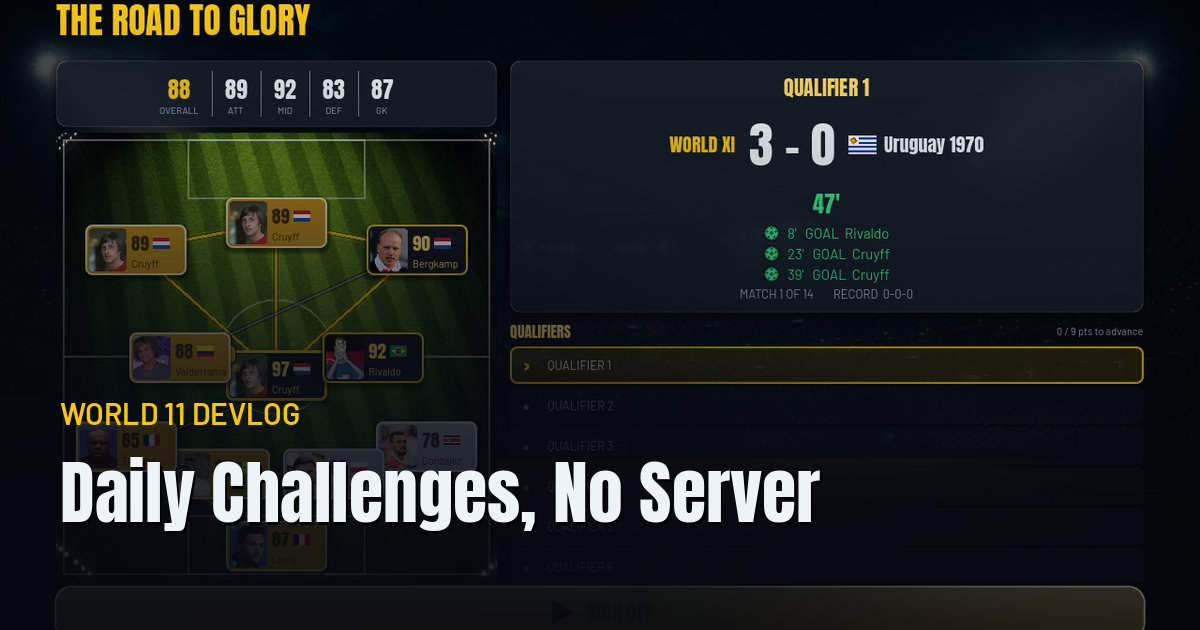
Daily Challenges and Shareable Seeds, No Server Required
A deterministic, seeded simulation gave my draft game a daily challenge and shareable challenge links for free, with no backend at all. Here is how a single integer unlocks both.
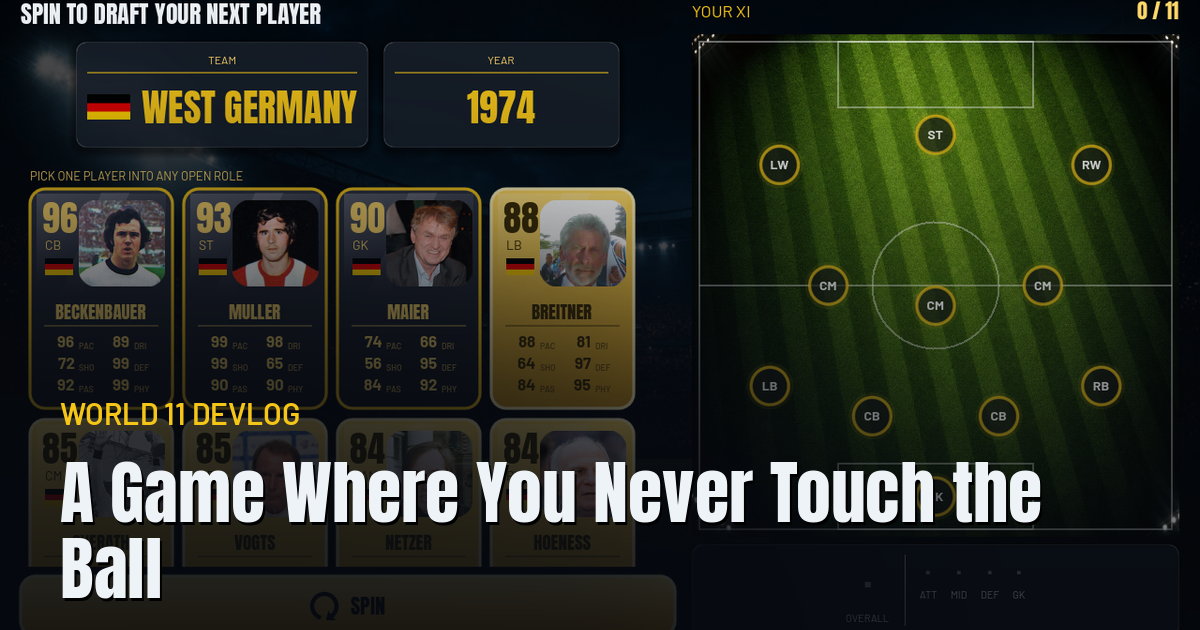
Why I Made a Football Game Where You Never Touch the Ball
World 11 is a football game with no passing, shooting, or defending. You draft a team and watch the result. Here is why a game about betting instead of playing is so addictive, and how the draft loop works.