Free Browser Games As A Solo Developer's Funnel
Why a solo developer should ship free browser games at all. A portfolio, a funnel, a reason for a stranger to click your name, and the leverage of link not download.

A free browser game is the most shareable thing a solo developer can make. That is the whole reason I keep shipping them. Not for the revenue line, there is none, but because of how a free game travels from one person to the next with almost nothing slowing it down. This post is about that travel, the distribution mechanics, the path a game takes when nobody is paying to push it.
The Link Is The Call To Action
A free browser game has the simplest call to action there is. It is a link. There is no buy button, no signup wall, no store page to convince anyone of anything. The entire ask is a click, and a click is the lowest commitment you can request of a stranger. That single property is why a free game moves where other things stall.
Compare it to almost anything else a developer ships. A paid product asks for a card. A newsletter asks for an email. A demo asks for a download and an install. Every one of those is a small wall, and every wall sheds the people who were only mildly curious. The free game link has no wall. Someone sees it, taps it, and is inside the thing seconds later. When the call to action and the experience are the same gesture, the distance between hearing about your game and playing it collapses to nothing.
How A Game Travels Friend To Friend
Here is the part that makes a free game worth the months. It spreads on its own, through people, not through me. A game is shareable in a way that a blog post or a landing page simply is not, because sharing it costs the sender nothing and gives the receiver something fun for free.
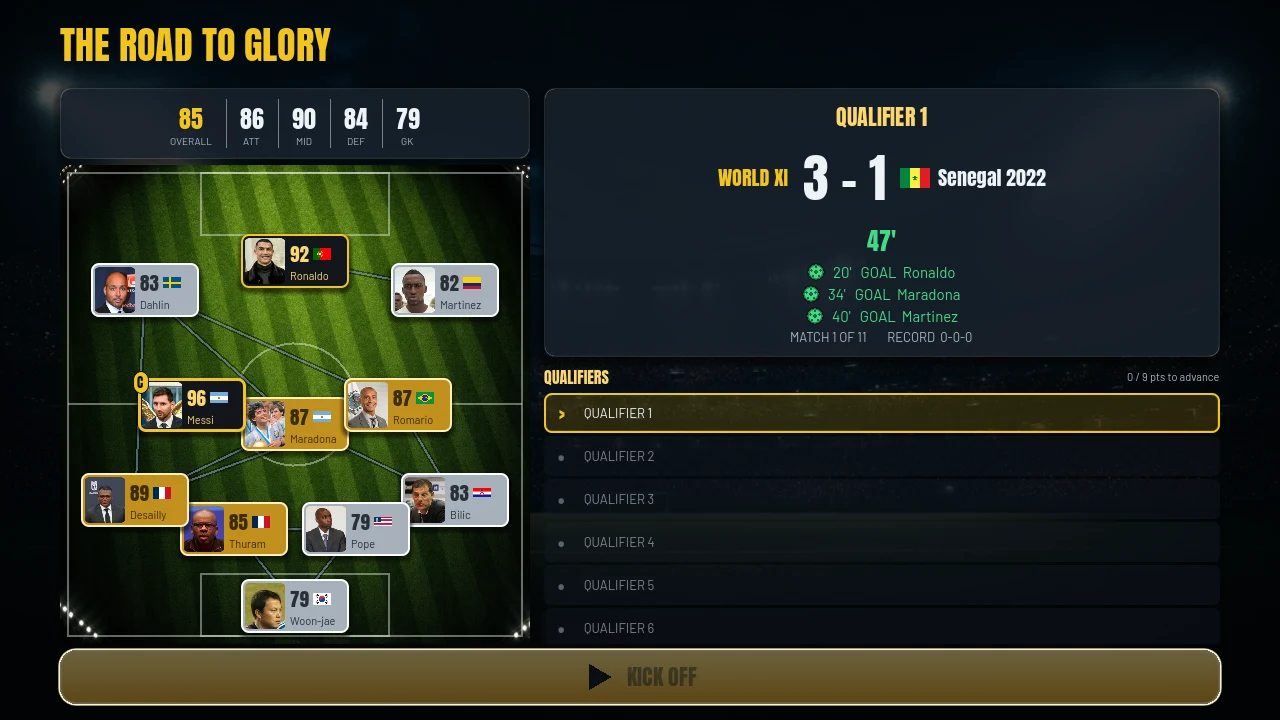
Watch the actual path. Someone plays a draft in World 11, hits a run they think is funny or absurd, and sends the link to a friend. The friend taps it, plays, and now two people have played instead of one. Maybe that friend sends it on. There is no referral program, no incentive, no mechanic engineered to force the share. The game is just good enough and cheap enough to pass along that passing it along is the natural thing to do. A free browser game is built for that friend to friend hop in a way a download or a paywalled product never can be, because the only thing being handed over is a link, and a link is weightless.
That is the funnel, and it is entirely the player's doing. I do not chase anyone. The game sits at its link, somebody enjoys it, somebody shares it, and the reach grows one trusted handoff at a time. A recommendation from a friend is worth more than any ad I could not afford anyway, and a free browser game is unusually good at earning those recommendations because it asks for nothing in return for the fun.
Link Not Download Is The Whole Leverage
The reason this strategy is even available to me is the distribution model, and it is worth being blunt about how much it matters. Both games are built in Godot 4 and export to the browser, so they live behind a link, not a download. That one fact is the difference between a funnel that works and one that does not.
Think about the friction of the old way. To play a downloadable game, a stranger has to trust an unsigned binary from a name they do not recognize, clear their operating system's security warnings, find disk space, and commit to an install before they have had a second of fun. Every one of those steps loses people, and they lose the most curious people first, the ones who were only mildly interested. A link loses none of them. Someone reads about the game, clicks, and is playing inside the same page seconds later. The barrier between curiosity and experience drops to nearly zero, and that is where a funnel lives or dies. For a solo developer with no marketing spend, removing the install step is the single highest leverage decision available, and the browser export hands it to you.
The Link Keeps Traveling Without Me
The distribution does not stop when I stop pushing. A free browser game sits at its link and stays shareable indefinitely. Someone finds it through a search, a friend, a mention months from now, taps it, plays, and maybe passes it on, and that whole chain runs without me being anywhere near it that day. A download goes stale the moment the install friction outweighs the curiosity. A link does not go stale, because there is no friction to outweigh.
That is the quiet leverage of building the call to action into the thing itself. The game is its own distribution. It travels friend to friend on the strength of being fun and free and one tap away, and every hop happens on its own time, long after I shipped it.
You can watch the mechanic work on yourself. World 11 is free in the browser, behind a link with no install, and the only thing it asks of you is a tap. Play a run, and if it makes you want to send the link to someone, that reflex is the entire distribution model in a single gesture.
Like this? You'll like what I'm building too.
Two ways to support and get more of this work.
HEARTH
A privacy-first Life OS for your desktop. Journal, tasks, and notes that stay on your machine. Coming soon, direct download from this site.
Read moreMY TOOLKITS
Receipts-first toolkits for shipping after hours, building Claude agents, publishing on Amazon, and more. The exact methods I used, not theory.
Browse on WhopRelated Articles
I Balanced My Roguelike With A Bot That Plays A Thousand Games
A balance bot runs hundreds of optimal teams through the full gauntlet and reports the champion rate. That dial replaced the playtest team a solo developer does not have.
How I Built A Game About Real Players Without A Licensing Nightmare
Facts are not copyrightable. Here is the practical line a solo developer can walk to ship a game using real names, positions, and years, with freely licensed faces.

I Treat Claude Code Like a Small Dev Team
Agentic AI coding gives real leverage only when you decompose work, isolate it, anchor it with durable context, and verify the output. Here is how I direct it.