Designing An Idle Economy Where Your Best Cards Wear Out
How I built the orchard in Orchard Deck around wall-clock growth and vitality that decays over nine harvests, turning worn-out cards into fuel instead of trash.
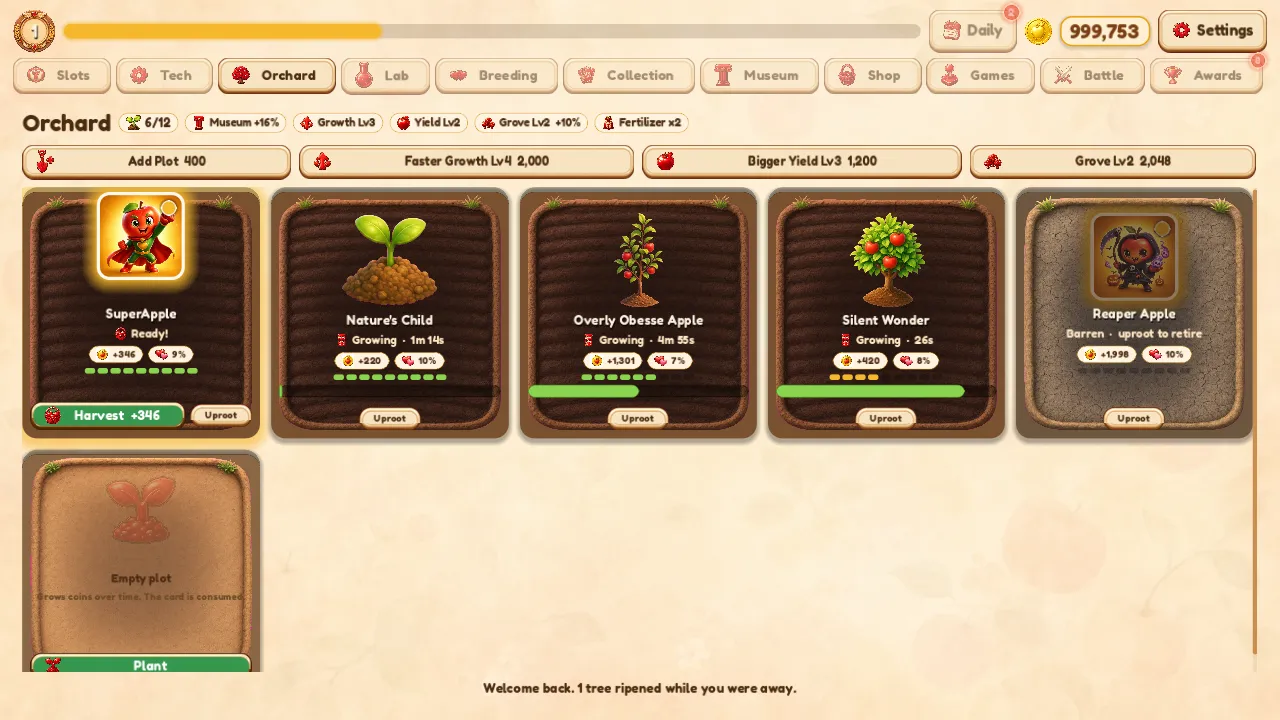
The orchard is the heart of Orchard Deck and it is the system that runs whether you are watching or not. You plant a card in a plot, it grows on real wall-clock time, and it produces coins that pile up while the browser tab is closed and you are doing something else entirely. That is the idle part, and the idle part is easy to get wrong in a way that makes the whole game boring. The thing that keeps the orchard from going stale is that the cards you plant wear out, and worn out cards do not become garbage, they become fuel.
Here is the loop in full. You plant a card, and how long it takes to mature is driven by the card's age stat, so a fast growing card is ready sooner than a slow one. Once mature you harvest it for coins, with the payout driven by the card's power. But every harvest wears the card's vitality down a step. A card survives nine harvests. On the ninth, its vitality hits the floor, it goes barren, and it returns to your collection as a worn card. The worn card is not dead weight. It is the exact thing the Lab and the rest of the economy want as input.
Play Orchard Deck in your browser
Wall-Clock Time Instead Of Session Time
The first decision was that the orchard runs on wall-clock time, not on time the game is open. A card planted at noon is ready a set number of real hours later, whether the game was running the whole time or whether you closed the tab and came back the next morning.
I store a timestamp when a card is planted and compute everything from the difference between then and now. When the game loads, it does not simulate every tick that passed while you were away. It looks at how much real time has elapsed, figures out how many harvest cycles that covers given the card's age stat, and resolves them in one calculation. The math is the same whether you were gone five minutes or five days. There is no loop running in the background, no server keeping time, just a stored timestamp and a subtraction at load.
Wall-clock growth is what makes the game respect your life. You are not punished for closing the tab, and you are not rewarded for leaving it open and idle, which would just be a tax on your battery. You plant, you leave, you come back, and the coins are waiting. A cozy game should fit around a day rather than demanding one, and a timestamp delta is how the orchard does that.
Why The Cards Have To Wear Out
The trap with a pure idle orchard is that it becomes set-and-forget. You plant your best cards once, they produce forever, and there is no reason to ever touch the orchard again. It runs itself into a flat line. The numbers go up but nothing decides anything, and a system where nothing decides anything is wallpaper, not a game.
Vitality decay is the fix. Because every harvest wears a card down, and because a card only survives nine harvests, no planting is permanent. Your best card in your best plot is not a fixture, it is a clock running down. Eventually it goes barren and you have to make a choice about the empty plot, and that recurring choice keeps the orchard alive as a system instead of a screensaver. The decay turns the orchard from a thing you set up once into a thing you tend.
The number nine is deliberate. It is enough harvests that planting a card feels worthwhile, and few enough that the end is always in sight. You can watch a card you like work its way down its vitality and feel the countdown. That countdown creates the small recurring engagement that idle games need and usually lack. You come back not just to collect coins but to manage a roster of assets all aging at different rates, and managing that roster is the actual gameplay sitting on top of the idle income.
A Decaying Asset That Becomes A Resource
The piece I am proudest of is what happens to a card when it goes barren, because the obvious design is the wrong one. The obvious design is that a worn out card is destroyed, or becomes worthless, and the player just eats the loss. That punishes the player for using the system as intended. You should not lose for playing.
So in Orchard Deck a barren card does not vanish. It returns to your collection as a worn card, and worn cards are the intended fuel for the Lab. The Lab extracts cards into essence, transmutes that essence up through the tiers, and crafts new cards from it. Worn cards are exactly what it wants to eat. So the orchard and the Lab form a cycle. The orchard consumes a card's vitality to produce coins and spits out a worn husk, and the Lab consumes that husk to produce essence, which becomes a fresh card that can go back in the orchard. Nothing is lost. Value transforms rather than evaporating.
This is the rule I designed the whole economy around, that no output is ever trash. A worn card is not a failure state, it is the next system's raw material. Designing it this way means the player never feels like they wasted a card by planting it. They spent its vitality on coins, and what is left over still has somewhere to go. The decay that keeps the orchard from being set-and-forget also feeds the recycler that keeps the player's collection turning over. One mechanic, vitality decay, does two jobs at once. It forces recurring decisions in the orchard, and it generates the input stream for the Lab.
What The Decay Taught Me
The lesson from building the orchard is that a number going up is not a system, and the way you turn a counter into one is to make the output of a decaying asset feed something. An idle game that only adds is flat no matter how big the numbers get, because addition with no subtraction is a wait, not a decision. The thing that made the orchard worth playing was subtraction, the vitality wearing down, the card going barren, the plot opening back up. A card that wears out and dies is a punishment. A card that wears out and returns as fuel for the next system is a loop. Decay created the choices, the worn husk pointed at the Lab created the cycle, and together they made the orchard a machine you feel humming along instead of a counter you watch tick.
The orchard is live in the browser build, growing cards on real time and wearing them down over their nine harvests, the whole thing humming along while you are off doing something else. Play Orchard Deck in your browser.
Like this? You'll like what I'm building too.
Two ways to support and get more of this work.
HEARTH
A privacy-first Life OS for your desktop. Journal, tasks, and notes that stay on your machine. Coming soon, direct download from this site.
Read moreMY TOOLKITS
Receipts-first toolkits for shipping after hours, building Claude agents, publishing on Amazon, and more. The exact methods I used, not theory.
Browse on WhopRelated Articles

Balancing a Roguelike to a One-in-Three Win Rate With a Headless Harness
My draft roguelike was too easy. A strong team won the cup two-thirds of the time, so winning meant nothing. Here is how I stopped guessing and tuned it to a real one-in-three with a few hundred simulated runs.
What Building Small Games on Nights and Weekends Taught Me
I keep my games small on purpose. Here is what shipping little, finished, free browser games in Godot, instead of chasing one big dream project, has taught me about scope, momentum, and actually finishing.

Daily Challenges and Shareable Seeds, No Server Required
A deterministic, seeded simulation gave my draft game a daily challenge and shareable challenge links for free, with no backend at all. Here is how a single integer unlocks both.