Designing The Chemistry System That Turns A Draft Into A Decision
Same-nation and same-decade bonuses make World 11 a real draft. Here is how chemistry sets up the tug of war between the obvious star and the player who fits.
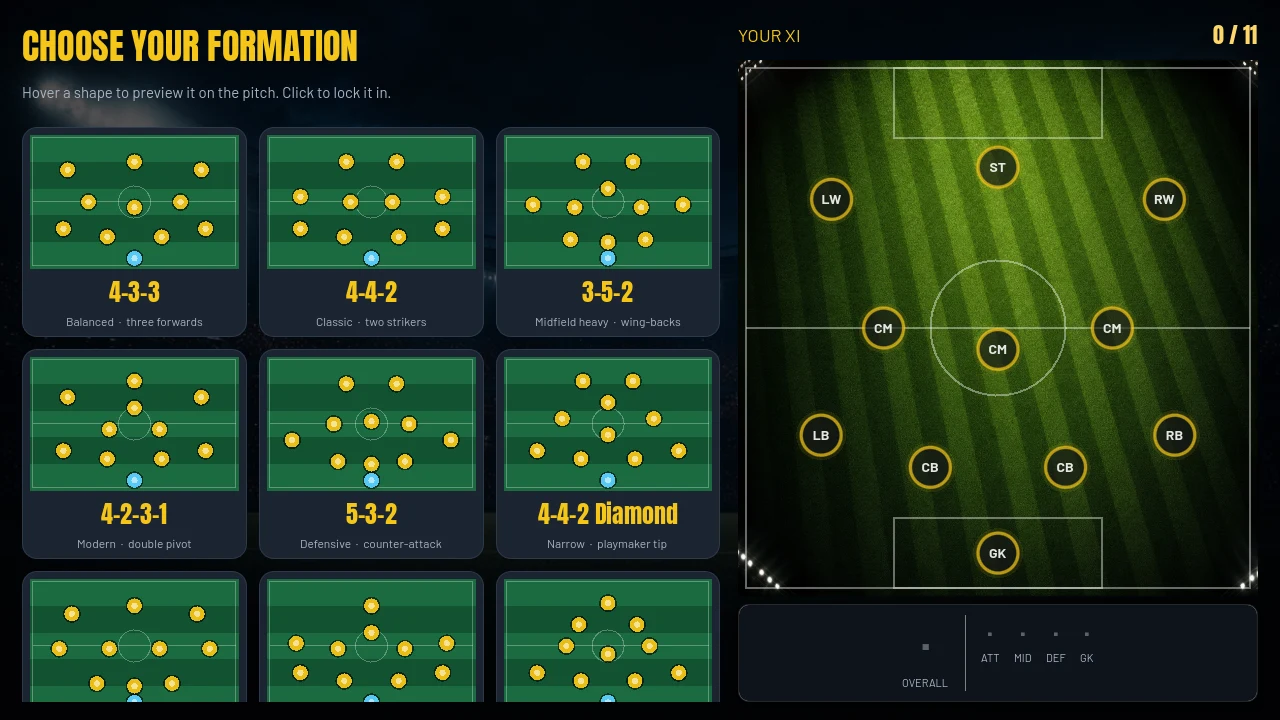
When I started World 11, the draft was just a shopping list. You picked a formation, the game spun a random nation and year, and then you filled eleven slots with the best real players you could find for each spot. It worked, and it was boring. There was always one obviously correct player per slot, and once you knew the rosters, every run drafted itself. A draft where every choice has a right answer is not a draft. It is a quiz.
Chemistry is the system that fixed that, and it is the reason a list of names becomes an actual decision. I want to walk through how I designed it, why the two bonuses are shaped the way they are, and how a single rule turned the most boring part of the game into the part people replay for.
Play World 11 in your browser, or read the overview of how the whole game was built for the wider tour.
The Problem Chemistry Solves
A draft is only interesting if picks interact. If every slot is independent, the optimal team is just the eleven highest-rated players you are allowed to take, and the player is doing arithmetic, not deciding anything. The whole appeal of a draft is that taking this player now changes what the next player is worth. You want the move where the strong pick and the smart pick pull in opposite directions, so that a person has to actually choose.
Chemistry is the mechanism that makes picks talk to each other. It says that the value of a player is not only his own rating. It is also how well he belongs with the eleven you have already taken. Suddenly a slightly weaker player can be the better pick, because of what he does to the team around him. That is the moment the draft stops being a shopping list.
Two Bonuses, On Purpose
I built chemistry on two relationships, and I picked them because they are the two things a football fan already feels without being taught.
The first is same-nation chemistry. Players from the same country who share a shirt get a bonus, because that is the unit a fan instinctively trusts. A spine of one nation feels like a real side, not a fantasy all-star team stapled together. When you draft three players from the same country in a row, you can feel the team becoming a team, and the bonus makes that feeling pay.
The second is same-decade chemistry. Players from the same era get a bonus, because eras have a texture. A side built out of one decade plays like it belonged together, and stitching a 1970 legend next to a 2018 star feels like a mismatch even before you check the numbers. Same-decade chemistry rewards the player who builds a coherent generation instead of cherry-picking the loudest name from every year.
I kept it to exactly these two. I tried more relationships early on, club ties and position links and a few others, and the draft turned into a spreadsheet. The point of chemistry is to create a tug of war a person can hold in their head, not to bury them in optimization. Two legible bonuses give you a real decision without a manual.
The Tug Of War
Here is the decision chemistry creates, and it is the heart of the game. You spin into a nation and year. A genuine superstar is sitting there, off to the side, available to draft. He is the best raw player on the board by a clear margin. But he does not share a nation with your spine, and he is from the wrong decade. Taking him gives you one brilliant individual and zero chemistry, and it quietly weakens the slots around him because nothing connects.
Next to him is a very good player, not a legend, who is from the same country as the four you have already taken and from the same decade as your core. He is worse on paper. He is better for the team. The bonus he brings, stacked across the chemistry he completes, can outweigh the gap in raw rating.
So you sit there for a second, and that second is the game. Do you take the obvious superstar and build around a glittering individual, or do you take the player who fits and trust the team you are assembling. There is no universally right answer, because it depends on what you have already drafted and what the formation needs. That is exactly what I wanted. The same board produces different correct answers depending on the run, and the player has to read the situation instead of recalling a checklist.
Why Chemistry Has To Be Visible
A bonus the player cannot see is a bonus that does not exist, design-wise. Early on, chemistry was real in the math but invisible on the screen, and people drafted as if it were not there, because nothing told them it mattered. The first thing I did to make chemistry land was to surface it on every pick. When a candidate would complete a same-nation link or extend a decade, the player needs to feel that the moment they consider him, not discover it after the run is lost.
The feel I was chasing is the small jolt of recognition when you spot the fit. You see a player who is a touch weaker, you notice he shares the nation and the era, and something clicks. That click is the entire design working. The player is no longer reading ratings. They are building a side, and the side is starting to mean something. Chemistry only earns its place when the player can feel it deciding the pick, so making it legible was not polish. It was the feature.
What I Learned Shaping It
The thing I underestimated is how much chemistry changes the texture of a whole run rather than a single pick. Once chemistry exists, your first few picks set a direction. Commit to a nation early and the rest of the draft becomes a search for countrymen, which is a tight, satisfying constraint. Spread across nations for raw quality and you are betting that pure talent beats cohesion, which is a real and sometimes correct gamble. The bonuses do not just price one player. They give the run a shape.
The other lesson is restraint. Chemistry is powerful precisely because it is the only relationship system in the draft. The moment I add a third or fourth interaction, the tug of war loses its clarity, and the player stops feeling the choice and starts grinding an optimizer. Two bonuses, both legible, both pulling against raw rating, is the whole design. That is enough to turn eleven slots into eleven decisions.
World 11 is the game where that draft lives, and the chemistry tug of war is waiting the moment you spin your first nation. Build a one-country spine or chase the loudest names and watch which one lifts the cup, because the answer changes with every spin. Play it at games.kevingabeci.com/world-11.
Like this? You'll like what I'm building too.
Two ways to support and get more of this work.
HEARTH
A privacy-first Life OS for your desktop. Journal, tasks, and notes that stay on your machine. Coming soon, direct download from this site.
Read moreMY TOOLKITS
Receipts-first toolkits for shipping after hours, building Claude agents, publishing on Amazon, and more. The exact methods I used, not theory.
Browse on WhopRelated Articles
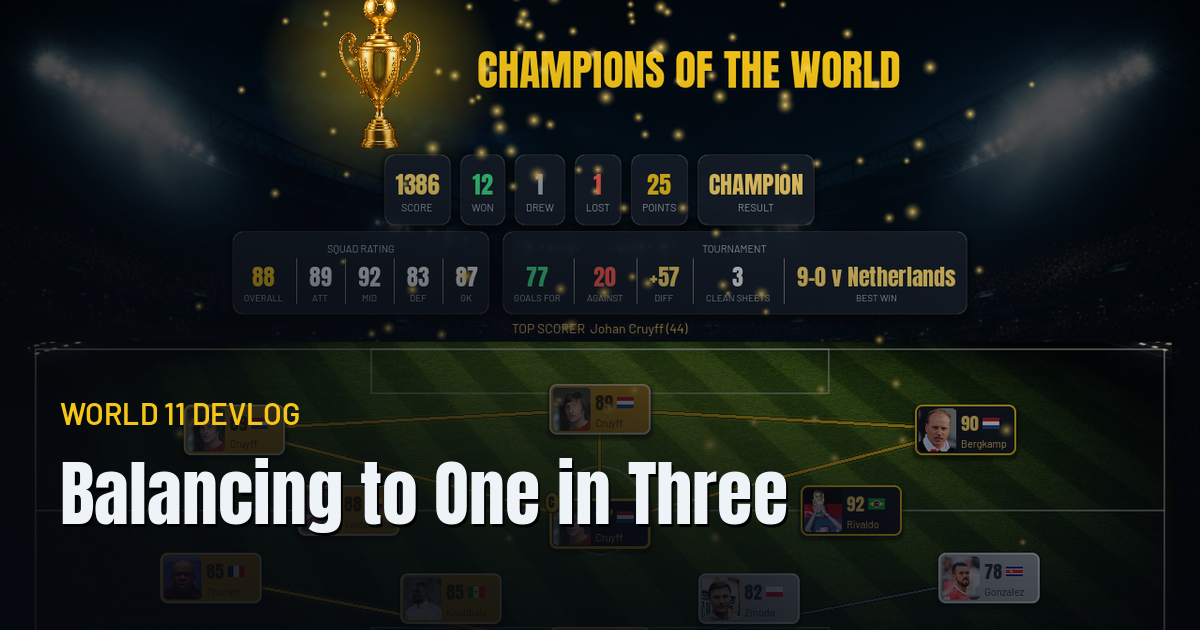
Balancing a Roguelike to a One-in-Three Win Rate With a Headless Harness
My draft roguelike was too easy. A strong team won the cup two-thirds of the time, so winning meant nothing. Here is how I stopped guessing and tuned it to a real one-in-three with a few hundred simulated runs.
What Building Small Games on Nights and Weekends Taught Me
I keep my games small on purpose. Here is what shipping little, finished, free browser games in Godot, instead of chasing one big dream project, has taught me about scope, momentum, and actually finishing.
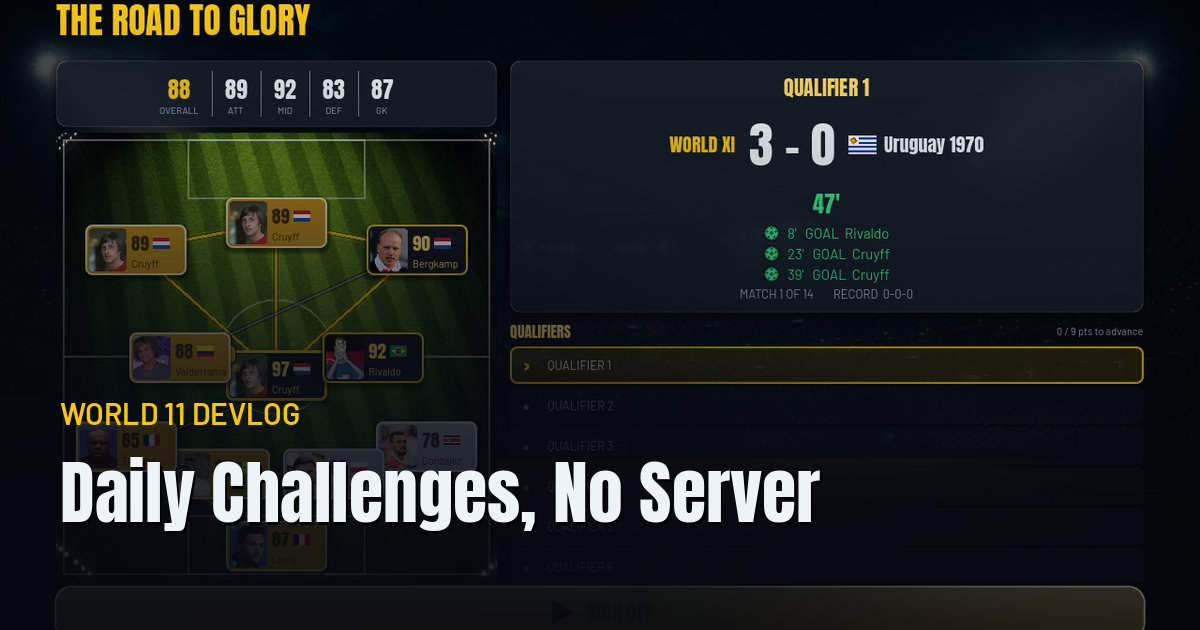
Daily Challenges and Shareable Seeds, No Server Required
A deterministic, seeded simulation gave my draft game a daily challenge and shareable challenge links for free, with no backend at all. Here is how a single integer unlocks both.