Encoding Football Intuition As Numbers With An Out Of Position Penalty
When you play a star out of his natural role, World 11 docks him. Here is how I turned the fuzzy sense that a winger is wasted at fullback into a rating system.
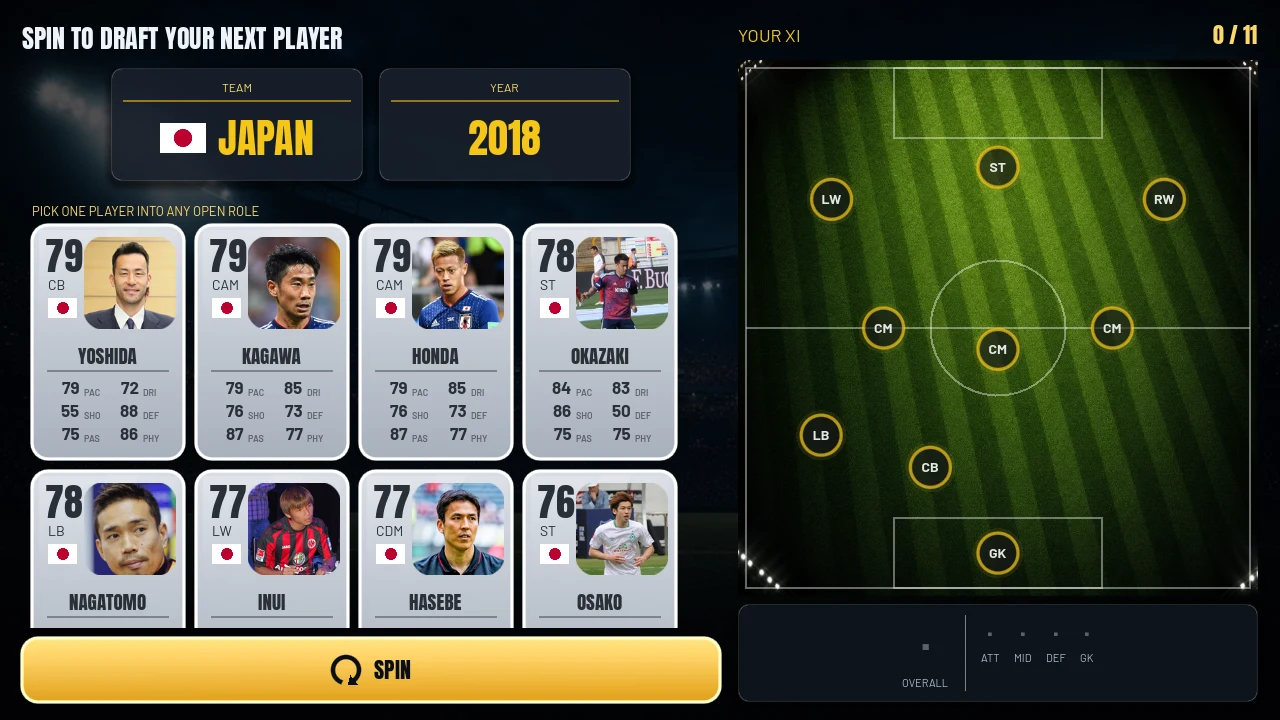
Every football fan knows, without thinking about it, that a brilliant winger shoved in at center back is a problem. You cannot quite say how much of a problem in a number, but you feel it. He is world class and also clearly in the wrong place, and a team built on that kind of square-peg shuffling is going to leak. World 11 needed to capture exactly that feeling, because the draft lets you put any player in any slot, and without a consequence the player would just stack his best names wherever they fit and call it a team.
The out of position penalty is how I turned that gut feeling into math. It docks a player's rating when you slot him somewhere that is not his natural role, and getting the size of that dock right was one of the more interesting calibration problems in the whole game. I want to walk through how I encoded a fan's instinct as a number, and why the number has to land in a narrow band to feel honest.
Play World 11 in your browser, or read the overview of how the whole game was built for the wider tour.
The Feeling I Had To Encode
Start with the thing I was trying to reproduce, because that is the spec. A fan looking at a lineup reads it as a set of right and wrong places. A striker up top is right. The same striker at left back is wrong, and the wrongness has a texture. He is not useless there, because he is still a superb athlete, but he is diminished, and the team is worse for the misuse. That is the intuition. A great player in the wrong slot is better than a poor player in the right slot, but worse than himself in his own slot, and the gap is real but not catastrophic.
My job was to find a number that produces that reading. Too small a penalty and the player would just play everyone out of position to grab the best names, because the dock would not matter. Too large a penalty and the player would never dare move anyone, because one misplacement would wreck a slot. The whole feature lives in the band between those two failures, and finding that band was the calibration.
Why It Has To Be A Penalty, Not A Wall
The first design instinct is to forbid it. Just lock each player to his real position and the problem disappears. I tried that, and it kills the draft. The fun of drafting from random nations and years is the scramble of fitting real players into the shape you chose, and half the joy is the compromise. You spin a nation with three great wingers and no real right back, and the interesting decision is whether to push one winger back and eat the cost, or take a weaker natural fullback and keep everyone in their lane. A hard lock erases that decision entirely.
So the answer had to be a penalty, not a wall. The player is always allowed to slot anyone anywhere. The game just charges for it. That charge is what keeps the decision honest. You can play your superstar out of position, and sometimes you should, but you pay a rating cost that has to be worth it. The penalty does not remove the option. It prices it, which is exactly what a good fan's intuition does too.
Calibrating Against What A Fan Would Accept
Here is where the craft is. The penalty cannot be a single flat number, because not all misplacements are equal, and a fan knows that. Asking a winger to play the other wing is barely a stretch. Asking a striker to play in defense is a serious one. Asking a goalkeeper to play outfield is absurd. The penalty has to scale with how far the move is from a player's home, because that is how the intuition is shaped.
I calibrated this by sitting with lineups and asking the only question that matters, which is whether the number agrees with the feeling. I would place a known great player in a slot, look at his docked rating, and check it against my gut. Does this still read as a strong contributor who is clearly misused, or does it read as ruined, or as if nothing happened. When the docked number matched the feeling across a range of players and a range of misplacements, the calibration was right. When a world class player moved one slot over and the game treated him like a journeyman, the penalty was too harsh and I pulled it in. When he played three positions from home and barely dropped, it was too soft and I pushed it out.
Why The Ratings Underneath Have To Be Fair First
None of this works if the base ratings are wrong, since the penalty only ever docks a starting number, so the out of position penalty rides on top of the rating curation and is the second layer to its first. The base rating says how good a player is in his own slot. The penalty says how much of that survives a move. Together they let the game answer the only question the draft ever asks, which is whether this specific player in this specific slot beats the alternative on the board right now.
What The Penalty Does To The Draft
The payoff is that the penalty makes the shape you picked actually matter. Because moving players costs rating, the formation you chose is not just a backdrop. It defines which slots are cheap to fill from a given nation and which ones force a painful out of position move. A nation loaded with attackers and thin at the back turns your defensive slots into hard choices, and you feel the squad's real shortage instead of papering over it by stacking names.
It also rewards the player who reads a roster like a fan. The strong move is often to take a slightly worse player who plays his natural position over a better player you would have to wrench out of his role, and spotting that is a genuine skill the penalty creates. The whole feature is one calibrated number doing the work of an instinct everybody already has. That is the most satisfying kind of game math, the kind that makes a player feel smart for knowing something they never had to be taught.
World 11 is the game where that instinct gets to pay off, and every slot you fill is weighed against the cost of moving someone out of his home. Build a side that respects its shape, or gamble on a misplaced star and find out whether the dock was worth eating. Play it at games.kevingabeci.com/world-11.
Like this? You'll like what I'm building too.
Two ways to support and get more of this work.
HEARTH
A privacy-first Life OS for your desktop. Journal, tasks, and notes that stay on your machine. Coming soon, direct download from this site.
Read moreMY TOOLKITS
Receipts-first toolkits for shipping after hours, building Claude agents, publishing on Amazon, and more. The exact methods I used, not theory.
Browse on WhopRelated Articles
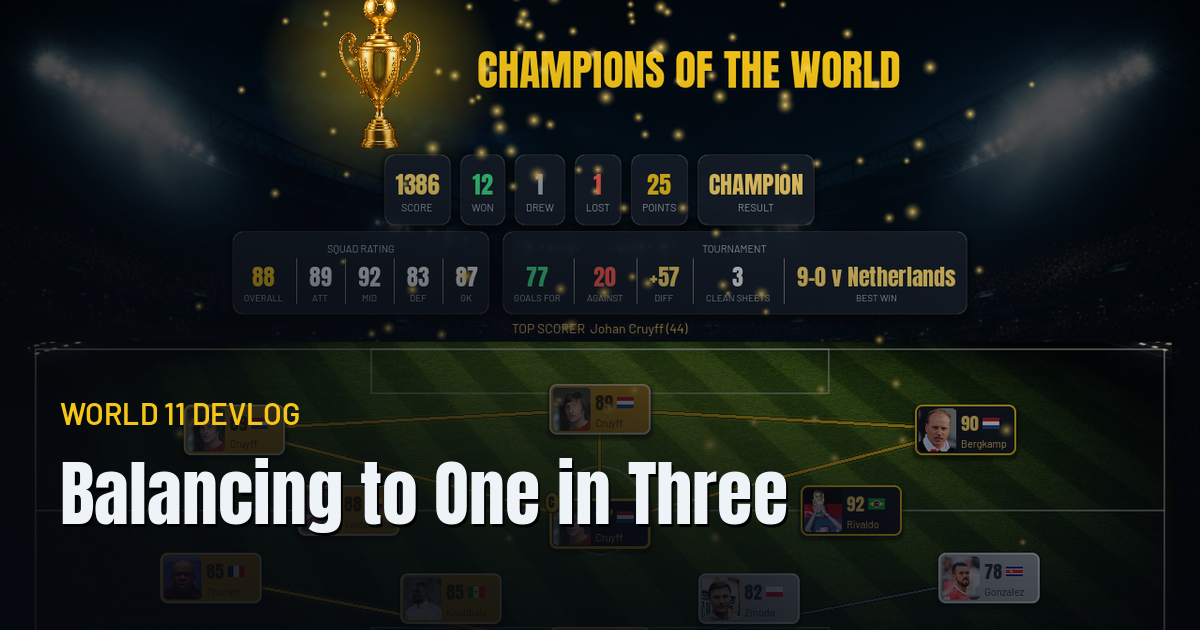
Balancing a Roguelike to a One-in-Three Win Rate With a Headless Harness
My draft roguelike was too easy. A strong team won the cup two-thirds of the time, so winning meant nothing. Here is how I stopped guessing and tuned it to a real one-in-three with a few hundred simulated runs.
What Building Small Games on Nights and Weekends Taught Me
I keep my games small on purpose. Here is what shipping little, finished, free browser games in Godot, instead of chasing one big dream project, has taught me about scope, momentum, and actually finishing.
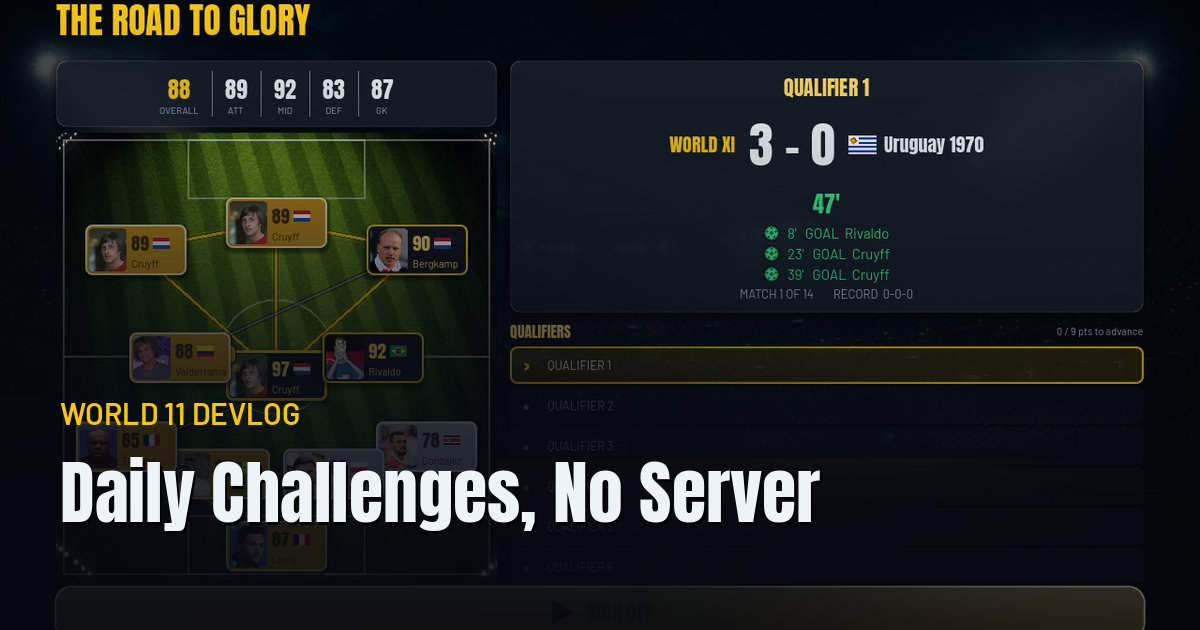
Daily Challenges and Shareable Seeds, No Server Required
A deterministic, seeded simulation gave my draft game a daily challenge and shareable challenge links for free, with no backend at all. Here is how a single integer unlocks both.