Designing A Breeding System That Costs You Two Cards To Make One
How I built breeding in Orchard Deck, where fusing two cards consumes both parents for a rarer child, and why the destructive cost is the point.
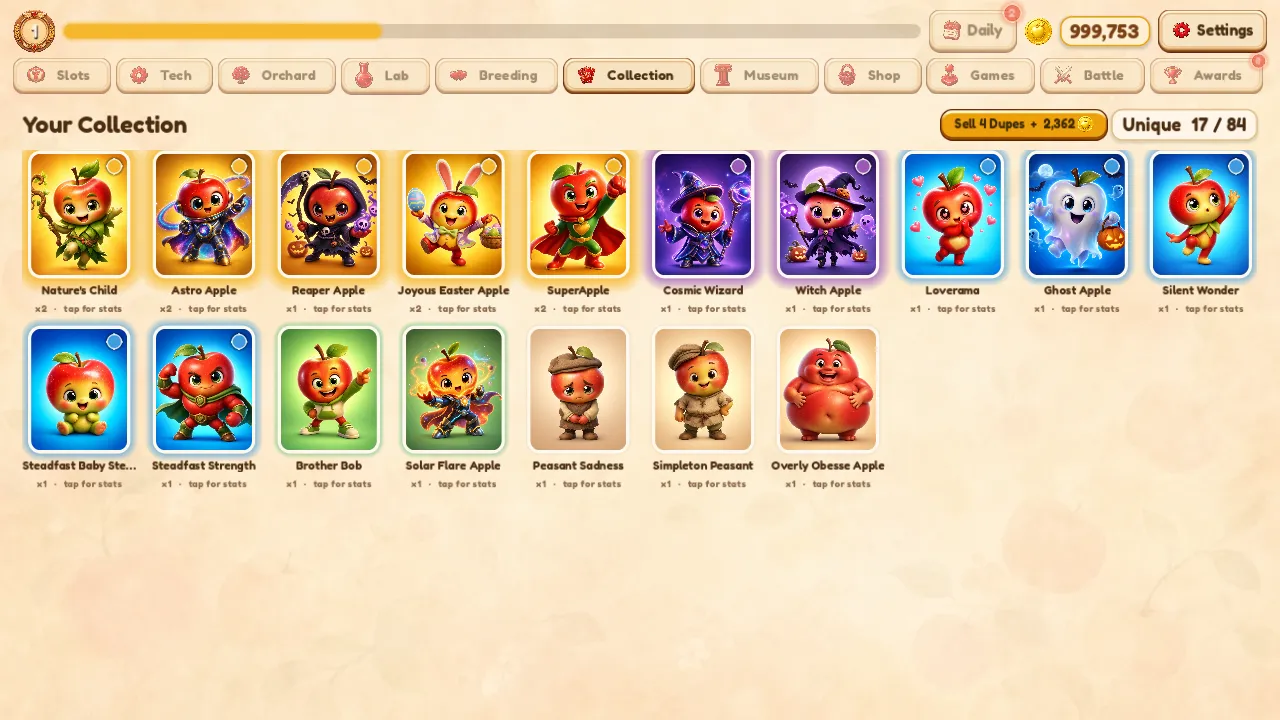
Breeding was the last of the six systems I added to Orchard Deck, and it is the one I rewrote the most times. Every version that felt safe also felt pointless, and every version that felt interesting also felt like it might break the economy. The version that shipped is the one where breeding hurts a little, and that small hurt is what makes it work.
The rule is short. You pick two cards you own, you pay a pile of coins, and you get back one child card. Both parents are consumed. The child is guaranteed to land at least at the tier of the better parent, and there is a twenty five percent chance it climbs one tier higher than that. Two cards go in, one card comes out, and you are betting coins on a one in four roll for an upgrade.
Play Orchard Deck in your browser
Why The Parents Have To Die
The first breeding prototype I built kept both parents. You fused them, you got a child, and you walked away with three cards where you started with two. It felt generous. It also quietly destroyed the entire game inside about ten minutes of playtesting against myself.
The problem is multiplication. If breeding adds cards instead of converting them, then every high tier card you own becomes a printing press. You breed your two best cards, keep them, breed them again, keep them again, and your collection grows without bound while the difficulty curve stands still. The slot machine, which is supposed to be your main source of new cards, becomes irrelevant. The whole pull economy collapses because breeding out-produces it for free.
Consuming both parents fixes this at the root. Breeding stops being a printing press and becomes a trade. You are spending two cards plus coins to buy a shot at one better card. The card count of your collection cannot grow through breeding, it can only stay flat or shrink, because the operation always takes two and returns one. That single subtraction keeps the slot machine relevant for the entire game, because the slot machine is the only system that adds net new cards to your hand.
What you are buying with those two parents is a gamble, and the shape of the gamble is the real differentiator. The child lands at the better parent's tier as a floor, and one breed in four climbs a tier higher than that floor. So most breeds confirm what you already had and one in four hands you a genuine jump. That variance is the whole appeal. You feed two cards in knowing the worst case is a wash and the best case is a card a full tier above either parent, and you do not know which you will get until it lands. The coin cost on top means every breed is a real wager on that one in four, priced so you cannot just spam it until the climb happens.
Inheritance Rules I Could Reason About
I wanted inheritance rules I could hold in my head without a spreadsheet, because rules a player cannot predict feel like a slot machine wearing a science costume.
The core rule is the floor. The child inherits the tier of the better of its two parents as a guaranteed minimum. If you breed a tier two card with a tier four card, the floor is tier four. You can never breed down. That guarantee is what lets a player plan, because the worst case is always known before they spend.
On top of the floor sits the climb. There is a flat twenty five percent chance the child comes out one tier above the floor. Breed two tier four cards and you are guaranteed a tier four child with a one in four shot at tier five. The chance is flat and it does not stack, scale, or hide behind secret modifiers. One in four, every time, stated plainly.
I deliberately rejected the more elaborate genetics models I sketched early on. I had a version where the lower parent nudged the odds, a version where matching the parents by pack gave a bonus, a version where stats blended in weighted averages. Each of those made the system more impressive on paper and less legible in the hand. A player breeding cards needs to answer one question before they commit, which is what they are likely to get back. The flat floor plus the flat climb answers that question in one sentence, and I decided one clear sentence beat three clever ones.
Breeding Competes With The Lab And The Orchard
The part of breeding I am most happy with is not breeding in isolation. It is the fact that breeding is fighting two other systems for the same scarce thing, which is cards.
The orchard wants your cards planted, where they sit in plots and produce coins on wall-clock time. The Lab wants your worn and spare cards fed in, where it extracts them into essence and transmutes that essence up the tiers into something craftable. Breeding wants two cards to fuse. All three want cards, and you only have so many cards, so every card in your collection is the subject of a quiet three way argument every time you look at it.
That competition is what turns breeding from a feature into a decision. A card is never just a card, it is a card you could plant for steady income, or recycle into Lab essence for guaranteed tier control, or gamble in the breeder for a one in four climb. The breeder is the high variance option in that trio. The Lab gives you a slower, surer path up the tiers through transmutation with no luck involved. Breeding gives you a faster path with a coin cost and a roll attached. A player who hates randomness can climb tiers entirely through the Lab and never breed once, and the game still works for them, which is exactly what I wanted. Breeding stays the spicy optional path for the players who want the gamble.
Because all three systems pull from the same pool, the coin cost on breeding does real work. If breeding were cheap, it would always beat the Lab, because a chance at a free tier up is better than a guaranteed slow grind whenever the chance is unpriced. Pricing breeding in coins forces the player to weigh the gamble against the sure thing, and against simply leaving the card in the orchard to earn its keep. The number on the breed button is what keeps all three systems in tension instead of one quietly winning.
What I Learned Building It
The lesson I keep returning to is that the cost of an action is the design, more than the reward is. I spent the early prototypes tuning what breeding gave you, the tiers and the odds and the climb. The thing that actually made breeding good was tuning what breeding took from you. Two cards in, one card out, paid for in coins, with a flinch attached. The reward was always going to be a better card. The interesting part was always the price.
Breeding is live right now in the browser build, two cards in, one card out, and a one in four roll riding on every fusion to see whether the child climbs. Play Orchard Deck in your browser.
Like this? You'll like what I'm building too.
Two ways to support and get more of this work.
HEARTH
A privacy-first Life OS for your desktop. Journal, tasks, and notes that stay on your machine. Coming soon, direct download from this site.
Read moreMY TOOLKITS
Receipts-first toolkits for shipping after hours, building Claude agents, publishing on Amazon, and more. The exact methods I used, not theory.
Browse on WhopRelated Articles

Balancing a Roguelike to a One-in-Three Win Rate With a Headless Harness
My draft roguelike was too easy. A strong team won the cup two-thirds of the time, so winning meant nothing. Here is how I stopped guessing and tuned it to a real one-in-three with a few hundred simulated runs.
What Building Small Games on Nights and Weekends Taught Me
I keep my games small on purpose. Here is what shipping little, finished, free browser games in Godot, instead of chasing one big dream project, has taught me about scope, momentum, and actually finishing.

Daily Challenges and Shareable Seeds, No Server Required
A deterministic, seeded simulation gave my draft game a daily challenge and shareable challenge links for free, with no backend at all. Here is how a single integer unlocks both.