Designing A Three-Act Auto-Battler With Eight Keywords
How I designed the campaign auto-battler in Orchard Deck. Eight combat keywords, six tribal synergies, a readable line of five cards, and replays that beat live control.
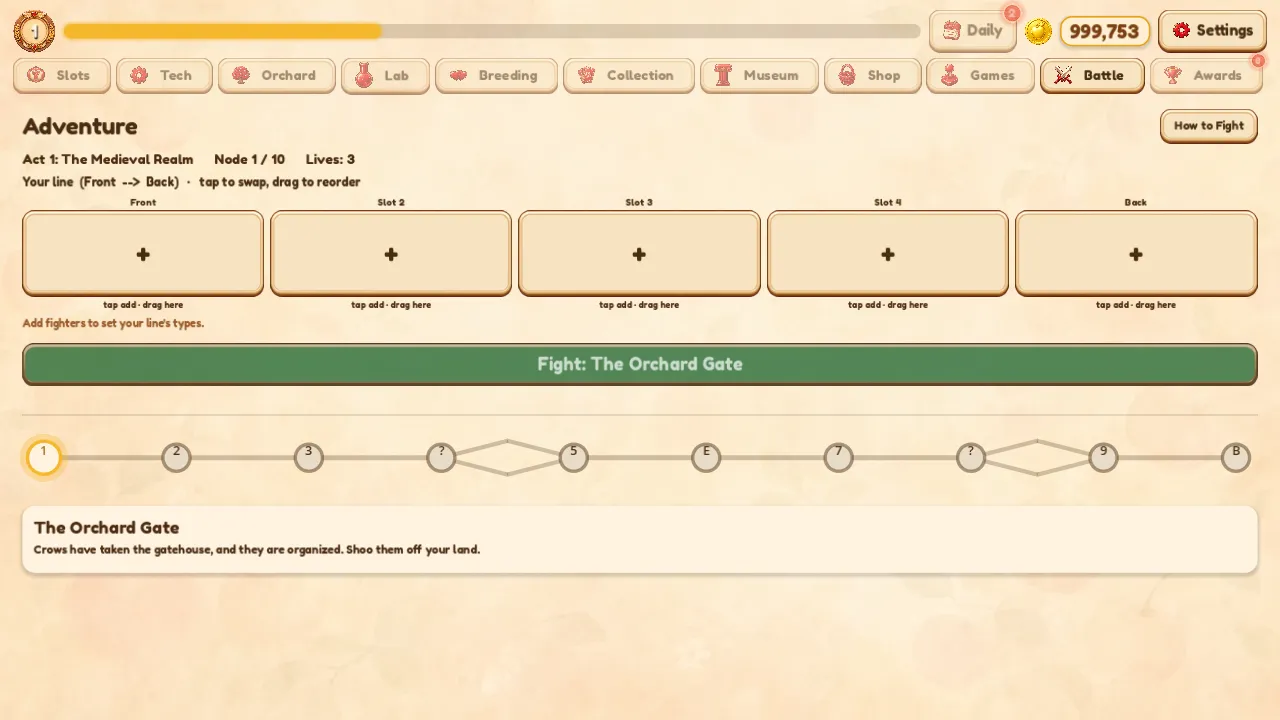
The campaign is where Orchard Deck stops being cozy and asks you to actually think. You take five cards from the collection you have been growing, arrange them in a line from front to back, and send them through three themed acts of ten nodes each. Fights, elites, forks, and bosses. The cards do the fighting on their own once the line is set. Your whole game is the decision you made before the bell rang. This is an auto-battler, and the design problem in an auto-battler is that all the depth has to live in a choice the player makes once and then watches play out.
That constraint shaped everything. With no live control, the five-card line has to carry the entire weight of strategy, which means the cards cannot be simple. They need keywords that interact, tribes that reward grouping, and a board state readable enough that a player can look at five cards and reason about what will happen. That is the heart of the design work, and it took longer than the rest of the campaign combined.
Play Orchard Deck in your browser
Why Five Cards In A Line
The first and most important decision was the size and shape of the board. I landed on exactly five cards in a single front-to-back line, and the number is not arbitrary. Five is large enough to hold a real combination of roles and small enough that a person can hold the whole board in their head at once. Seven would have been more flexible and far less readable. Three would have been readable and far too shallow. Five is the sweet spot where you can see every card, understand every interaction, and still face a genuine puzzle.
The line is ordered front to back, and the order matters because position is a resource. A front card takes hits first and shields the back. A back card is protected but might never reach the enemy if a keyword keeps it out of range. So before you even consider what is printed on a card, you are making a spatial decision about who stands where. That single axis, position, is what turns five cards into a puzzle instead of a pile. You are not just picking the five strongest cards. You are arranging them so their keywords line up into something greater than the sum.
Eight Keywords That Talk To Each Other
The keywords are the verbs of combat, and there are eight of them. The trick with a small keyword set is that the depth has to come from how they interact, not from how many there are. Eight keywords that each do one isolated thing is a shallow game with eight buttons. Eight keywords that combine is a deep game, because the real move count is the number of pairings, not the number of keywords.
Consider Ranged and Snipe, two of the eight. Ranged lets a card strike from the back of the line without needing to be up front, which immediately changes the position math, because now a fragile card can deal damage from safety. Snipe lets a card choose its target instead of hitting whatever is in front, which means it can reach past the enemy's shield and delete the dangerous card hiding in the back. Put those together and you have a back-line card that picks off the enemy's most important piece without ever being exposed. Neither keyword is overpowered alone. The combination is a strategy, and you found it by reasoning about how two verbs stack.
Haunt is my favorite, because it does something after a card dies, which means a card you placed can keep affecting the fight from the grave. That turns death from a pure loss into a planned event. You can build a line that wants a card to die early so its Haunt effect triggers at the right moment. Designing keywords that make losing a card into a tool, rather than only a setback, is where an auto-battler gets its texture, because it gives the player a second layer of plans that sit underneath the obvious one.
Six Tribes For The Synergy Layer
If keywords are the verbs, the six tribal synergies are the grammar that rewards you for speaking in full sentences. Every card belongs to a tribe, and stacking cards of the same tribe in your line unlocks a bonus that gets stronger the more of that tribe you run. This is a second, independent axis of decision laid over the keyword axis, and the interplay between the two is where the deepest play lives.
The reason tribes matter is that they create a tension. The best keyword combination and the best tribal stack are usually not the same five cards. You might have a perfect Ranged-and-Snipe back-line pairing, but those two cards belong to different tribes, so leaning into them weakens your tribal bonus. Now you have a real trade-off. Do you run the clean keyword combo and skip the tribal payoff, or do you commit to a tribe and accept a slightly clumsier keyword fit for a powerful stacking bonus. Five slots, two competing pulls on every one of them. That tension is the engine of the whole campaign, and it exists entirely because keywords and tribes are deliberately not aligned.
The tribes also give the three acts their identity. Each act is themed, and the enemies in an act lean on particular tribes and keywords, so a line that crushed act one can stumble in act two if you do not adapt. The campaign is not one puzzle solved once. It is three puzzles, each asking you to re-tune your five cards against a different shape of threat.
Why A Replay Beats Live Control
Here is the choice that surprised people when I described it. The fights are resolved by a seeded simulation and then shown to you as an animated replay. You do not control the cards as they fight. You set the line, you press go, and you watch the resolved battle play out. No clicking during combat, no reactions, no live decisions once the bell rings.
I tried live control first and it was worse. The problem is that an auto-battler is a game about your pre-fight decision, and live control quietly undermines that. If you can react during the fight, then the pre-fight arrangement matters less, because you can patch a bad line with good reflexes. That moves the skill from planning to twitch, and planning is the entire point of the genre. By resolving the fight as a simulation and replaying it, I make your arrangement the only thing that matters. The fight is the verdict on a decision you already made.
The replay also reads better than live play, and this is a subtle thing about clarity. When a fight resolves and then animates, every event happens in a clean order you can follow. The Ranged card strikes, the Snipe lands on the back-line target, the Haunt triggers as a card falls. You see the consequences of your arrangement laid out as a clear sequence, which teaches you what your line actually does. A live, chaotic fight where six things happen at once is exciting but illegible. The replay is legible, and legibility is what lets a player learn from a loss and build a better line next time. An auto-battler that does not teach you why you lost is just a slot machine with extra steps. The clean replay is what makes it a strategy game.
Set The Line And Watch It Resolve
The fastest way to feel the design is to take five cards into the first act and pay attention to position. Put a tough card in front, a Ranged striker in the back, and see whether your line holds. Then lose a fight, watch the replay, and notice the exact moment your arrangement failed. That moment, the one where the replay shows you the flaw in a decision you made a minute ago, is the whole campaign in miniature.
There is a feedback button right on the game page. If a fight ever resolves in a way you cannot explain from looking at your line, that is a clarity bug in my eyes, because the entire promise of the replay is that the outcome should always be readable back to the choice you made. I want to hear about any fight that breaks that promise.
Like this? You'll like what I'm building too.
Two ways to support and get more of this work.
HEARTH
A privacy-first Life OS for your desktop. Journal, tasks, and notes that stay on your machine. Coming soon, direct download from this site.
Read moreMY TOOLKITS
Receipts-first toolkits for shipping after hours, building Claude agents, publishing on Amazon, and more. The exact methods I used, not theory.
Browse on WhopRelated Articles
Balancing a Roguelike to a One-in-Three Win Rate With a Headless Harness
My draft roguelike was too easy. A strong team won the cup two-thirds of the time, so winning meant nothing. Here is how I stopped guessing and tuned it to a real one-in-three with a few hundred simulated runs.
What Building Small Games on Nights and Weekends Taught Me
I keep my games small on purpose. Here is what shipping little, finished, free browser games in Godot, instead of chasing one big dream project, has taught me about scope, momentum, and actually finishing.
Daily Challenges and Shareable Seeds, No Server Required
A deterministic, seeded simulation gave my draft game a daily challenge and shareable challenge links for free, with no backend at all. Here is how a single integer unlocks both.