Why Permanent Upgrades Feel Different When They Cost You Forever
How the museum in Orchard Deck turns cards you donate into permanent production multipliers, and why a one-time sacrifice feels heavier than a repeatable cost.
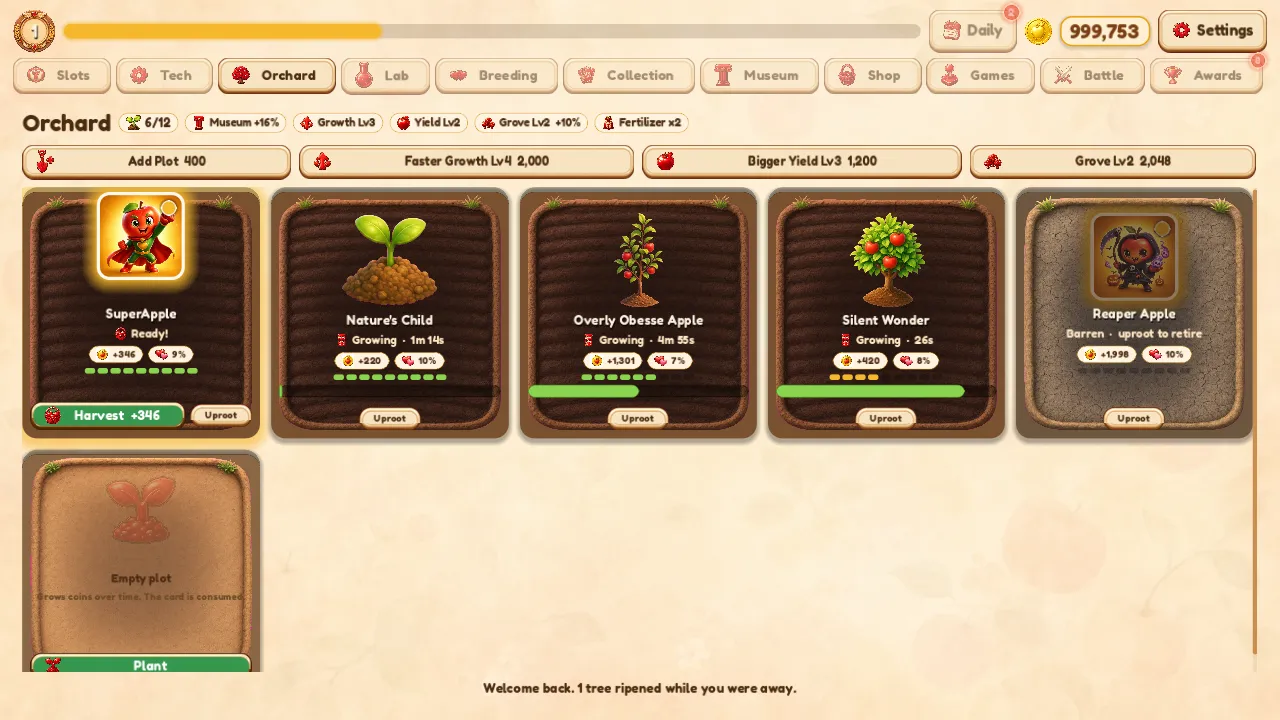
Most of the systems in Orchard Deck are loops. You spin, you plant, you harvest, you recycle, and the cycle comes back around. The museum is the one system that does not loop. It is a one way door. You put cards through it, you can never get them back, and in exchange you change the rules of the game permanently. That permanence is the entire reason it exists, and it took me a while to understand why it feels so different.
The museum holds ten themed sets. Each set is a list of specific cards, and you fill it by donating matching cards from your collection. A donated card is consumed, gone for good, the same as if you had sold it, except you get no coins for it. When a set is completed it pays out two things, a one time pile of coins, and a permanent production multiplier that applies for the rest of the game. Finish every set and the multipliers stack to a total bonus of one hundred and sixteen percent across the orchard. That is more than double your baseline production, locked in, forever, paid for in cards you will never see again.
Play Orchard Deck in your browser
A One-Time Cost Buys A Forever Reward
The shape of the museum trade is unusual inside this game, and the shape is what gives it weight. You pay once. The benefit never stops. Every other cost in Orchard Deck is recurring or recoverable. You spend coins to spin, but coins flow back in from the orchard. You spend cards in the Lab, but the Lab gives you essence and a new card in return. You plant a card and it wears down, but a worn card returns to you as fuel. The economy is mostly a set of cycles where value moves around rather than leaving.
The museum breaks that pattern on purpose. When you donate a card to a set, no value comes back to your collection. The card is just gone. What you get instead is a permanent change to how every future card in your orchard produces. The math is one payment for an unbounded benefit, and that asymmetry is what makes the museum the spine of long term progression. Late game, when the orchard is full and the multipliers have stacked, that one hundred and sixteen percent is the difference between a trickle and a flood.
I think this is why one time permanent upgrades feel categorically different from repeatable ones, and it is a feeling I designed around deliberately. A repeatable upgrade is a habit. You buy it again and again, it becomes routine, and routine has no weight. A one time permanent upgrade is a commitment. You make the decision once, the consequence lasts the whole game, and that makes the moment of deciding actually matter. There is no undo, so the choice has to be sat with rather than skimmed past.
The Tension Of Giving Up A Card You Like
Here is the part that I did not fully appreciate until I watched the system work on me. The cards the museum asks for are not junk. They are specific cards, often good ones, and the sets are themed so they tend to want the cards you have grown attached to.
This creates a genuine ache. A card you have been planting in the orchard, that you have harvested a dozen times, that you know the stats of by heart, is exactly the kind of card a set wants donated. To complete the set you have to give it up. Not sell it for coins you could spend on a replacement, not recycle it into essence you could reshape, but hand it over to the museum where it is consumed and gone. The thing that earned you money and that you liked having around is the price of the permanent multiplier.
I leaned into that tension rather than softening it. An earlier draft of the museum let you donate a card and keep a copy, or buy the card back later at a premium. Both versions removed the ache, and removing the ache removed the point. The museum is supposed to ask you to give up something you would rather keep. If you can have the multiplier and the card, there is no decision, just a chore. The whole emotional engine of the system is the moment where you look at a card you like and decide whether a permanent rule change is worth losing it.
What surprised me is that this makes players ration their good cards across two desires that pull against each other. You want your best cards in the orchard producing coins right now. You also want them in the museum locking in multipliers forever. The same card cannot do both. So every strong card becomes a question of present income versus permanent power, and that question has no clean answer, which is the kind of decision a cozy game usually avoids and that I wanted this one to have.
Designing Around No Refunds
Building a system with no refunds meant I had to be careful about clarity, because a permanent irreversible choice that the player makes by accident is not a feature, it is a trap.
The museum never auto donates. Nothing gets pulled into a set without an explicit confirmation. The set screen shows you exactly which cards a set wants, which ones you have donated, and which ones are still missing, so completing a set is always a series of deliberate decisions rather than a slow leak you do not notice. I would rather a player stares at a set for a week deciding whether to finish it than have them complete it without meaning to and feel cheated by their own collection shrinking.
I also kept the reward visible before the cost is paid. You can see what multiplier a set will grant before you donate a single card to it. That matters because a permanent decision needs a knowable payoff. Asking a player to give up cards forever for a mystery reward would be cruel. Asking them to give up cards forever for a stated and substantial multiplier is a fair trade, and fairness is what lets the irreversibility feel like depth instead of punishment.
The thing I learned is that permanence is a design resource you spend carefully, because you only get a few permanent decisions before they stop feeling special. Ten sets is finite, and that finiteness is intentional. Each completed set is a moment the player remembers because it cost them something real and changed the game forever. If everything were permanent, nothing would feel it. The museum works because it is the only thing in Orchard Deck that you cannot take back.
The museum is fully playable in the browser build right now, all ten sets and the stacking multipliers up to that one hundred and sixteen percent total. Every donation is a one way door, and a card you give up is gone for a rule change that lasts the whole game. Play Orchard Deck in your browser.
Like this? You'll like what I'm building too.
Two ways to support and get more of this work.
HEARTH
A privacy-first Life OS for your desktop. Journal, tasks, and notes that stay on your machine. Coming soon, direct download from this site.
Read moreMY TOOLKITS
Receipts-first toolkits for shipping after hours, building Claude agents, publishing on Amazon, and more. The exact methods I used, not theory.
Browse on WhopRelated Articles

Balancing a Roguelike to a One-in-Three Win Rate With a Headless Harness
My draft roguelike was too easy. A strong team won the cup two-thirds of the time, so winning meant nothing. Here is how I stopped guessing and tuned it to a real one-in-three with a few hundred simulated runs.
What Building Small Games on Nights and Weekends Taught Me
I keep my games small on purpose. Here is what shipping little, finished, free browser games in Godot, instead of chasing one big dream project, has taught me about scope, momentum, and actually finishing.

Daily Challenges and Shareable Seeds, No Server Required
A deterministic, seeded simulation gave my draft game a daily challenge and shareable challenge links for free, with no backend at all. Here is how a single integer unlocks both.