How Six Interlocking Systems Give A Cozy Card Game Real Depth
Orchard Deck has six interlocking systems where every output feeds another input. Here is how I designed slots, orchard, museum, lab, breeding, and campaign to feel deep.
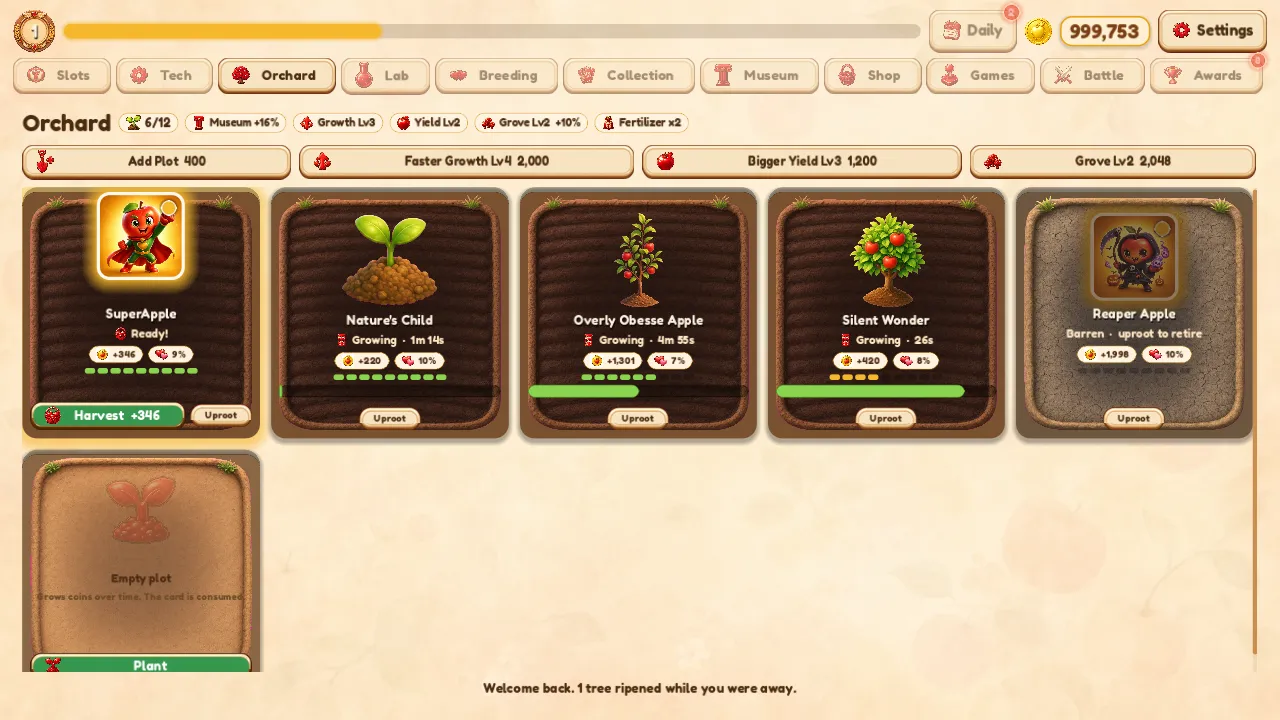
A cozy game lives or dies on a question that sounds simple and is not. After the first hour, when the novelty of the art has worn off and the player has seen most of the screens, is there a reason to keep playing. Most cozy games answer no. They are a pleasant surface with a thin loop underneath, and once you have seen the loop you are done. Orchard Deck was my attempt to build the same warm surface over real depth, and the depth comes entirely from how six systems feed each other.
The rule I designed around, the one I came back to every time I added something new, is that no output is ever a dead end. Whatever a system produces has to be the input to another system. If I ever found myself making a resource that just sat in your inventory with nowhere to go, that was a design bug, not a feature.
The Six Systems
Before the connections make sense, here is the cast. Six systems, each fun on its own, each with a job in the larger machine.
The slot machine is the source. You spin reels, match three of a kind, and win a card of that rarity tier. The orchard is the engine, where you plant cards in plots and they produce coins on wall-clock time whether the game is open or not. The museum is the vault, ten themed sets you complete by donating matching cards, each finished set paying a permanent production multiplier. The Lab is the recycler, where you extract cards into tier-matched essence, transmute essence up the tiers, and craft a card of whatever tier you choose. Breeding is the combiner, fusing two cards into a child of at least the better parent's tier with a chance to climb higher. And the campaign is the proving ground, where you arrange five cards and fight through three themed acts.
Six systems. Now the interesting part, which is the wiring between them.
Every Output Is Another Input
Watch what happens to a single card as it moves through the machine, because that journey is the whole design.
You win a card from the slot machine. You plant it in the orchard, where it earns you coins passively. But every harvest wears its vitality down, over nine harvests, until the card goes barren and returns to you as a worn card. In a lazily designed game, a worn-out card would be trash. In Orchard Deck, worn cards are the intended cheap fuel for the Lab. You extract them into essence, transmute that essence up a few tiers, and craft a fresh high-tier card. So the card that gave its life producing coins becomes the raw material for a better card. The orchard's exhaust is the Lab's intake.
Meanwhile, the slot machine keeps paying out cards you already own. Duplicates would be clutter in most collection games. Here, spares feed breeding, where you fuse two cards into a child that is at least as rare as the better parent, with a 25 percent chance to tier up beyond that. Your overflow becomes your path to rarities you cannot easily win directly. And the cards you do not plant or breed or extract go to the museum, where completing a set pays a permanent production multiplier that flows right back into the orchard, making every future harvest worth more.
Coins close every loop. The slot machine consumes coins to spin and to upgrade its tech tree. Packs unlock with coins and feed every pool with new cards. The orchard produces coins, the museum multiplies them, and the campaign rewards them. Money flows out through the machine and back in through the orchard, and the museum's multiplier is the lever that bends the whole curve upward over a long session.
Why A Cozy Game Specifically Needs This
The first prototype was just the slot machine and the orchard. You spun, you won a card, you planted it, it made coins, you spent the coins spinning again. It was pleasant for about twenty minutes, and then I caught myself spinning on autopilot with one eye on a different window, because there was nothing to decide. That dead feeling is exactly the trap a cozy game has to avoid, and the reason is specific to the genre.
The danger of a cozy game is not that it is too hard. It is that it is too shallow, that it becomes pretty busywork. You are clicking the same button to get the same reward on a treadmill that goes nowhere, and the soft art and gentle music are camouflage for the fact that nothing meaningful is happening. That is the failure mode, and it is the most common one in the genre.
Interlocking systems are the cure because they turn busywork into strategy without adding stress. When your worn cards feed the Lab and your spares feed breeding and your sets multiply your orchard, every small action you take is connected to a larger plan you are building toward. The last time I sat down to play my own build, I won a rare card and actually stopped, because planting it would have earned me coins while holding it would have completed the museum set I was one card away from. Then I noticed my duplicate stack was big enough to breed for a tier I could not win directly, and the orchard timer was about to pay out. None of those decisions is hard or punishing, which keeps the game cozy, but they are real decisions, which keeps it deep. The coziness comes from the soft surface and the absence of failure states. The depth comes from the wiring underneath.
No Dead Ends As A Design Principle
The no-dead-ends rule turned out to be the most useful constraint I gave myself, because it forced good decisions automatically.
Every time I considered a new feature, the rule asked two questions. What does this consume, and what does this produce. If I could not answer both with an existing system, the feature did not belong, or it needed another system built to receive its output. That is how I knew the Lab had to exist. Once the orchard was wearing cards down to barren, I had created an output, worn cards, with nowhere to go. The rule told me I had a dead end, and the Lab was the answer to it. The recycler was not a feature I dreamed up in isolation, it was demanded by the consequence of another system.
This is the difference between a collection of mini-games and an actual game. A collection of mini-games has six things you can do that do not touch each other, and you bounce between them until you are bored of each. A game has six things that pull on each other, so that getting better at one opens up another, and the whole thing compounds. The no-dead-ends rule is what converts the first into the second, and it is the single principle I would hand to anyone building a systems-driven game solo.
See How The Pieces Pull On Each Other
The fastest way to understand the loop is to plant your first card, watch it wear down, and feel the moment you realize the barren card is not the end of its story.
Play Orchard Deck in your browser
If you want the wider context on how the whole thing came together, there is an overview of building Orchard Deck. And there is a feedback button right on the game page. If a system feels like a dead end to you, if some output does not have a satisfying place to go, that is exactly the kind of thing I want to hear, because the no-dead-ends rule only works if it holds up for the people actually playing.
Like this? You'll like what I'm building too.
Two ways to support and get more of this work.
HEARTH
A privacy-first Life OS for your desktop. Journal, tasks, and notes that stay on your machine. Coming soon, direct download from this site.
Read moreMY TOOLKITS
Receipts-first toolkits for shipping after hours, building Claude agents, publishing on Amazon, and more. The exact methods I used, not theory.
Browse on WhopRelated Articles
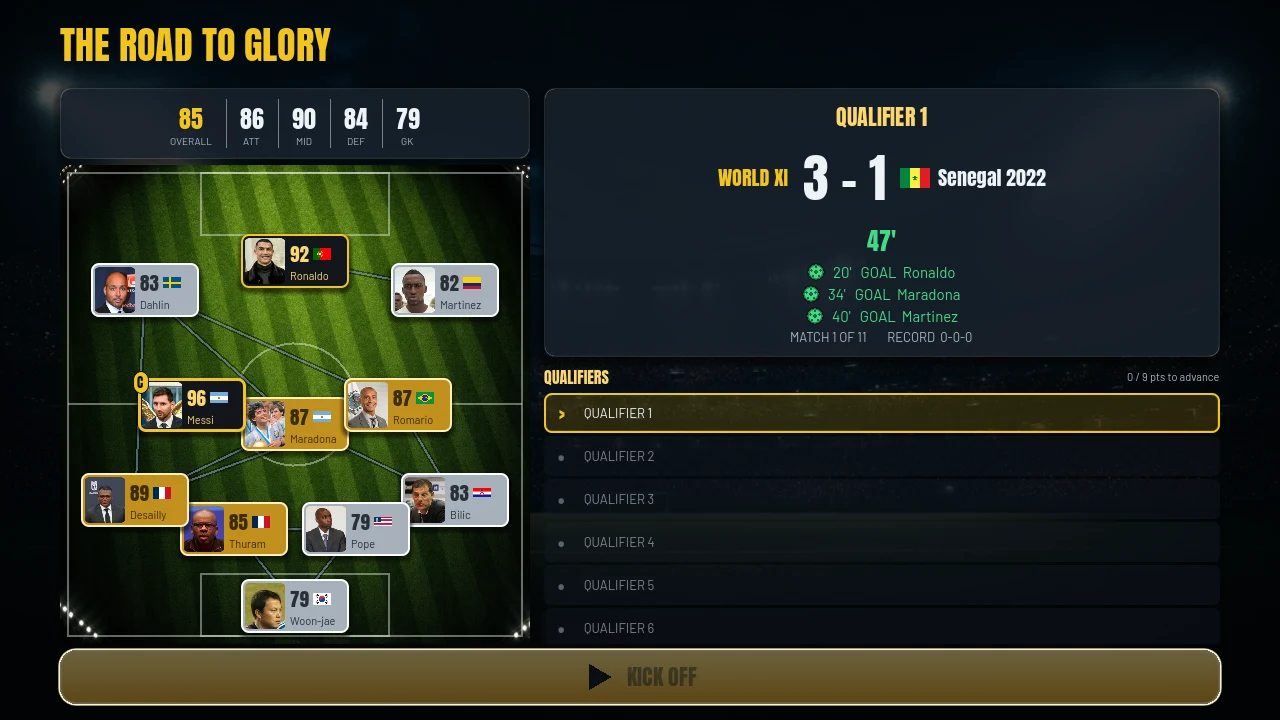
I Balanced My Roguelike With A Bot That Plays A Thousand Games
A balance bot runs hundreds of optimal teams through the full gauntlet and reports the champion rate. That dial replaced the playtest team a solo developer does not have.
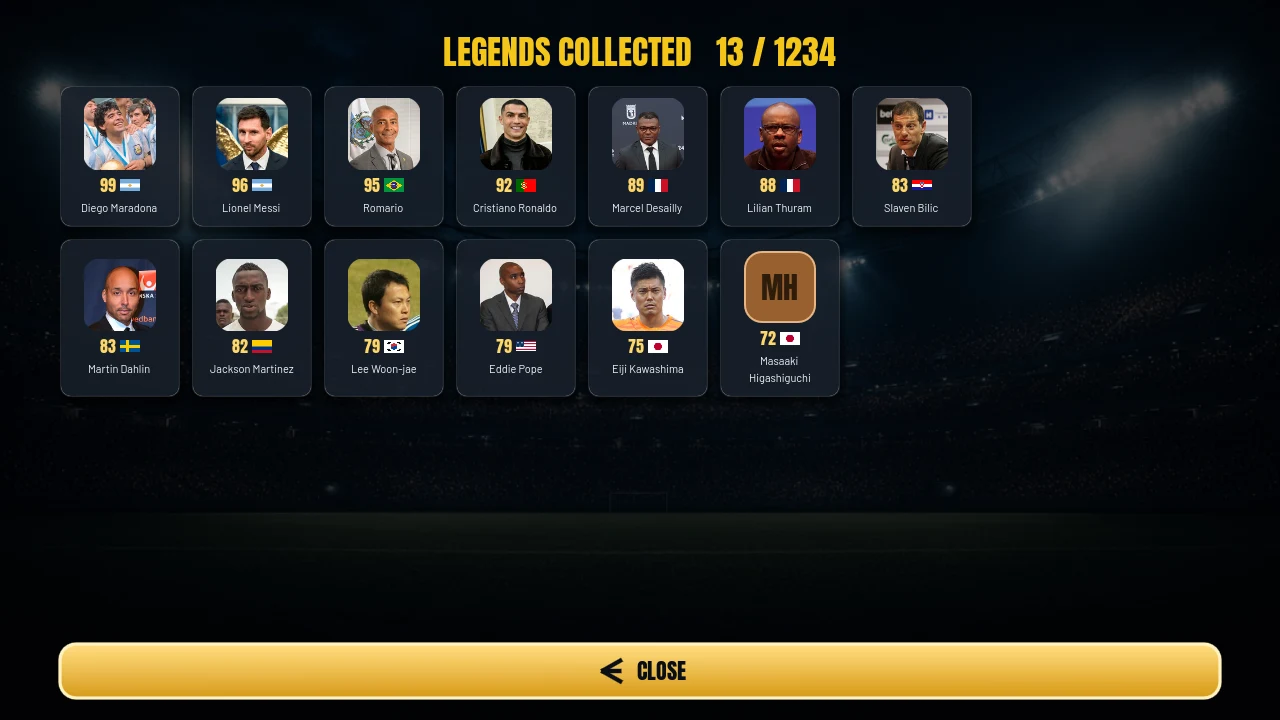
How I Built A Game About Real Players Without A Licensing Nightmare
Facts are not copyrightable. Here is the practical line a solo developer can walk to ship a game using real names, positions, and years, with freely licensed faces.

I Treat Claude Code Like a Small Dev Team
Agentic AI coding gives real leverage only when you decompose work, isolate it, anchor it with durable context, and verify the output. Here is how I direct it.