How I Designed A Slot Machine Economy With None Of The Dark Patterns
Orchard Deck is built around a slot machine, but there are no purchases and one in-game currency. Here is how I designed the odds to reward players without exploiting them.
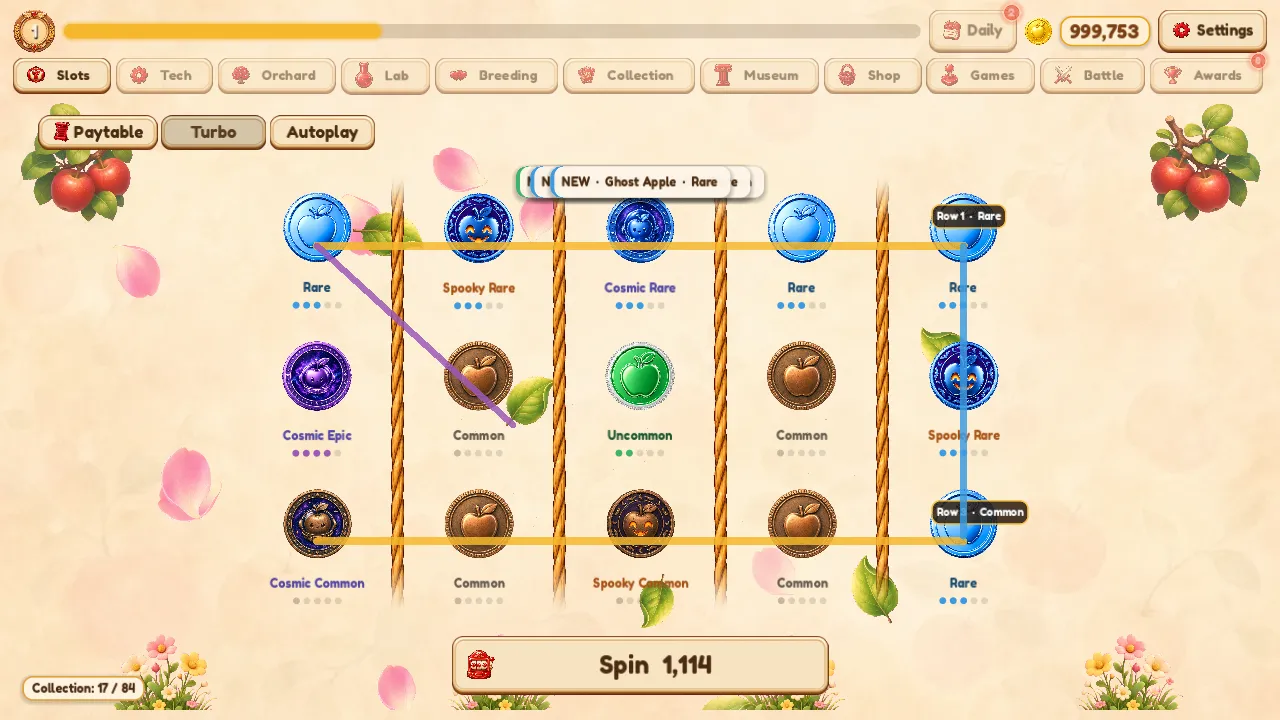
When I tell people Orchard Deck is built around a slot machine, I watch them flinch. The word carries decades of baggage. Slot machines are the most refined extraction device humans have ever built, tuned to take money slowly and keep you pulling the lever long after the fun is gone. So why would I put one at the center of a cozy game I made for free.
Because the slot machine mechanic and the slot machine business model are two completely different things, and we have let the second one poison the first. The spin, the anticipation, the payout, that core loop is genuinely satisfying. The predatory part is everything bolted on around it to convert that satisfaction into your money. My whole goal with Orchard Deck was to keep the loop and strip out the bolt-ons.
What Makes A Slot Machine Predatory
It helps to be precise about the actual dark patterns, because once you name them you can design against each one.
Real-money input is the first and worst. You feed money in, the house keeps a cut, and the expected value of every pull is negative by design. Variable-ratio reinforcement is the second, the unpredictable payout schedule that psychology research has shown is the hardest reinforcement pattern to walk away from. Then there are the layers stacked on top, near-miss animations engineered to feel like you almost won when you did not, premium currencies that obscure how much real money you are spending, fear of missing out timers, and loss-aversion mechanics that punish you for stopping.
Strip all of that away and you are left with a question. Can the spin itself still be fun if nobody can lose anything they value. I believed the answer was yes, and Orchard Deck is the test.
One Currency, Earned Entirely In The Game
The foundation is the simplest rule I could write down. There is exactly one currency, coins, and you can only earn it by playing. There is no purchase of any kind anywhere in the game. No store page sells coins. No bundle, no battle pass, no remove-ads upgrade, no cosmetic shop with a real-money tab hidden in the corner. The game is free, it stays free, and the only thing you ever spend is time.
That single decision removes the entire predatory category in one stroke. If money cannot enter the system, the system cannot be tuned to extract money. The slot machine's expected value being negative simply does not matter when the input is coins you earned by harvesting your orchard ten minutes ago. The worst case outcome of a bad spin is that you go earn more coins, which means you go play more of the game, which is the point.
The Odds, And Why I Can Tell You Them Exactly
Predatory games hide their odds. Mine are published, verified, and I can tell you precisely how I know them.
You spin reels, and three of a kind on a row wins you a card of that rarity tier. At the base three reels, the win probability per row is 11.3 percent. The tech tree lets you upgrade the machine to four reels, where it climbs to 31.5 percent, and then to five reels, where a row wins 56.1 percent of the time. You can also unlock additional simultaneous rows, so a fully upgraded machine is spinning multiple high-odds rows at once.
Those are not estimates or marketing numbers. The test suite exhaustively enumerates every possible reel combination and counts the winning ones, so the percentages are exact arithmetic, not a simulation that ran a few thousand times and got close. I know the odds because I computed every outcome the machine can produce. A predatory operator would never let you see that table. I lead with it.
The shape of that progression is the real design. A new player at 11.3 percent feels the machine is stingy, which it is on purpose, because the entire upgrade arc is about earning the odds bending in your favor. By the time you have spent coins climbing the tech tree to five reels and multiple rows, a single pull lands two or three cards at once and the reels barely stop clattering before the next win drops in. The reward is not a bigger jackpot, it is the machine itself becoming generous.
Anti-Frustration Instead Of Anti-Player
The pity charm is the mechanic I spent the most hours actually tuning, and the tuning taught me something about the difference between a fair machine and a kind one. The first version I built fired far too late. I set the dry streak threshold high, the way a gacha game would, and when I sat down to playtest I hit a stretch of eleven spins with nothing but stray pairs and watched myself get genuinely annoyed at my own game. That annoyance was the data. I pulled the threshold down until the guaranteed win arrived right at the point where my patience was about to snap, then nudged it a hair earlier, because I would rather the charm feel slightly generous than slightly stingy. A gacha studio tunes that exact number to maximize the spend that comes right after the relief. I tuned it to make sure the relief comes before anyone reaches for a tab they want to close.
Around that core I added two smaller cushions. Pairs pay a refund instead of nothing, so a near miss at the low base odds does not feel like pure loss, and blessed wins occasionally bump a payout up a tier, an upside surprise on an outcome that was already good. Every one of those is a tool the extraction industry invented, repurposed. Pity timers, refund mechanics, and bonus upgrades were all built to manage the emotional arc of a paying player. I kept the emotional management and threw away the payment. The result is a machine that respects your time because my incentives give me no reason to waste it.
A Core Loop Does Not Have To Mean Exploitation
The lesson I keep coming back to is that the mechanic was never the problem. The spin is a clean, satisfying loop of anticipation and payoff that humans have enjoyed in one form or another forever. What made slot machines a public health concern was the business model wrapped around the loop, and we let that wrapper define the entire genre.
When you remove real money from the equation, a slot machine stops being a way to take from someone and becomes what it always was underneath, a fun way to get rewards. The odds can be honest because nothing is riding on them. The pity systems can be kind because there is no purchase to protect. The progression can be generous because a generous machine is simply a better toy. Orchard Deck is my proof that you can build a game on a slot machine and have it be a gift rather than a trap.
Play It And Pull The Lever
The machine is sitting right there, free, with the odds I described and no way to lose a cent.
Play Orchard Deck in your browser
If you have played other things I have built, you can read the broader overview of how Orchard Deck came together. And there is a feedback button right on the game page. If a spin feels bad, if the pity charm is too slow, if the early odds frustrate you more than they should, tell me. I tuned this economy by hand, and the players pulling the lever are the only people who can tell me where it still needs work.
Like this? You'll like what I'm building too.
Two ways to support and get more of this work.
HEARTH
A privacy-first Life OS for your desktop. Journal, tasks, and notes that stay on your machine. Coming soon, direct download from this site.
Read moreMY TOOLKITS
Receipts-first toolkits for shipping after hours, building Claude agents, publishing on Amazon, and more. The exact methods I used, not theory.
Browse on WhopRelated Articles

I Balanced My Roguelike With A Bot That Plays A Thousand Games
A balance bot runs hundreds of optimal teams through the full gauntlet and reports the champion rate. That dial replaced the playtest team a solo developer does not have.

How I Built A Game About Real Players Without A Licensing Nightmare
Facts are not copyrightable. Here is the practical line a solo developer can walk to ship a game using real names, positions, and years, with freely licensed faces.

I Treat Claude Code Like a Small Dev Team
Agentic AI coding gives real leverage only when you decompose work, isolate it, anchor it with durable context, and verify the output. Here is how I direct it.