The Slot Machine Tech Tree Is The Spine Of My Game
How a slot-machine tech tree became the progression backbone of Orchard Deck. Three reels grow to five, jackpots arrive, and the odds visibly bend your way.
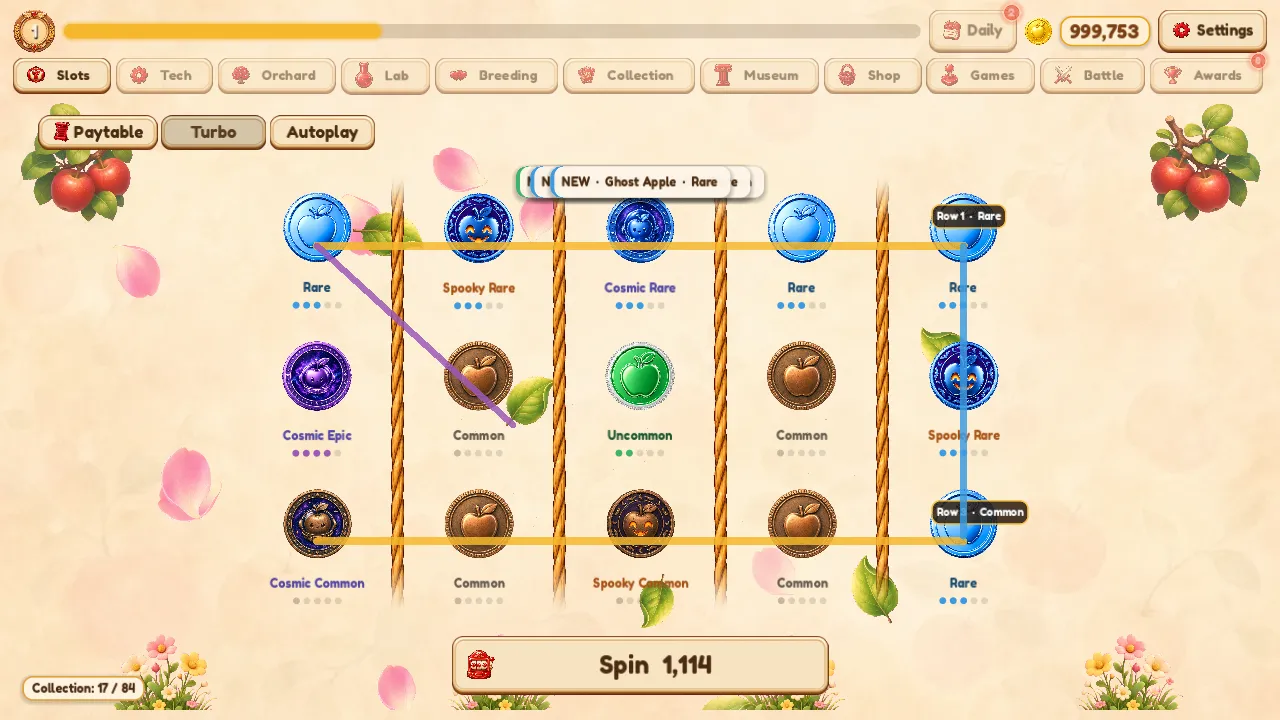
Most games hang their progression on a level number or a skill tree that gives you new abilities. Orchard Deck hangs almost all of its long-term progression on one machine getting better. The slot machine is where you win cards, and the tech tree that upgrades it is the closest thing the game has to a spine. Everything else, the orchard, the museum, the campaign, grows in scale as you play, but the felt sense of getting more powerful comes overwhelmingly from watching this one machine transform from a cramped three-reel toy into a sprawling engine that pays out constantly.
I did not plan it this way at the start. The slot machine began as a simple card source, spin three reels, match three of a kind, win a card. The tech tree was going to be a small optional menu of conveniences. It became the heart of the game because, once I started building upgrades for it, I realized the act of upgrading the machine was more satisfying than almost anything else in the build, and a smart solo dev follows the fun.
Play Orchard Deck in your browser
Why The Machine Itself Is The Progression
The trap with a slot-style core is that it can feel static. You pull, you win or you do not, and a thousand pulls later you are doing the exact same action you did at the start. That sameness is death for retention. The thing that has to change over a long session is not the action, it is the machine. If pull number one thousand is meaningfully richer than pull number one, the loop stays alive even though your hands are doing the same thing.
So I made the machine the object of progression. You do not upgrade an abstract stat sheet. You upgrade the literal thing in front of you, and every upgrade changes how it looks and behaves when you spin. That is a deliberate choice. Numbers on a character sheet are progression you have to remember. A machine that visibly grows more reels and starts flashing jackpots is progression you see and hear every time you play. The feedback loop is immediate and physical. You bought the upgrade, and now the screen is doing something new.
Three Reels Become Five
The opening move of the tech tree, and the one that anchors everything, is the reel count. You start with three reels. Matching three of a kind across three reels is the only way to win a card at the beginning, and the per-row chance of that is a little over eleven percent. Roughly one spin in nine pays. That is intentionally a touch stingy at the start, because the whole arc of the tech tree is the climb out of that scarcity.
The first major purchase widens the machine to four reels. The next pushes it to five. Each added reel is more surface for a match to land on, and the per-row win chance climbs hard with each one, from the low eleven percent at three reels, up past thirty percent at four, and well over fifty percent at five. By the time you have all five reels, more than half your rows are paying out. The arc is the point. You begin in a world where a win is a small event and you end in a world where wins are the steady weather. The player does not need to read those percentages anywhere. They feel them. Early on, a payout is a moment. Later, dry spins are the moment, because they have become rare. The bend in the odds is the emotional core of the progression, and the reel-count upgrades are what bend it.
The Layers That Stack On Top
If reel count were the only axis, the tech tree would be three purchases long and then over. The depth comes from the other branches that layer on once the reels are wide.
There are jackpots for n-of-a-kind. Three of a kind wins a card, but once you unlock the jackpot tiers, four of a kind and five of a kind pay escalating coin bonuses on top of the card. This rewards the wide machine specifically, because longer matches only become possible once you have the reels for them. So the reel upgrades and the jackpot upgrades reinforce each other. Widen the machine, then teach the machine to celebrate the long matches the width made possible.
There are extra rows. The machine starts spinning one row at a time. The tech tree lets you run two and then three rows simultaneously on a single spin, so one pull resolves multiple chances at once. This is a different kind of power than better odds. It is throughput. A single click now does the work of three, which transforms the pacing of a session from one-pull-one-result into a small cascade of results per click.
There is a pity charm, which quietly guarantees a win after a streak of losses, so a cold run never spirals into frustration. And there are pair refunds, which hand back a portion of your bet when you land two of a kind, turning near-misses from pure losses into soft consolations. Neither of these is flashy, but together they smooth the floor of the experience, so the variance that makes wins exciting never tips over into feeling cheated.
Designing The Order Of The Climb
The interesting design work in a tech tree is not the upgrades. It is the order you let the player buy them in and the price curve that paces that order. A tech tree is a sequence of decisions, and a good one makes every decision feel like the obvious next step while still leaving room for a player to chase the branch they personally want first.
I sequenced it so the early purchases are cheap and transformative. The jump from three reels to four is one of the first things you can afford, and it changes the game immediately, which teaches the player that this menu is where power lives. After that, the costs climb and the upgrades branch. Do you push for the fifth reel and the flood of wins it brings, or do you grab the second row first and triple your throughput on the machine you already have. Do you invest in jackpots to turn your wide reels into coin fountains, or do you buy the pity charm and pair refunds to smooth out your luck. There is no single correct order, which is what keeps the tree feeling like yours.
The coins to buy all this come from the orchard and the museum and the campaign, so the tech tree is also the place where every other system's output finally gets spent on something that visibly matters. You earn coins everywhere, and you pour them into making the machine better, and the better machine wins more cards, which feed every other system. The tech tree is the hub where the whole economy resolves into the feeling of progress.
Feel The Odds Bend Over A Session
The honest test of all this is a long sitting. Open the game with a fresh three-reel machine and a thin trickle of wins. Spend an hour pushing the tech tree, widening to five reels, adding a second row, unlocking the jackpots. Then look at the machine you have built. It is wider, it pays more often, it celebrates the long matches, and it does the work of several spins per click. You did not get a bigger number on a sheet. You rebuilt the machine into something that pours out cards, and you felt every step of that climb as you bought it.
That feeling, the odds visibly bending in your favor over time, is the spine of the game, and it lives entirely in this one upgrade tree. The cramped three-reel toy you start with becomes a five-reel engine running multiple rows at once, flashing jackpots on the long matches and softening every cold streak, and you watch it grow into that out of every coin you pour back in. The machine at the end is the whole arc of the game made physical, sitting right there in front of you, paying out.
Like this? You'll like what I'm building too.
Two ways to support and get more of this work.
HEARTH
A privacy-first Life OS for your desktop. Journal, tasks, and notes that stay on your machine. Coming soon, direct download from this site.
Read moreMY TOOLKITS
Receipts-first toolkits for shipping after hours, building Claude agents, publishing on Amazon, and more. The exact methods I used, not theory.
Browse on WhopRelated Articles

Balancing a Roguelike to a One-in-Three Win Rate With a Headless Harness
My draft roguelike was too easy. A strong team won the cup two-thirds of the time, so winning meant nothing. Here is how I stopped guessing and tuned it to a real one-in-three with a few hundred simulated runs.
What Building Small Games on Nights and Weekends Taught Me
I keep my games small on purpose. Here is what shipping little, finished, free browser games in Godot, instead of chasing one big dream project, has taught me about scope, momentum, and actually finishing.

Daily Challenges and Shareable Seeds, No Server Required
A deterministic, seeded simulation gave my draft game a daily challenge and shareable challenge links for free, with no backend at all. Here is how a single integer unlocks both.