Putting Ten Arcade Minigames In One Game Without The Bloat
Ten arcade minigames inside Orchard Deck without turning it into a grind. Entry fees, payouts, once-per-day rewards, and level gating that keeps them optional.
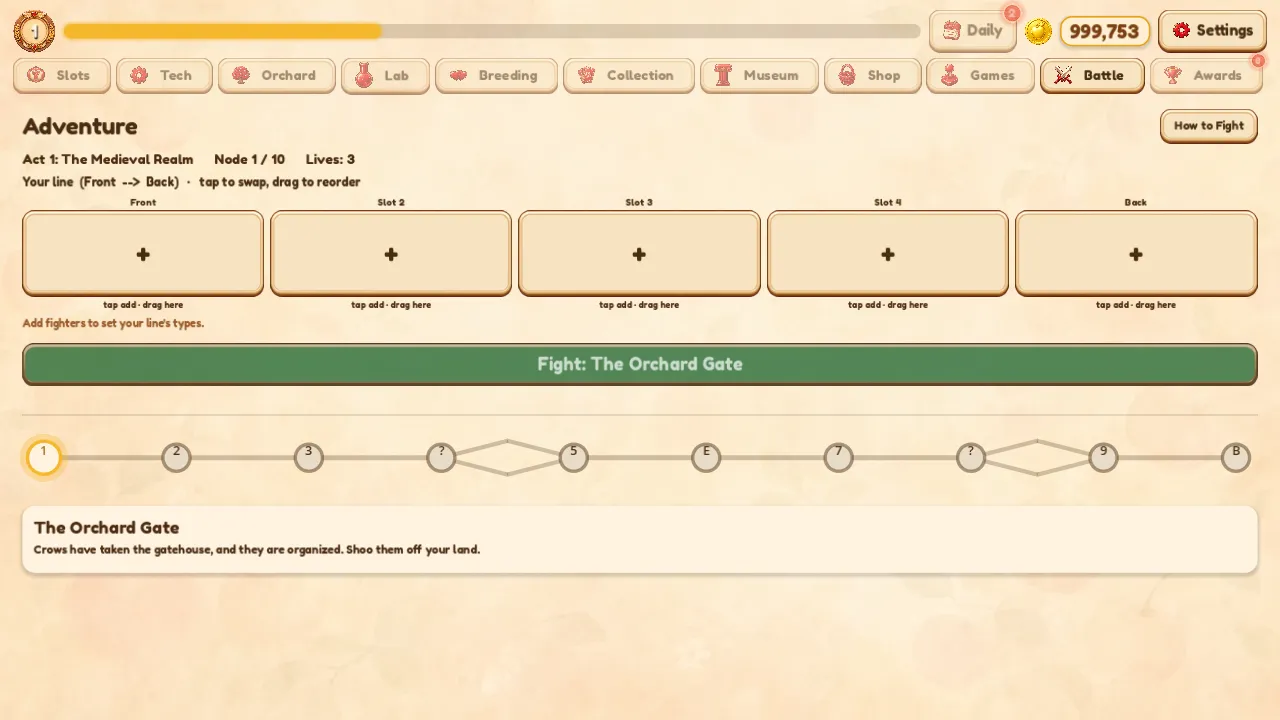
Ten is a lot of minigames to put in one game. When I wrote it down the first time it looked like a mistake, the kind of feature list a studio of forty people ships, not something one person should attempt on the side of a card game. The fear was not the building of ten small games, each of those is a weekend. The fear was that ten of them stacked together would drown the thing they live inside. Orchard Deck is a cozy card collector first. The arcade is a wing off the main hall, and a wing is not supposed to be bigger than the house.
So the real design problem was never how to build a minigame. It was how to add ten of them without the game's center of gravity sliding into the arcade. Everything I decided about entry fees, payouts, reward caps, and unlocks came out of that single worry.
Play Orchard Deck in your browser
The Bloat I Was Trying To Avoid
There is a specific failure I have watched happen to games I liked. A studio bolts a minigame onto the main loop, the minigame turns out to pay better per minute than the actual game, and suddenly the optimal way to play is to ignore the thing the game is about and farm the side activity. The fishing pays more than the dungeon. The card game in the tavern pays more than the quest. The main loop becomes the chore you tolerate so you can afford to do the side thing, and the whole shape of the game inverts.
I did not want a single one of my ten minigames to ever be the most efficient way to earn coins. The orchard is the engine of Orchard Deck. The slot machine is its heart. If a player ever opened my game, walked straight past both of those, and ground a reaction-time minigame for an hour because the coins per minute were better, I had built the game wrong. The arcade had to be a place you visit for fun and a small bonus, never the place a spreadsheet tells you to live.
Entry Fees As The First Brake
The first lever is the entry fee. Every minigame costs coins to play. That sounds like friction you would want to remove from a free game, and for a while I wondered if it was hostile. It is the opposite. The entry fee is what stops a minigame from being a free money printer.
If a game were free to enter and paid out coins, the correct strategy would be to play it forever, because every attempt is pure upside. By charging to enter, I make each attempt a small wager. You pay in, you play, and the payout has to beat the fee for the session to be worth it on coins alone. That immediately caps the appeal as a grind, because grinding something with a real cost per attempt is not a printer, it is a coin flip you can lose. The fee also makes a win feel earned. You risked something small and beat it. Free games that pay out feel like chores. Games with a buy-in feel like arcades, which is exactly the feeling I wanted, since these are arcade games.
The fees scale with the payouts, so a higher-stakes minigame costs more to enter and can pay more back. The ratio is tuned so the expected return on coins alone hovers near break-even for an average run. You are not there to farm coins. The coins are the scoreboard. You are there because the minigame is fun for three minutes.
The Once-Per-Day Card Reward
Coins were the easy part. The harder question was cards, because cards are the real currency of Orchard Deck. Coins buy spins and upgrades, but cards are what you actually collect, and a card is worth far more emotionally than the coins it would take to chase one. So the cards a minigame can give had to be controlled far more tightly than the coins.
Each minigame has a score threshold that, the first time you cross it on a given day, hands you a card reward. The crucial word is first. You can play the same minigame twenty times in an afternoon and it will pay coins every time, but it gives that card exactly once per day, and then the card tap is dry until tomorrow. This is the single most important rule in the whole arcade. It means there is a real reason to play a minigame today, getting that card is a genuine pull, but there is a hard ceiling on how much the arcade can flood your collection. Ten minigames with a daily card each gives a motivated player ten cards a day from the arcade, which is a nice bonus and nowhere near enough to replace the slot machine as the source of your collection.
The threshold also gives me a difficulty dial that is separate from the payout dial. I can make a card hard to earn by setting a high score bar without making the minigame stingy with coins, so a casual player still has fun and earns coins while a skilled player gets the card. One number for skill, one number for time spent, tuned independently.
Level Gating So Ten Does Not Land At Once
The last piece is unlock pacing, and this is what actually saves the player from the bloat I was afraid of. All ten minigames do not exist on day one. They unlock by player level, spread from level one all the way out to level twenty-four. The first minigame is there the moment you start. The last one is a long way off, a reward for a player who has been around for a while.
This matters more than it sounds. A new player who lands in front of ten arcade machines on their first session is overwhelmed, and overwhelmed is the feeling right before someone closes the tab. By dripping the minigames out across two dozen levels, the arcade grows alongside the player. You learn the card game first. Then a minigame appears, and it is a small treat. Levels later, another shows up, and by then you have the headroom to enjoy it. The arcade is never a wall of choices. It is a slow reveal, one fresh thing at a time, each arriving when you have earned it and have the context to appreciate it.
Level gating also turns the arcade into a reason to engage with the main loop rather than an escape from it. You want the next minigame, and the way to get it is to level up, and the way to level up is to play the core game. The side content pulls you back to the center instead of away from it. That is the inversion I was trying to prevent, run in reverse.
What Ten Optional Things Actually Buys You
The point of all of this is that the ten minigames are side dishes, and side dishes are supposed to be optional. A player can ignore the entire arcade and lose nothing essential. The orchard still runs, the slots still pay, the campaign still waits. The arcade is there for the player who wants a change of texture, a quick burst of arcade reflexes between harvests, and a small daily card for the effort. Nobody is ever forced into it, and nobody is ever punished for living there a little, because the brakes keep it from paying enough to make living there correct.
The fastest way to feel the balance is to open the arcade, drop a few coins into the first machine, and chase its card threshold once. You will feel the fee, feel the payout, and feel the moment the daily card lands and the well goes quiet. Then go back to your orchard, because that is where the game actually is. Ten minigames could have buried a small card game under a pile of arcade machines. Held to the side as optional dishes, level-gated and capped, they stay what a wing should be, a place you can wander into for a few minutes and walk back out of without ever feeling like you skipped the main course. The house is still the house, and the arcade is still just a wing off it.
Like this? You'll like what I'm building too.
Two ways to support and get more of this work.
HEARTH
A privacy-first Life OS for your desktop. Journal, tasks, and notes that stay on your machine. Coming soon, direct download from this site.
Read moreMY TOOLKITS
Receipts-first toolkits for shipping after hours, building Claude agents, publishing on Amazon, and more. The exact methods I used, not theory.
Browse on WhopRelated Articles

Balancing a Roguelike to a One-in-Three Win Rate With a Headless Harness
My draft roguelike was too easy. A strong team won the cup two-thirds of the time, so winning meant nothing. Here is how I stopped guessing and tuned it to a real one-in-three with a few hundred simulated runs.
What Building Small Games on Nights and Weekends Taught Me
I keep my games small on purpose. Here is what shipping little, finished, free browser games in Godot, instead of chasing one big dream project, has taught me about scope, momentum, and actually finishing.

Daily Challenges and Shareable Seeds, No Server Required
A deterministic, seeded simulation gave my draft game a daily challenge and shareable challenge links for free, with no backend at all. Here is how a single integer unlocks both.